🌊 Deep Dive Series: Tubbataha Reefs, Philippines
🐠 A Remote Marine Sanctuary at the Heart of the Coral Triangle
Rising from the depths of the Sulu Sea, far from any shoreline, Tubbataha Reefs Natural Park represents one of Southeast Asia’s most extraordinary dive destinations — and one of the clearest examples of what a coral reef ecosystem can look like when given space, time, and meaningful protection. It is a place shaped as much by absence as by abundance: absent of development, crowds, and constant human pressure, yet overflowing with life.
Accessible only by liveaboard for a few short months each year, Tubbataha is defined by its isolation. There are no nearby islands, no coastal development, and no day boats arriving from shore. What you find instead are vast coral walls rising from deep open ocean, exceptional visibility, and an abundance of marine life that feels increasingly rare in today’s seas. This remoteness isn’t a drawback — it’s the very reason the reefs remain so healthy, so alive, and so uncompromised.
Often described as the Philippines’ crown jewel of diving, Tubbataha is far more than a collection of beautiful dive sites. It is a UNESCO World Heritage Site, a fully protected marine sanctuary, and one of the most compelling conservation success stories in Southeast Asia. Reef sharks patrol the drop-offs with quiet confidence, turtles glide effortlessly along the walls, and massive schools of fish blanket the reef in constant motion. At the right time, pelagic visitors emerge from the blue — not on cue, not guaranteed, but on their own terms.
Diving Tubbataha feels different. There is a sense of scale, stillness, and privilege that comes with knowing you are exploring a place few divers ever reach — and one that still exists largely as nature intended. The experience is less about chasing highlights and more about immersion: long, unhurried dives in a reef system that functions as a whole.
Tubbataha is not just a destination to be seen. It is a reef system to be experienced, understood, and respected — a powerful reminder of what the ocean can be when protection is taken seriously, and a benchmark against which many other reefs are inevitably measured.
To understand why Tubbataha looks and feels the way it does underwater, it helps to first understand where it is — and just how far removed it is from land. Its location is not incidental; it is the foundation of its health, its protection, and the unique diving experience it offers. Tubbataha’s remoteness shapes everything from reef structure and marine life abundance to how divers access and experience this remarkable marine sanctuary.
📍 Where Is Tubbataha Reef?
Tubbataha Reefs Natural Park lies in the middle of the Sulu Sea, roughly 150 kilometers southeast of Puerto Princesa, the capital of Palawan in the Philippines. Unlike most dive destinations, it is not adjacent to any island, village, or coastline — instead, it rises abruptly from deep open ocean, completely isolated from land-based influence.
This lack of proximity to land is unusual, even in Southeast Asia. There are no nearby river systems, no coastal settlements, and no surrounding infrastructure. As a result, Tubbataha exists as a true offshore reef system, shaped almost entirely by oceanic forces rather than human activity.
The park is composed of two large coral atolls — the North Atoll and the South Atoll — along with a smaller but biologically rich reef known as Jessie Beazley Reef. These atolls form expansive reef tops that suddenly drop away into near-vertical walls, plunging hundreds of meters into deep blue water. From above, they appear as small shapes in a vast expanse of sea; underwater, they feel immense.
Tubbataha’s isolation is one of the primary reasons it remains so pristine. With no rivers, agriculture, or coastal development nearby, the reefs are free from sediment runoff, nutrient overload, and pollution that affect many coastal reef systems. Water clarity is consistently high, and coral growth is supported by clean conditions and steady ocean currents.
Those nutrient-rich currents play a vital role in the ecosystem. Flowing freely around the atolls, they bring plankton and nutrients that fuel coral health and attract pelagic species from the surrounding open ocean. This constant exchange between reef and sea is what gives Tubbataha its distinctly oceanic character and high biodiversity.
Because of its remote location, Tubbataha is accessible only by liveaboard, and only during a short seasonal window each year when sea conditions allow safe passage across the Sulu Sea. This natural limitation on access has helped preserve the reef’s integrity, ensuring that human presence remains carefully managed and intentionally limited.
In many ways, Tubbataha’s location is its greatest protection — a natural barrier that has allowed one of Southeast Asia’s most important reef systems to remain remarkably intact.
🛡️ History & Conservation: A Rare Success Story
Tubbataha’s reputation is built not just on beauty, but on protection that works. Long before it became a world-renowned dive destination, the reefs of Tubbataha were recognized for their exceptional ecological value and relative isolation from human pressure.
In the late 1970s and early 1980s, marine scientists began documenting the area’s remarkable biodiversity. What they found was a reef system in unusually good condition — healthy coral cover, abundant fish life, and intact predator populations at a time when many reefs elsewhere in the region were already showing signs of decline.
Recognizing its importance, Tubbataha was officially declared a marine park in 1988, marking a critical step toward long-term protection. This commitment was further strengthened in 1993, when the site was designated a UNESCO World Heritage Site for its outstanding universal value and role within the Coral Triangle.
What truly sets Tubbataha apart, however, is not just its protected status on paper, but active, on-the-ground enforcement. The park is guarded year-round by ranger stations positioned directly on the reef. Fishing is strictly prohibited, anchoring is banned, and all access is carefully regulated. Entry permits, permanent mooring buoys, and clearly defined diving protocols ensure that human impact remains minimal.
The results of these measures are clearly visible underwater. Coral cover remains high, fish biomass is dense, and reef shark populations are stable — a rarity in many parts of Southeast Asia. Tubbataha also plays a crucial ecological role as a larval source, with ocean currents carrying fish larvae from its protected waters to reefs throughout the wider Sulu Sea.
In a region where many reef systems continue to struggle under pressure from overfishing, development, and climate stress, Tubbataha stands as proof that strong protection, consistent enforcement, and limited access can succeed. It is not just a sanctuary for marine life, but a living demonstration of what effective marine conservation can achieve when it is taken seriously.
🌊 Underwater Landscape: Walls, Drop-Offs & Open-Ocean Reefs
Tubbataha’s underwater landscape is defined by scale and exposure. Reef tops begin in relatively shallow water, often bathed in sunlight, before dropping abruptly into near-vertical walls that plunge hundreds of meters into deep blue open ocean. This dramatic topography creates a powerful sense of depth and space that is immediately apparent from the first descent.
The walls themselves are adorned with sponges, sea fans, and healthy coral growth, shaped over time by steady currents and exceptional water quality. With no sediment runoff or pollution from nearby land, the reef structure remains clean and well defined. Visibility is often outstanding, and strong light penetration gives the walls a sense of openness rather than enclosure.
Along the atolls, channels, corners, and exposed points funnel water movement across the reef. These areas act as natural gathering points for marine life, delivering nutrients that support coral growth and attracting pelagic species cruising along the reef edge. Divers often find that the most dynamic encounters occur where reef structure meets moving water.
Unlike sheltered coastal reefs or lagoon systems, Tubbataha feels unmistakably oceanic. There is little sense of shelter here — instead, dives unfold on the boundary between reef and open sea, where encounters frequently emerge from the blue. It’s this exposure, combined with pristine conditions, that gives Tubbataha its distinctive character: diving on the edge of something vast, alive, and largely untouched.
🦈 Marine Life at Tubbataha: A Functioning Reef Ecosystem
What makes Tubbataha special is not just what you see, but how everything fits together. Predators are present, prey species are abundant, and the ecosystem feels balanced and intact — a rarity in many modern reef systems.
Rather than isolated highlights, dives here reveal a constant sense of interaction between species, reef structure, and open ocean.
🦈 Sharks & Large Predators
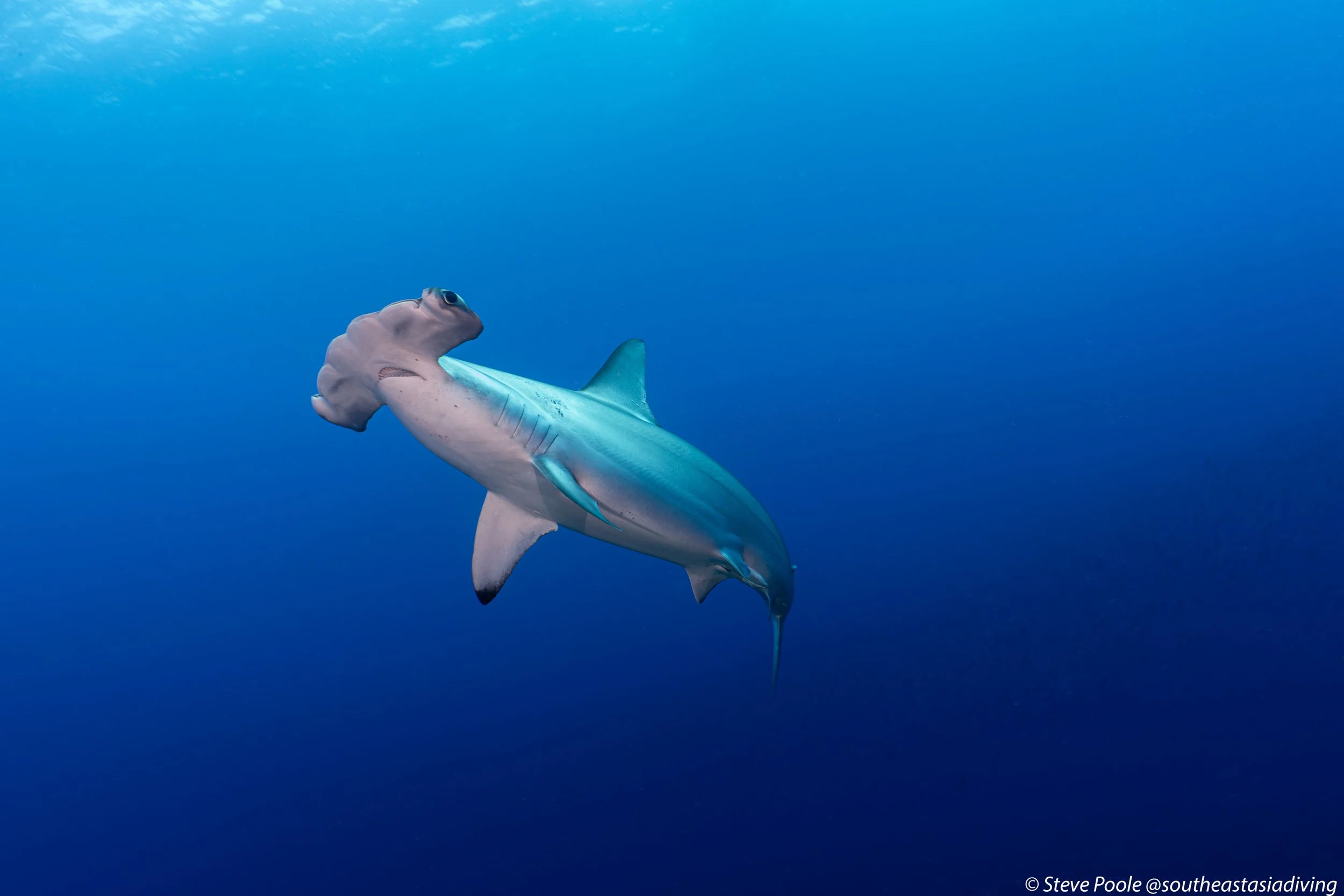
It is sometimes possible to see Hammerhead Sharks at Tubbataha
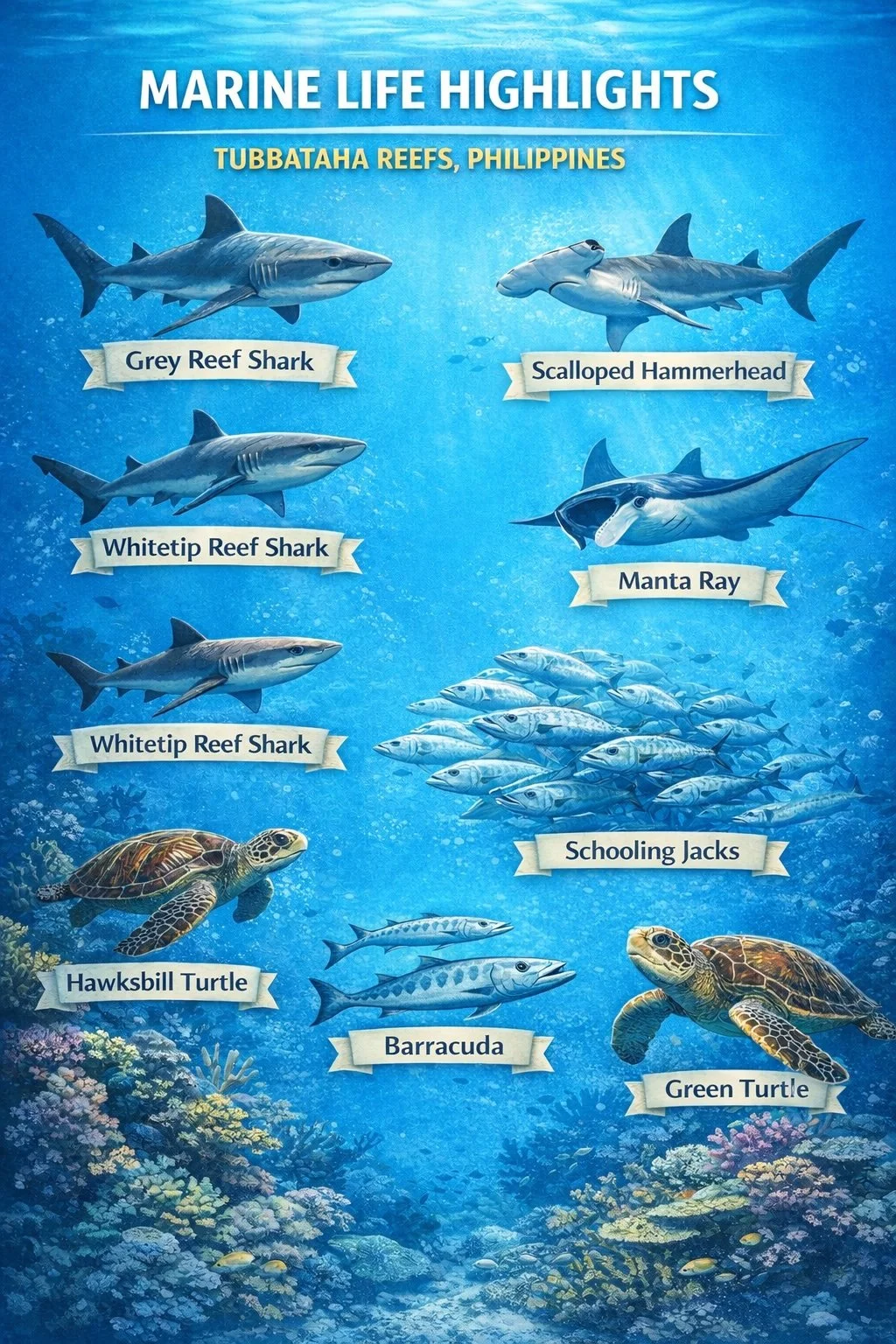
Grey reef sharks and whitetip reef sharks are commonly seen cruising along the walls and drop-offs, particularly where currents bring nutrients to the reef edge. Their regular presence is a strong indicator of reef health and effective protection.
At the right time and under the right conditions, divers may also encounter:
Silvertip sharks
Scalloped hammerheads
Manta rays
Occasional whale sharks
These encounters are never staged or guaranteed — and that unpredictability is part of what makes them so memorable. When large animals appear, they do so on their own terms, reinforcing the wild, unpressured nature of the reef.
🐟 Pelagic & Schooling Fish
Tubbataha is renowned for its sheer volume of fish life. Large schools of jacks, trevallies, barracuda, snapper, and tuna patrol the reef edges and open water, often forming dense, swirling formations that fill the water column.
These mid-water species bring constant movement to dives, creating classic wide-angle scenes and reinforcing the sense that the reef is functioning at full capacity.
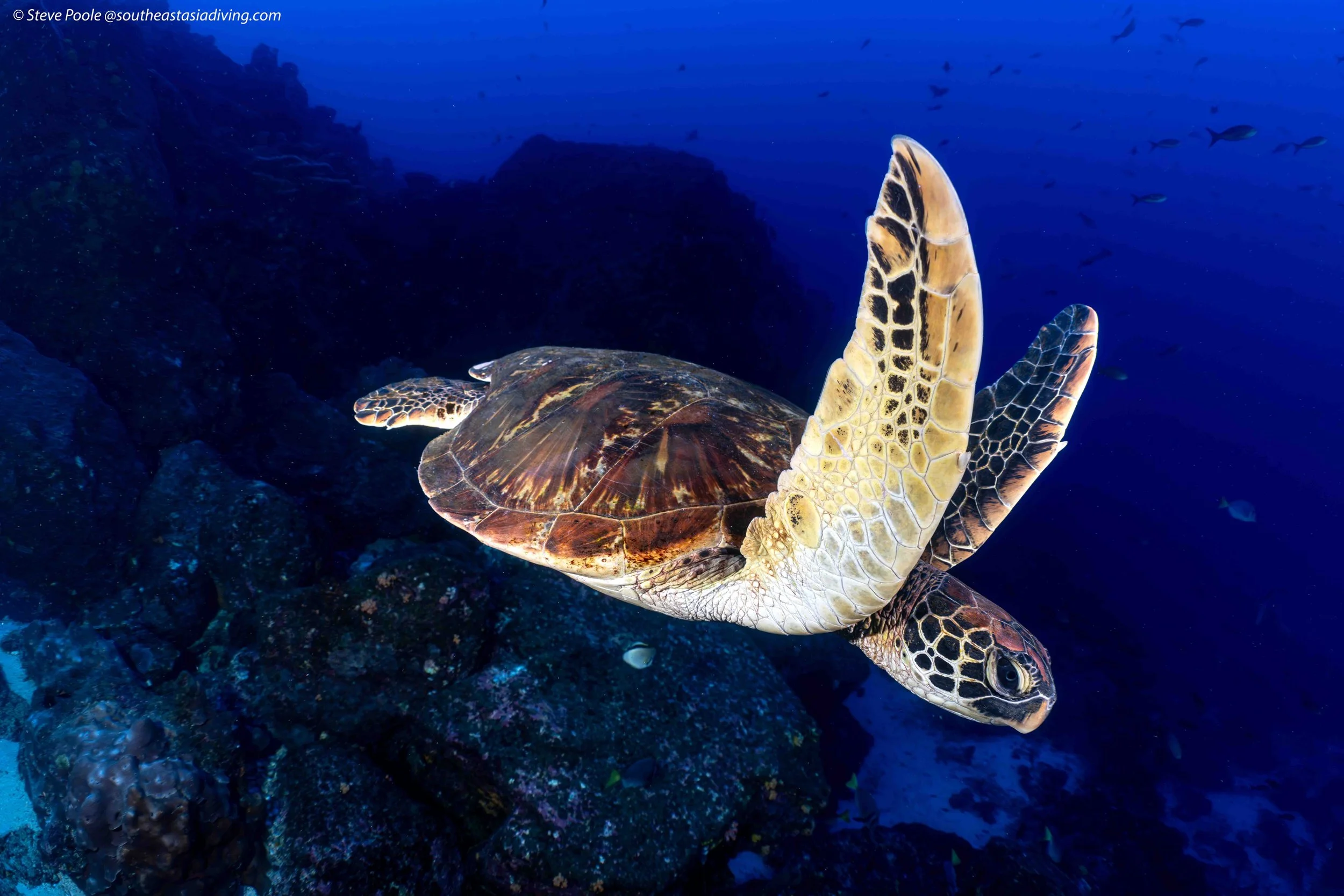
Turtles are also often sighted too
🐢 Turtles & Reef Life
Both green and hawksbill turtles are frequently encountered, often seen resting on ledges or gliding effortlessly along the walls. Unlike destinations where turtle sightings feel like a highlight, here they are a regular part of the underwater landscape.
Reef life is equally abundant, with:
Bumphead parrotfish grazing across reef tops
Triggerfish, angelfish, and butterflyfish adding color and structure
Dense populations of reef fish occupying every available niche
🐌 Macro Life
While Tubbataha is not considered a macro destination, patient and observant divers will still find nudibranchs, crustaceans, and smaller reef critters tucked into coral heads and sponge growth.
Macro here feels like a quiet bonus rather than the main attraction — a reminder that even in a big-animal environment, small life continues to thrive.
Tubbataha offers something increasingly rare: a reef that feels complete. Nothing appears overexploited or out of balance. Predators, schooling fish, turtles, and reef life all coexist in a way that reflects what coral reef ecosystems can look like when protection is effective and pressure is minimal.
🌬️ Dive Conditions & Experience
Diving at Tubbataha is best described as open-ocean wall diving. Conditions are shaped by exposure to the Sulu Sea and the steady movement of water around the atolls. While the diving is not extreme, it does demand confidence, awareness, and comfort in blue-water environments.
This is a place where conditions work with the reef — currents bring nutrients, visibility stays high, and marine life thrives — but divers need to be prepared to adapt.
🌊 Currents & Water Movement
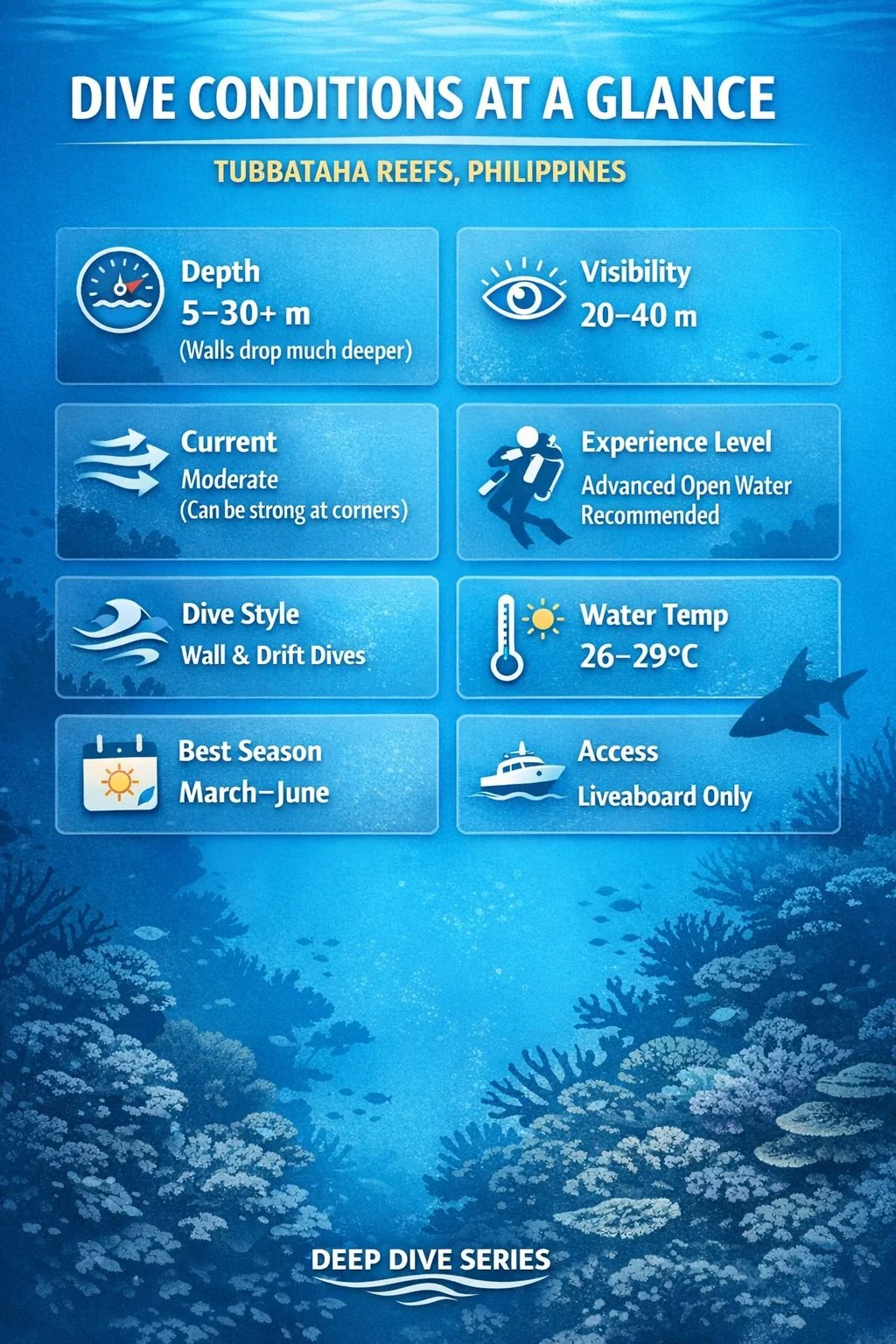
Currents at Tubbataha are typically moderate, though they can strengthen around corners, channels, and exposed points depending on tides and conditions. These currents are a major reason for the reef’s productivity and the presence of large marine life.
As a result:
Drift dives are common, often following the contour of the wall
Negative entries may be used when required
Dive routes are carefully planned and adjusted by experienced guides
Currents are rarely chaotic, but they are an integral part of the experience and should be respected.
🔵 Visibility & Water Temperature
Visibility at Tubbataha is often exceptional, commonly ranging from 20–40 meters, with clear blue water extending far beyond the reef edge. This clarity enhances both the diving experience and photography opportunities, particularly for wide-angle scenes.
Water temperatures typically average 26–29°C, though mild thermoclines can occasionally be felt at depth. Most divers are comfortable in a 3–5 mm wetsuit, depending on personal tolerance and dive duration.
⬆️ Dive Profiles & Safety Stops
Most dives follow recreational depth profiles, with reef tops starting shallow and walls dropping well beyond recreational limits. Much of the action occurs along the reef edge in the 15–25 meter range, where currents and marine life activity are often strongest.
Because of the wall structure, blue-water safety stops are standard, often conducted away from the reef. Divers should be confident deploying a DSMB and maintaining buoyancy without visual references.
🤿 Who Tubbataha Is Best Suited For
Tubbataha is not a training destination and is generally best suited to:
Experienced recreational divers
Divers with solid buoyancy and trim
Those comfortable with currents and open water
Divers accustomed to repetitive liveaboard diving
That said, confident divers who meet experience requirements often find the conditions manageable and incredibly rewarding.
🌊 The Overall Experience
What defines diving at Tubbataha is consistency. Dive after dive delivers healthy reefs, abundant life, and a strong sense of space. There are no rushed schedules, no crowded sites, and no manufactured encounters — just carefully planned dives in one of Southeast Asia’s most protected marine environments.
Planning a liveaboard to Tubbataha Reefs?
Because Tubbataha is accessible only by liveaboard with government permits, comparing operators and itineraries can help you secure space and timing that match your travel plans.
You can browse availability, routes and pricing below:
Disclosure: The booking tool above is an affiliate integration. If you choose to book through it, we may earn a commission at no additional cost to you. This helps support independent dive site guides like this one.
For divers who appreciate natural encounters, open-ocean settings, and reefs that function as complete ecosystems, Tubbataha offers a deeply satisfying and memorable experience.
🚢 Liveaboard Diving at Tubbataha: The Only Way In
There is no shore diving at Tubbataha — liveaboards are the only way to access the reef. Its remote location in the middle of the Sulu Sea makes day trips impossible, and that limitation plays a crucial role in preserving the health of the ecosystem.
Trips typically run 6–7 nights, departing from Puerto Princesa, Palawan, with an overnight crossing to the reef. Once onsite, the pace shifts noticeably. Life revolves around diving, resting, and absorbing the scale of the environment — free from schedules shaped by shore logistics or crowds.
🤿 A Typical Dive Day
Once inside the marine park, divers usually enjoy:
3–4 dives per day, conditions permitting
Early-morning dives timed for peak marine activity
Afternoon wall or drift dives
Occasional dusk or night dives when conditions allow
Dives are carefully planned around tides and conditions, with detailed briefings that prioritize both safety and reef protection.
🧭 Access & Dive Site Management
Liveaboards provide access to multiple sites across:
North Atoll
South Atoll
Jessie Beazley Reef
Because vessels remain onsite for several days, dive teams can rotate locations and adapt plans based on conditions. This approach ensures:
Minimal pressure on any single reef
Well-paced dive schedules
Uncrowded dive sites
Permanent mooring buoys are used throughout the park, and anchoring is strictly prohibited.
🌿 Why Liveaboards Suit Tubbataha So Well
Liveaboard diving isn’t just a logistical necessity here — it’s the best way to experience Tubbataha responsibly.
Liveaboards allow:
Access to remote reef sections unreachable by day boats
Early-morning and dusk dives that reveal different behaviors
Long, uninterrupted periods immersed in the marine environment
A slower, more intentional rhythm that mirrors the nature of the reef itself
With no need to return to land, divers remain connected to the ecosystem throughout the trip, gaining a deeper appreciation for its patterns and scale.
🌊 The Overall Liveaboard Experience
The liveaboard experience at Tubbataha is immersive, focused, and intentionally limited. Groups are small, dive plans are conservative, and the emphasis is on quality rather than quantity.
For many divers, this format enhances the sense of privilege that comes with visiting such a protected place. There’s a shared understanding onboard that this is not casual diving, but a rare opportunity to explore one of Southeast Asia’s most intact reef systems — exactly the way it should be.
📍 How to Get to Tubbataha Reefs
Reaching Tubbataha requires planning, patience, and commitment — and that’s very much by design. Its remote location in the middle of the Sulu Sea means access is carefully controlled, helping preserve the reef’s integrity and limit human impact.
The journey typically follows these steps:
✈️ Fly internationally to Manila or Cebu
Most international travelers arrive via one of the Philippines’ main hubs before continuing domestically.🛫 Take a domestic flight to Puerto Princesa (PPS)
Puerto Princesa, the capital of Palawan, is the departure point for all Tubbataha liveaboards. Flights from Manila and Cebu are frequent and relatively short.🚢 Board your liveaboard and cross overnight to the reef
Liveaboards usually depart in the late afternoon or evening, making an overnight crossing across the Sulu Sea and arriving at Tubbataha early the following morning.
Once onboard, all permits, park fees, and access logistics are handled by the operator in coordination with marine park authorities.
Because trips operate only during a short seasonal window and access is limited, bookings often need to be made months — and sometimes a year — in advance, especially for peak-season departures.
🗓️ Best Time to Dive Tubbataha
Tubbataha is a strictly seasonal dive destination, open to divers only when sea conditions allow safe access and minimal environmental impact.
🌊 Official Diving Season: March to June
This narrow window coincides with calmer seas in the Sulu Sea and the most reliable diving conditions of the year.
March–April
Widely considered peak season, with calmer seas, excellent visibility, and consistent reef shark activity.May–June
Slightly warmer water temperatures and increased plankton can attract larger pelagic species. Conditions may be more dynamic, but marine life activity remains high.
Outside this window, access to Tubbataha is closed. Rough seas and unpredictable weather make crossings unsafe, and restricting access during these months plays a vital role in protecting the reef from damage and overuse.
The short season is part of what makes Tubbataha so special — visits are intentional, carefully managed, and aligned with the long-term health of the ecosystem.
📸 Photography Opportunities
Tubbataha is a destination that strongly favors wide-angle photography, rewarding photographers who enjoy scale, clean water, and natural behavior rather than staged encounters. Its open-ocean setting, dramatic walls, and abundant marine life create consistently strong conditions for big, uncluttered compositions — the kind of environment that defines serious Tubbataha underwater photography.
For those planning a dedicated photo-focused trip, I’ve outlined broader approaches to underwater photography across Southeast Asia separately, along with the specific underwater photography gear setups that perform reliably in current-exposed, blue-water environments like this.
🌊 Wide-Angle & Big-Scene Photography
The defining photographic feature of Tubbataha is space. Vertical walls drop into deep blue water, schools of fish move through the frame, and sharks and turtles often appear silhouetted against the open ocean.
Photographers can expect excellent opportunities for:
Reef sharks cruising along drop-offs
Turtles gliding parallel to the wall
Large schools of jacks, barracuda, and snapper
Reef scenes filled with life rather than empty coral
Visibility is often excellent, allowing subjects to separate cleanly from the background — ideal for classic reef-edge compositions.
☀️ Natural Light & Water Clarity
With no sediment runoff and strong light penetration, Tubbataha lends itself particularly well to ambient light photography. Many dives are bright enough to capture dramatic scenes without heavy strobe use, especially when shooting mid-water subjects or wide reefscapes.
Strobes are still useful for foreground detail, but photographers often find that:
Natural light enhances scale and mood
Blue-water backgrounds remain clean and uncluttered
Contrast is easier to manage than at coastal sites
🦈 Sharks, Turtles & Pelagics
Encounters with large animals at Tubbataha are natural and unconditioned. Sharks and rays are not baited, and animals move through the reef on their own terms. This encourages a more patient, observational approach to photography.
The most successful images often come from:
Holding position along the reef edge
Maintaining eye-level framing
Letting subjects approach naturally rather than chasing
These moments tend to feel calm and authentic — qualities that translate strongly into compelling images.
🐌 Macro as a Secondary Option
While Tubbataha is not a macro destination, smaller subjects such as nudibranchs, crustaceans, and reef details can still be found, particularly on calmer sections of the reef. However, macro photography here is best viewed as a bonus, not the primary focus.
Most photographers choose to commit to a wide-angle setup for the duration of the trip, given how consistently big-scene opportunities present themselves.
⚠️ Buoyancy & Environmental Awareness
Strong buoyancy control is essential for photography at Tubbataha. Walls, currents, and blue-water backgrounds require photographers to maintain awareness of depth, position, and fin movement at all times.
Equally important is respecting marine life:
Avoid blocking animals’ paths
Never crowd or corner subjects
Keep fins, strobes, and hoses clear of the reef
The best images here come from restraint rather than pursuit.
🌊 A Different Kind of Photography Experience
Photographing Tubbataha is less about collecting shots and more about documenting a functioning ecosystem. Images tend to tell broader stories — of space, balance, and healthy reefs — rather than isolated moments.
For photographers who value authenticity, scale, and natural behavior, Tubbataha offers one of the most rewarding underwater shooting environments in Southeast Asia.
♻️ Safety & Environmental Notes
Diving at Tubbataha comes with a shared responsibility. This is one of Southeast Asia’s most pristine reef systems, and its continued health depends on careful diving practices, situational awareness, and respect for strict conservation rules.
Key considerations for divers include:
⚖️ Maintain excellent buoyancy at all times
Walls, sponges, and sea fans are fragile, and even accidental contact can cause damage. Good trim and control are essential throughout every dive.🟠 DSMB deployment skills are essential
Blue-water ascents and safety stops are standard at Tubbataha. Divers should be confident deploying a DSMB independently and maintaining position in open water.🚫 No touching, chasing, or manipulating marine life
All encounters should remain passive and observational. Marine life here behaves naturally because it is not pressured — that balance must be preserved.📸 Photography must never alter behavior
Avoid crowding subjects, blocking movement paths, or positioning yourself too closely for a shot. The best images come from patience and restraint.📋 Follow all briefings and park regulations
Dive planning, site selection, and entry procedures are designed to protect both divers and the reef. These rules are enforced for a reason.
Diving at Tubbataha is a privilege, not a right. Every diver who enters the park becomes a temporary steward of the reef, with a responsibility to leave no trace and help ensure that this ecosystem remains intact for future generations.
✨ Final Thoughts: Why Tubbataha Matters
Tubbataha is not just one of the Philippines’ best dive destinations — it is a powerful reminder of what coral reefs can be when protection is taken seriously. In a region where many reefs face mounting pressure, Tubbataha stands apart as a living example of resilience, balance, and long-term stewardship.
The effort required to reach it ensures that visits are intentional rather than casual. Divers come here with purpose, prepared for the journey and aware of the privilege it represents. The limited season protects the reef from overuse, while consistent enforcement makes the results visible underwater — in healthy coral cover, abundant fish life, and stable predator populations that are increasingly rare elsewhere.
For many divers, Tubbataha becomes a benchmark. It reshapes expectations, reframes what “good” reef health truly looks like, and challenges assumptions formed in more heavily impacted environments. Time spent here often changes how divers see other reefs, and deepens appreciation for the role conservation plays in preserving marine ecosystems.
Perhaps most importantly, Tubbataha offers something increasingly rare: hope. In a changing ocean, places like this matter more than ever. They show that decline is not inevitable, and that when protection is meaningful, enforced, and respected, coral reefs can still thrive — not just survive.
Diving Tubbataha is more than a memorable trip. It’s an encounter with what the ocean is still capable of, and a reminder of why protecting places like this matters far beyond the dive itself.
❓ Frequently Asked Questions (FAQ)
Can beginner divers dive Tubbataha?
Generally no. Tubbataha is best suited to experienced recreational divers who are comfortable with wall diving, moderate currents, and blue-water ascents and safety stops. While conditions are not extreme, the open-ocean environment requires confidence, situational awareness, and solid buoyancy control.
Most liveaboards enforce minimum logged dive requirements, and this is not a destination designed for training or first post-certification trips.
Is a liveaboard required to dive Tubbataha?
Yes. Liveaboards are the only way to access Tubbataha. The reef lies far offshore in the middle of the Sulu Sea, with no nearby islands, shore facilities, or day-boat access.
This limitation is a key reason the reef remains so healthy — access is controlled, intentional, and carefully managed.
How many dives can I expect on a trip?
Most liveaboard itineraries offer 18–22 dives over a 6–7 night trip, depending on weather, sea conditions, and the specific operator.
Typical days include 3–4 dives, often starting early in the morning to take advantage of peak marine activity, with occasional dusk or night dives when conditions allow.
Is marine life guaranteed at Tubbataha?
Nothing in the ocean is ever guaranteed — and that’s part of what keeps Tubbataha feeling wild and authentic.
That said, divers can consistently expect:
Healthy coral reefs
Frequent turtle sightings
Large schools of reef fish
Regular encounters with reef sharks
Pelagic species such as hammerheads, manta rays, or whale sharks are possible but unpredictable, appearing on their own terms rather than on a schedule.
Is Tubbataha worth the cost?
For many divers, absolutely. While a Tubbataha trip requires more planning and investment than land-based diving in the Philippines, it offers access to one of Southeast Asia’s most pristine and well-protected reef systems.
For those who value healthy reefs, natural encounters, and conservation-focused diving, Tubbataha is widely considered a once-in-a-lifetime benchmark experience — one that often reshapes expectations of what reef diving can be.
How rough is the crossing to Tubbataha?
The overnight crossing from Puerto Princesa can be moderately rough, depending on weather and sea conditions. Because Tubbataha lies far offshore, some swell and motion are normal — particularly on the first and last night of the trip.
Choosing a well-maintained liveaboard, traveling during the official March–June season, and taking seasickness precautions if you’re prone to motion sickness can make a big difference. Once onsite, conditions are usually calmer around the reefs.
What equipment should I bring for diving Tubbataha?
Most divers are comfortable with a 3–5 mm wetsuit, depending on personal tolerance and dive frequency. A DSMB and reel are essential, as blue-water safety stops are standard.
For photographers, a wide-angle setup is strongly recommended, given the walls, sharks, turtles, and schooling fish. Liveaboards typically provide tanks and weights, but it’s always best to confirm equipment details with your operator in advance.