🌊Deep Dive Series: Anilao, Philippines
Macro Diving Capital with Easy Access & World-Class Critters
Just a few hours south of Manila lies Anilao, one of Southeast Asia’s most celebrated macro diving destinations and a true playground for underwater photographers. Often described as the Philippines’ answer to Lembeh Strait, Anilao is shaped by volcanic activity, creating a rich mix of dark sand slopes, coral rubble, and healthy reef patches. These varied habitats provide the perfect hiding places for some of the ocean’s smallest, strangest, and most photogenic creatures.
What makes Anilao exceptional is not just the diversity of marine life, but the sheer consistency of sightings. On a single dive, it’s common to encounter multiple species of nudibranchs, frogfish tucked into sponges, camouflaged ghost pipefish hovering near crinoids, and octopus displaying fascinating behavior. For macro enthusiasts, Anilao offers the kind of rewarding, slow-paced diving where patience is constantly paid back.
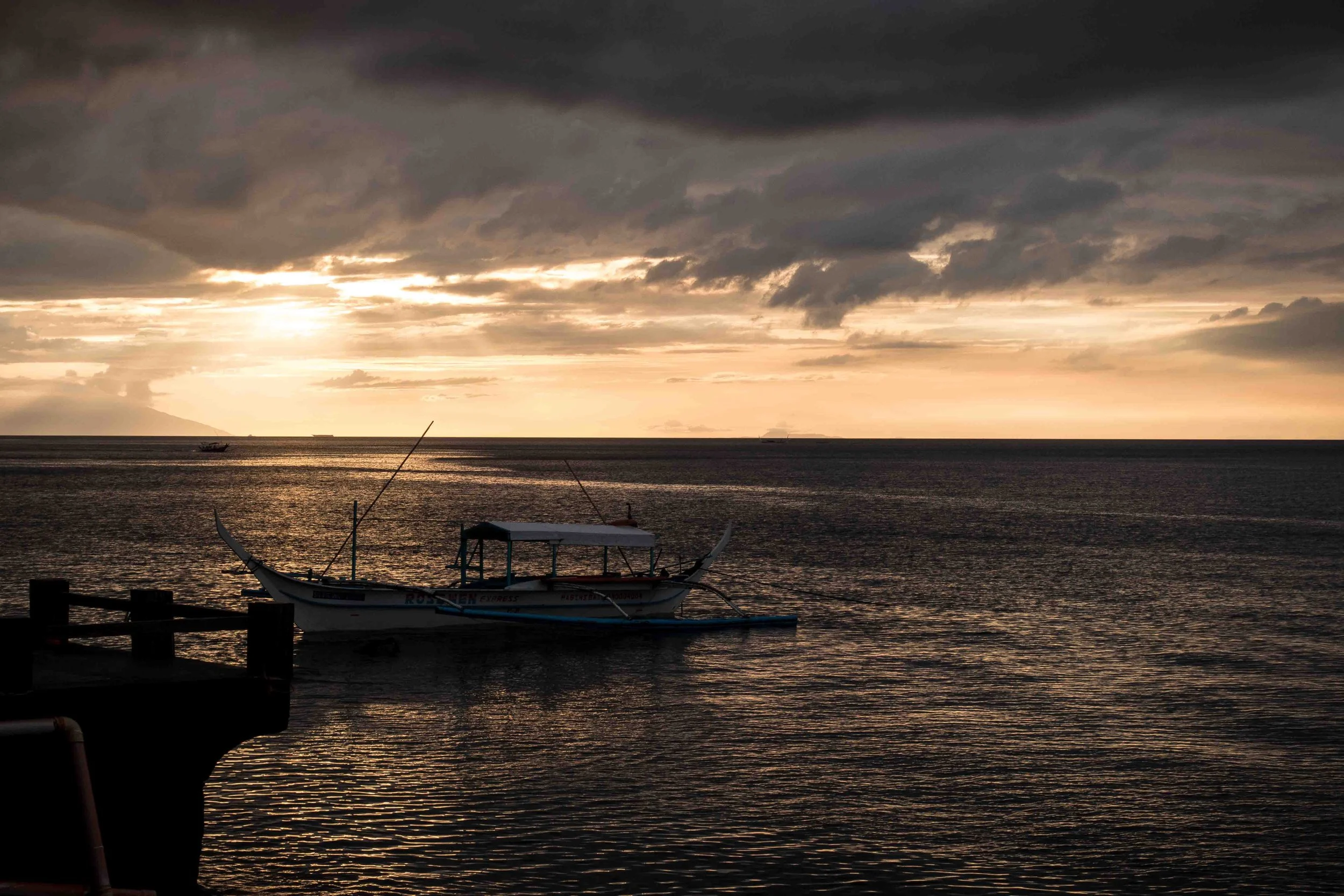
What truly sets Anilao apart, however, is its unmatched accessibility. Unlike many world-class macro destinations that demand multiple flights, liveaboards, or long boat transfers, Anilao can be reached by road from Manila. This ease of access has made it a favorite for weekend dive trips, international photography workshops, and extended macro-focused stays, allowing divers to maximize time underwater rather than in transit.
Combining extraordinary biodiversity with calm conditions and easy logistics, Anilao has earned its reputation as one of the world’s premier macro diving destinations — a place where both beginners and seasoned photographers can slow down, refine their skills, and immerse themselves in the beauty of the small.
📍 Where Is Anilao?
Anilao is located in Batangas Province, on the southern edge of Luzon Island in the Philippines, overlooking the Verde Island Passage — an area widely regarded as one of the most biodiverse marine regions on the planet. The drive from Manila typically takes 2.5–3 hours, making Anilao one of the most accessible world-class dive destinations in Southeast Asia.
Rather than being a single town or island, Anilao is made up of a collection of small coastal barangays (villages)scattered around a rugged peninsula. Dive sites are spread along the coastline and nearby islets, each offering slightly different underwater topography, from gentle muck slopes and rubble fields to coral gardens, small walls, and reef patches. This variety allows divers to experience a wide range of habitats without long boat rides or complicated logistics.
Despite its international reputation among underwater photographers, Anilao has retained a quiet, dive-focused atmosphere. The area is largely free from large-scale resorts, nightlife, and cruise tourism. Instead, most accommodations are small, purpose-built dive resorts, catering to photographers, macro enthusiasts, and divers who value time underwater over luxury extras.
This low-key setting, combined with easy access and exceptional biodiversity, makes Anilao an ideal destination for divers seeking serious underwater exploration without the crowds — a place where the focus remains firmly on the diving itself.
🌋 Underwater Landscape & Dive Conditions
Anilao’s underwater landscape is heavily influenced by volcanic activity, which has shaped a mosaic of habitats ideally suited to macro life. The seabed is dominated by black and dark-brown sand slopes, interspersed with rubble fields, coral fragments, and scattered debris that provide endless hiding places for small, cryptic species.
Rubble areas are often covered in sponges, hydroids, algae, and soft corals, creating perfect micro-habitats for nudibranchs, frogfish, ghost pipefish, and juvenile fish. In between these muck-style environments, divers will also find patch reefs, coral bommies, shallow reef flats, and occasional small walls, adding variety to each dive and supporting a broader range of marine life.
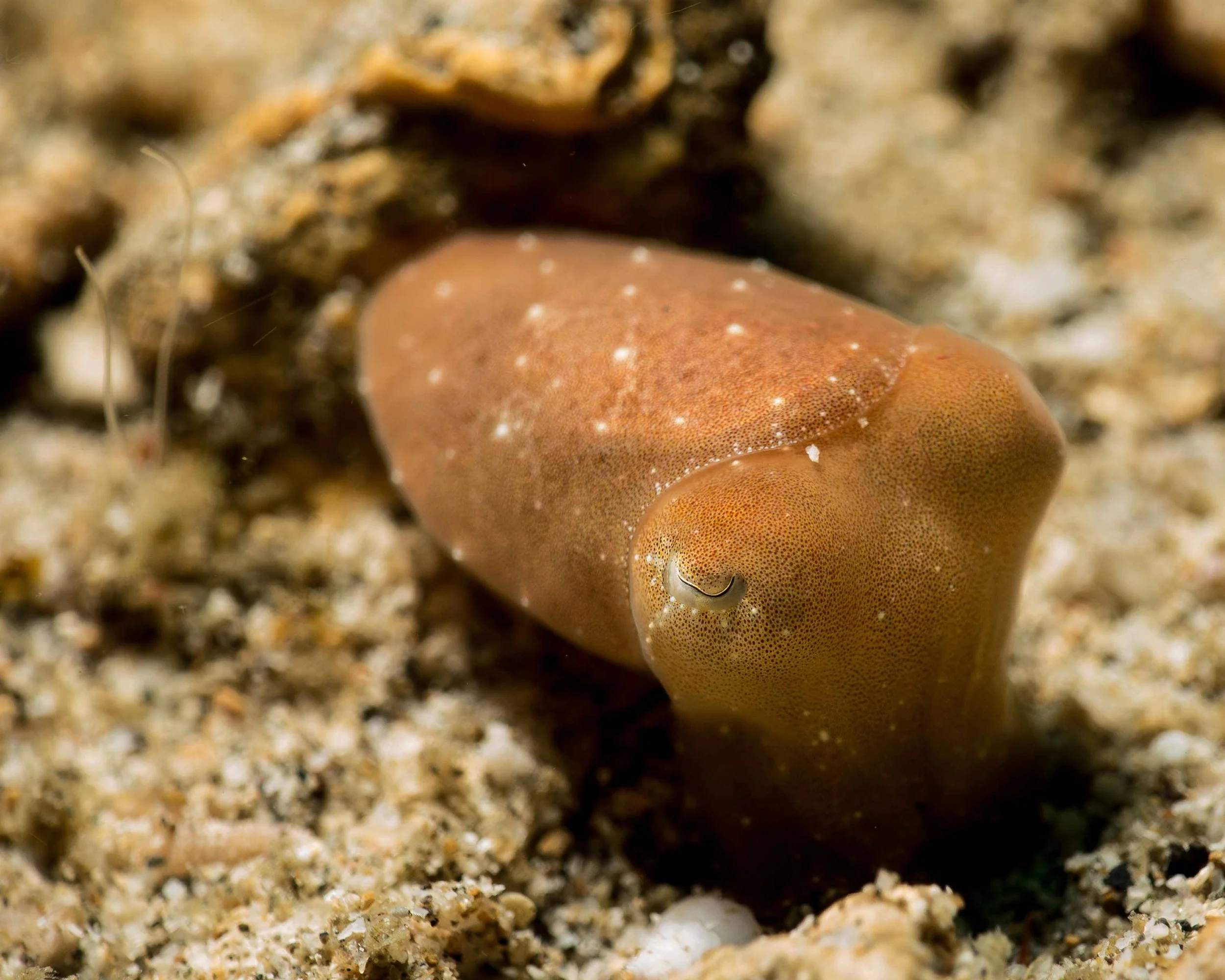
Anilao is home to the weird and wonderful
This mix of terrain makes Anilao especially rewarding for divers who enjoy slow, methodical exploration. Rather than dramatic drop-offs or fast drift dives, most sites encourage careful searching and patient observation — exactly the conditions favored by macro photographers and critter hunters.
Dive Conditions
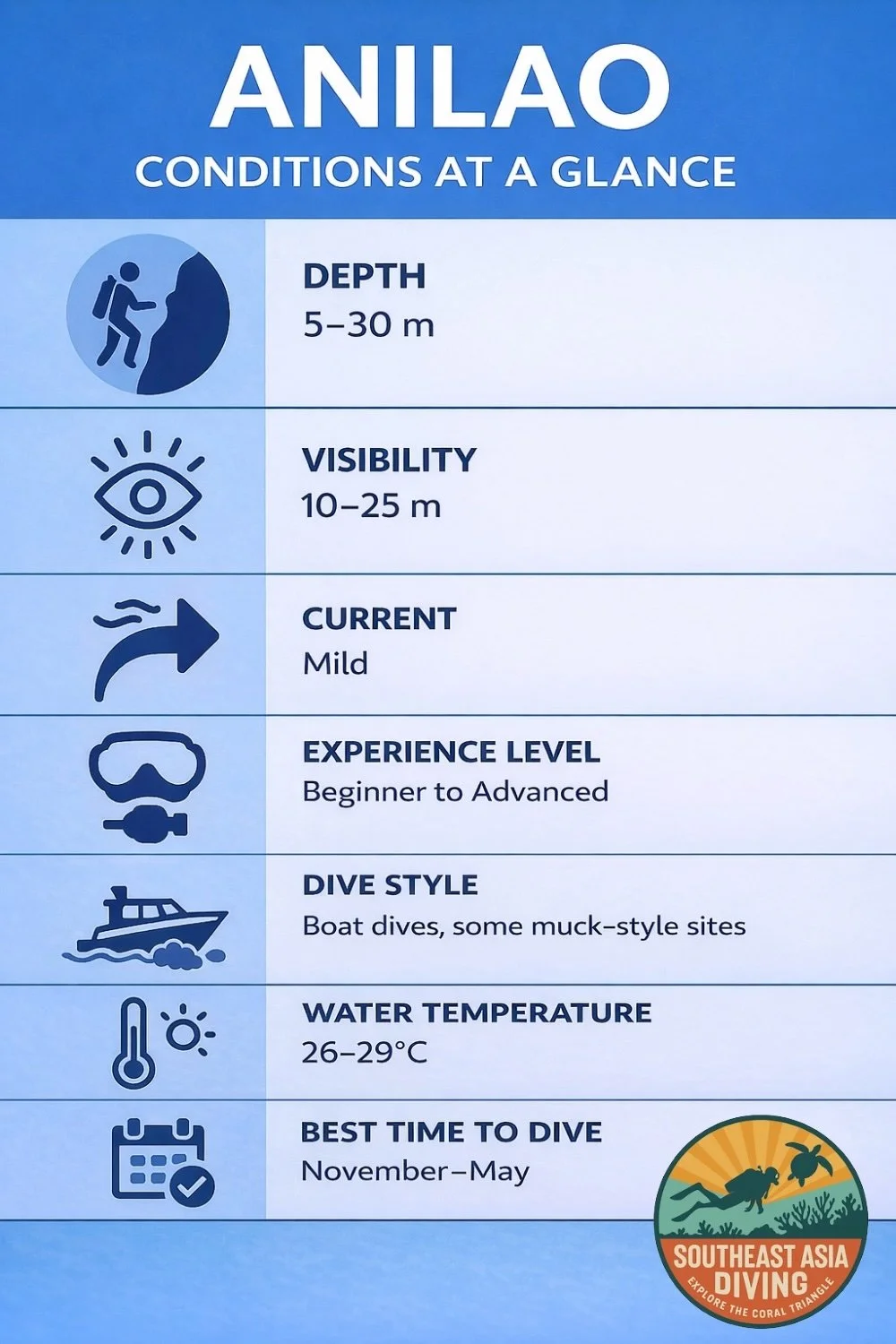
Dive conditions in Anilao are generally calm and forgiving, making the area suitable for a wide range of experience levels. Currents are typically mild, allowing for extended bottom times and relaxed dive profiles. On more exposed sites, divers may encounter light surge, particularly in shallower water, but this is rarely strong enough to disrupt macro-focused dives.
Visibility in Anilao can vary depending on season and site, typically ranging from moderate to very good. While visibility may not always match crystal-clear reef destinations, the slightly reduced clarity often works in favor of macro diving, as it encourages divers to focus closely on the reef and substrate rather than the wider environment.
Depths are generally shallow to moderate, with many productive macro dives taking place between 5 and 30 meters, allowing for long dives, safe profiles, and multiple daily dives without excessive fatigue.
Together, Anilao’s diverse underwater terrain and manageable conditions create an environment where time, patience, and attention to detail are consistently rewarded — a key reason it remains one of Southeast Asia’s premier macro diving destinations.
🐙 Marine Life Highlights
Anilao is renowned for its astonishing biodiversity, particularly when it comes to small, cryptic, and highly sought-after species. This is a destination where patience is consistently rewarded — slow down, search carefully, and the reef begins to reveal an endless parade of unusual and often rare marine life.
What sets Anilao apart is not just the number of species, but the density of sightings. It’s common for divers to encounter multiple “bucket-list” critters on a single dive, especially when diving with experienced local guides who know exactly where to look.
Signature Macro Critters
Nudibranchs
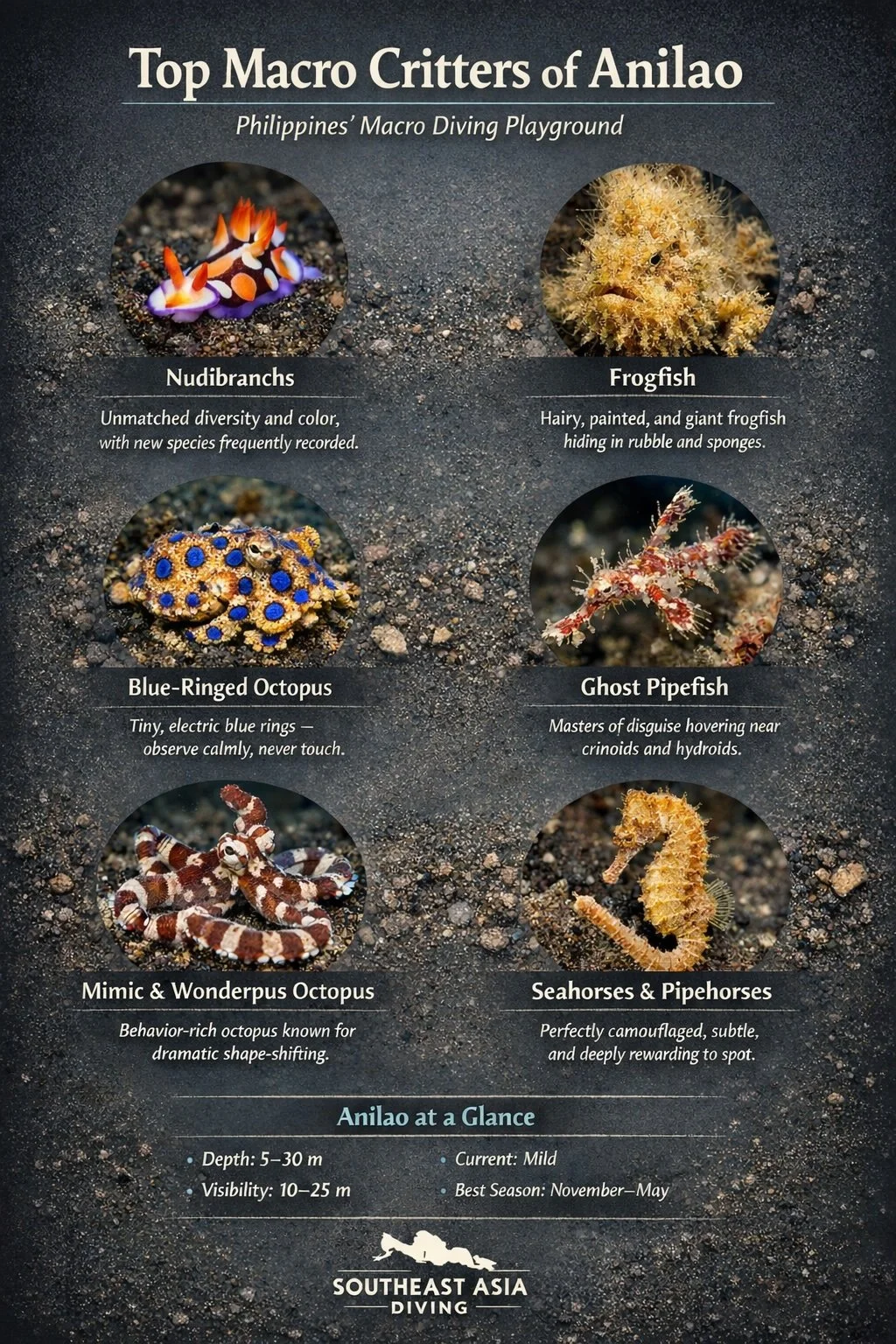
Anilao is a nudibranch hotspot, with dozens of species recorded year-round. From tiny, jewel-like slugs to larger, flamboyant varieties, the diversity of color, pattern, and behavior makes Anilao a dream destination for nudibranch enthusiasts and photographers alike.
Frogfish (Hairy, Painted & Giant)
Frogfish are a consistent highlight, often found camouflaged among sponges, rubble, and algae. Hairy frogfish are particularly photogenic here, blending perfectly into volcanic substrates, while painted and giant frogfish provide striking size and color contrasts.
Ghost Pipefish
Both ornate and robust ghost pipefish are regularly encountered, hovering near crinoids, hydroids, and soft coral. Their camouflage and delicate movement make them challenging but deeply rewarding subjects for macro shooters.
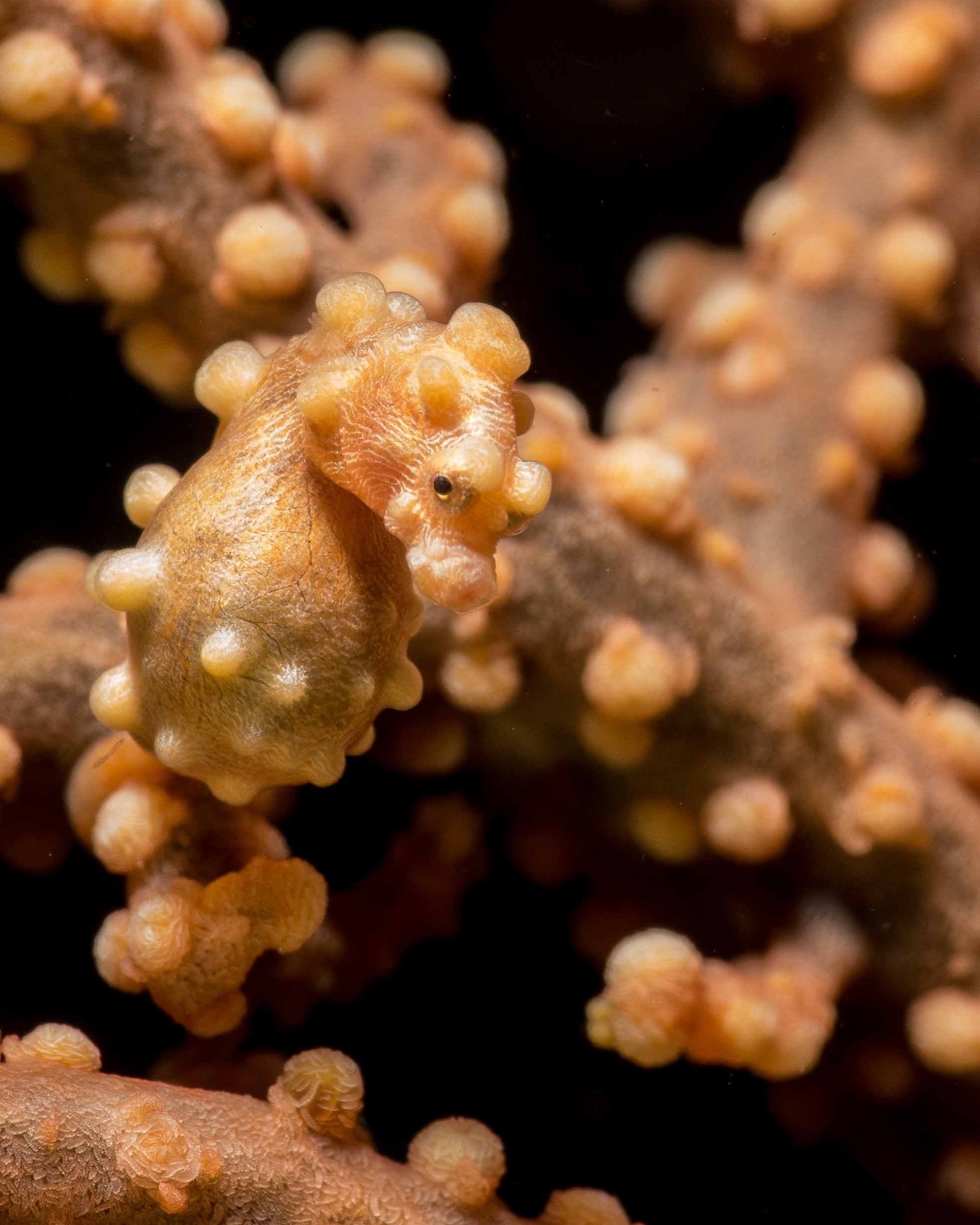
You can see Pygmy Seahorses in Anilao
Rhinopias (Seasonal)
One of Anilao’s most exciting finds, Rhinopias scorpionfish appear seasonally and are never guaranteed — but when present, they attract underwater photographers from around the world. Their elaborate fins and textured appearance make them among the most dramatic macro subjects in Southeast Asia.
Mimic & Wonderpus Octopus
Anilao’s sandy slopes and rubble fields provide ideal habitat for mimic and wonderpus octopus, known for their shape-shifting behavior and expressive movement. Encounters often involve fascinating behavior, making them excellent subjects for both still photography and video.
Blue-Ringed Octopus
Small, striking, and highly venomous, the blue-ringed octopus is most commonly spotted on night dives. These encounters require calm, respectful observation and are a reminder of just how much life thrives in Anilao’s seemingly barren sand.
Seahorses, Pipehorses & Pygmy Seahorses
Beyond the more commonly seen seahorses and pipehorses, Anilao also offers the chance to encounter pygmy seahorses— among the most coveted macro subjects in the region. Perfectly camouflaged and incredibly small, they are typically found on specific host corals and are best located with the help of knowledgeable local guides.
Reef & Supporting Life
While macro critters steal the spotlight, Anilao’s reefs are supported by a rich community of smaller life that brings the ecosystem together:
Octopus and cuttlefish, often seen displaying fascinating hunting and camouflage behavior
Juvenile fish and larval stages, especially after dusk or during night dives
Cleaner shrimp, boxer crabs, and commensal species living among anemones and coral heads
Leaf scorpionfish and waspfish, blending seamlessly into algae and rubble
Although Anilao is not known for big pelagic action, its true strength lies in sheer variety and reliability. For macro divers, it’s the kind of place where multiple rare and unusual subjects can be found on a single dive, reinforcing its reputation as one of Southeast Asia’s most rewarding destinations for those who appreciate the small, strange, and spectacular.
🤿 The Diver Experience
Diving in Anilao is typically boat-based, with most dive sites located just minutes from shore. Short boat rides allow for flexible scheduling and efficient dive days, making it easy to fit in multiple relaxed dives without feeling rushed. This setup is especially appealing to underwater photographers, who benefit from more time in the water and less time in transit.
Many dive resorts in Anilao are highly photographer-focused, tailoring their operations to macro diving. This often includes:
Extended bottom times, particularly on shallower sites
Slow-paced, methodical dives designed for critter searching
Dedicated macro guides with exceptional spotting skills
Easy back-to-back diving, ideal for multi-dive days and night dives
Most dive sites are suitable for Open Water certified divers, as conditions are generally calm and depths moderate. However, excellent buoyancy control is essential. Many of Anilao’s most interesting subjects live just above silty sand or delicate substrates, and precise control helps protect the environment while also improving photography opportunities.
Water Temperature & Exposure Protection
While Anilao is a tropical destination, water temperatures can vary noticeably by season. During the prime dry season, water temperatures are typically comfortable, but out of season (especially during the cooler months) temperatures can drop enough for longer macro dives to feel chilly — particularly when spending extended periods hovering nearly motionless.
For this reason, divers are strongly encouraged to bring an appropriate wetsuit, with many photographers opting for a 5 mm suit, hooded vest, or additional thermal layers to stay comfortable during long dives and night dives. Staying warm not only improves comfort but also helps maintain focus, buoyancy control, and air consumption.
Overall, Anilao offers a diving experience that prioritizes time, patience, and precision. It’s an ideal destination for divers who enjoy slowing down, refining their skills, and fully immersing themselves in the details of the underwater world — whether you’re a macro photography beginner or an experienced critter hunter.
📸 Macro Photography in Anilao
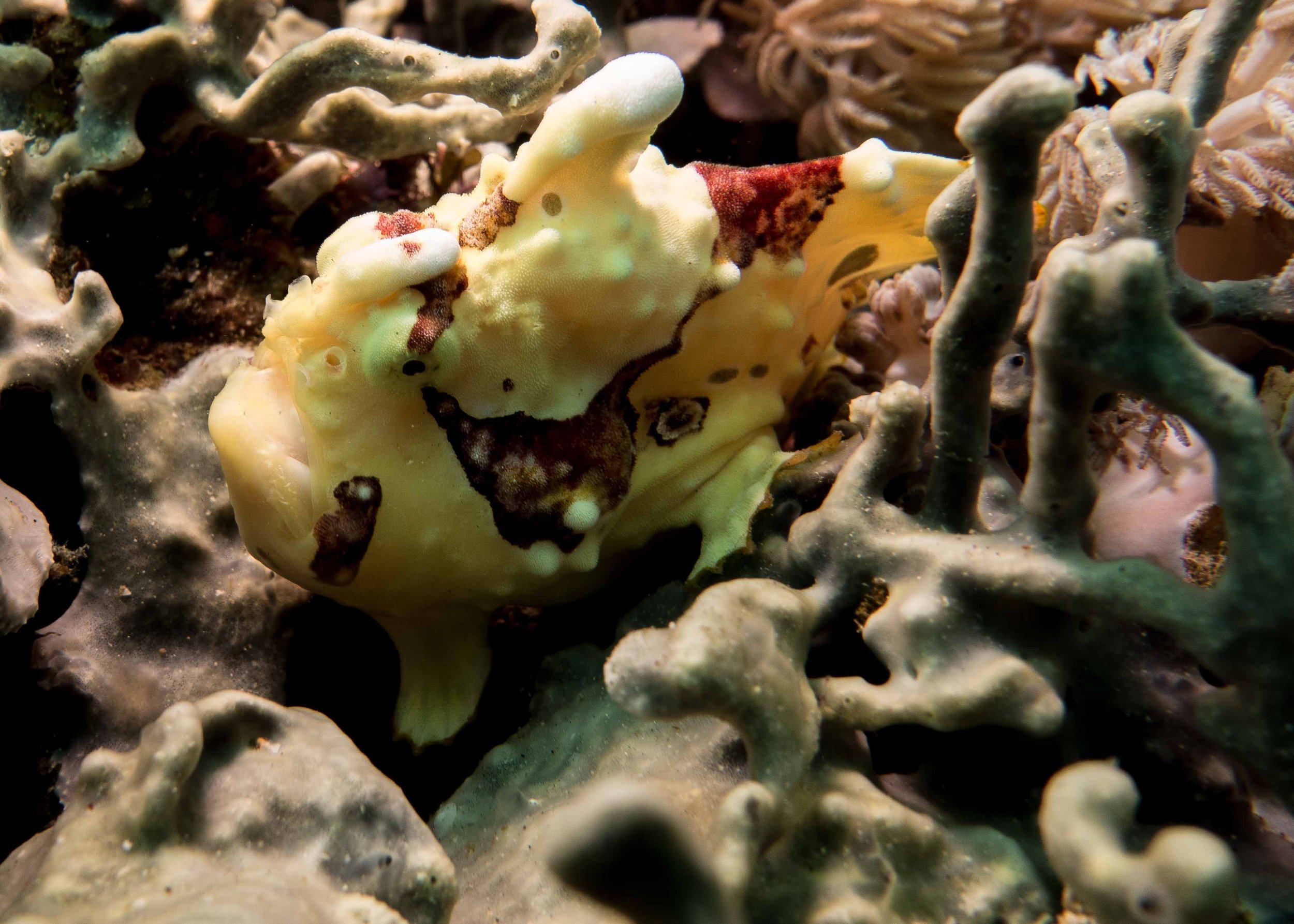
Frogfish are common on dives in Anilao
Anilao is widely regarded as one of the best macro photography destinations in the world, Anilao is widely regarded as one of the best macro photography destinations in the world, attracting underwater photographers from across the globe. From international workshops to seasoned professionals refining their portfolios, the area’s combination of biodiversity, calm conditions, and knowledgeable guides makes it an ideal place to focus purely on the art of macro shooting.
What sets Anilao apart for photographers is not just the number of critters, but the quality of encounters. Subjects are often found in predictable locations, remain relatively cooperative, and can be approached carefully for extended shooting opportunities — allowing photographers to experiment with composition, lighting, and behavior.
Why Photographers Love Anilao
High critter density, with multiple subjects often found on a single dive
Cooperative subjects that allow for careful framing and repeat attempts
Calm conditions that support precise buoyancy and stable shooting
Highly skilled local guides with exceptional spotting ability and deep knowledge of critter behavior
Recommended Macro Photography Gear
Macro Lenses
A 60mm macro lens is an excellent all-round choice in Anilao, offering flexibility for slightly larger subjects such as frogfish and cuttlefish while still performing well for smaller critters. For photographers targeting tiny subjects like nudibranchs, ghost pipefish, and pygmy seahorses, a 100mm (or equivalent) macro lens provides greater working distance and tighter framing.
Wet Lenses (Diopters)
Wet lenses are extremely popular in Anilao and can dramatically expand creative possibilities. +5 to +10 diopters allow photographers to capture super-macro detail, revealing textures, rhinophores, and eye detail that would otherwise be missed. Wet lenses also offer flexibility, as they can be added or removed underwater depending on the subject.
Strobes & Lighting
Dual strobes are commonly used to control shadows and isolate subjects from dark backgrounds. In Anilao’s silty environments, careful strobe positioning is key to avoiding backscatter. Many photographers favor slightly pulled-back strobes with angled light to create contrast without lighting up the water column.
Focus Lights
A reliable focus light is essential, especially for night dives and low-contrast subjects. Adjustable brightness is ideal, allowing you to dial down light output for skittish critters or increase it when shooting in dark sand or overcast conditions.
Snoots & Creative Accessories
For photographers looking to elevate their images, snoots are increasingly popular in Anilao. By narrowing the beam of light, snoots help isolate subjects against black backgrounds, adding drama and artistic flair. Other creative tools, such as colored background cards or reflectors, are occasionally used by advanced shooters under controlled conditions.
Technique & Shooting Tips
Precise buoyancy control is critical — many critters sit just above fine silt, and a careless fin kick can ruin both visibility and a shot
Approach subjects slowly and avoid blocking their natural escape routes
Be patient and observe behavior before shooting — many of Anilao’s best moments happen when divers pause rather than chase
Night dives reveal completely different species and behaviors, offering some of the most exciting photographic opportunities
Whether you’re capturing nudibranch portraits, documenting rare Rhinopias, or waiting for octopus behavior to unfold, Anilao consistently rewards patience, preparation, and attention to detail — making it one of the most fulfilling destinations in Southeast Asia for macro photographers.
🛟 Safety & Environmental Notes
nilao’s extraordinary macro life depends on fragile muck habitats that are easily disturbed. Fine volcanic sand, rubble fields, and delicate micro-ecosystems support many of the rare species divers come to see — and even small impacts can have lasting effects.
Excellent buoyancy control is essential. Many critters live just above silty substrates, and a single fin kick or hand placement can reduce visibility instantly and damage habitat. Maintaining neutral buoyancy not only protects the environment but also improves air consumption, stability, and photographic results.
Marine life should never be touched, moved, or repositioned for photographs. Ethical macro diving relies on patience and observation, allowing natural behavior to unfold rather than manipulating subjects for a shot.
The use of pointer sticks is strongly discouraged in Anilao. While sometimes promoted as a stability aid, pointer sticks can easily damage fragile substrates, disturb hidden animals, and encourage poor buoyancy habits. Divers are encouraged to develop proper trim and control rather than relying on tools that introduce unnecessary contact with the environment. Many operators and photographers in Anilao now actively avoid their use altogether.
Extra caution is also required during night dives, when some of Anilao’s most fascinating — and potentially dangerous — species become active. Blue-ringed octopus, while small and visually striking, are highly venomous. All encounters should remain calm, hands-off, and at a respectful distance.
By prioritizing buoyancy, minimizing contact, and embracing a truly hands-off approach, divers help ensure that Anilao remains a healthy, productive, and world-class macro diving destination for future generations.
🗓️ Best Time to Dive Anilao
Anilao is a year-round diving destination, with productive macro diving possible in every season. However, conditions do vary throughout the year, and understanding these seasonal differences can help divers plan their trip to match personal preferences for visibility, conditions, and crowd levels.
Best Season: November–May
The dry season, from November through May, is widely considered the best time to dive Anilao. During these months, divers can expect:
Calmer sea conditions, with minimal surface chop
Better and more consistent visibility
Comfortable water temperatures
Peak macro activity, with excellent critter sightings
These conditions make the dry season particularly appealing for underwater photographers, as stable conditions allow for long, relaxed dives and easier lighting control. As this is also the most popular period, dive resorts can be busier — especially during holidays and photography workshops — so booking in advance is recommended.
Rainy Season: June–October
The rainy season, from June to October, is still very much diveable and can be an attractive option for divers who prefer a quieter experience. During this period:
Visibility may be reduced at times, particularly after heavy rain
Seas can be less predictable, with occasional wind and swell
Fewer crowds mean more flexible dive schedules and a relaxed pace
Many photographers enjoy this season for its lush coastal scenery and the opportunity to focus on macro subjects without competition at popular sites. With experienced guides and flexible planning, excellent dives are still common throughout these months.
Water Temperature
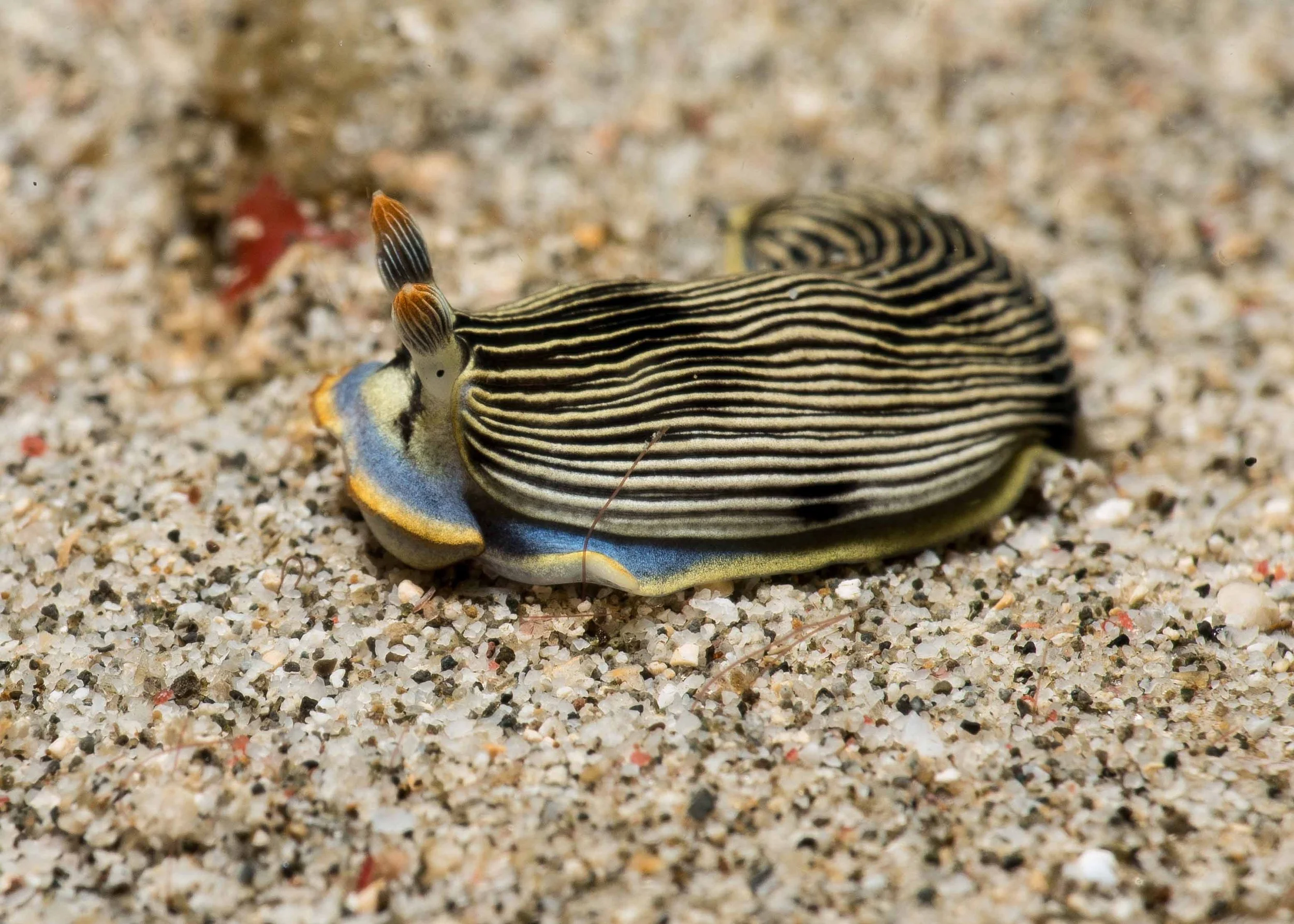
Many different Nudibranchs can be seen in Anilao
Water temperatures in Anilao typically range from 26–29°C (79–84°F). While generally warm, temperatures can feel noticeably cooler during certain months or on extended macro dives where divers spend long periods relatively motionless. Bringing an appropriate wetsuit — often a 3–5 mm, depending on personal tolerance — helps ensure comfort throughout multi-dive days.
Overall, Anilao offers reliable macro diving in every season, with the best conditions from November to May and quieter, still-rewarding diving available during the rainy months.
🧭 Final Thoughts
Anilao proves that you don’t need remote islands, liveaboards, or long travel days to experience truly world-class macro diving. Just a short drive from Manila, it delivers an extraordinary concentration of marine life, a wide variety of underwater habitats, and conditions that consistently reward slow, thoughtful diving.
What makes Anilao especially compelling is how well it caters to macro-focused divers and photographers. Calm conditions, flexible dive schedules, skilled local guides, and an abundance of rare and unusual critters combine to create an environment where divers can refine their skills, experiment creatively, and fully immerse themselves in the details of the underwater world.
From colorful nudibranchs and camouflaged frogfish to elusive pygmy seahorses and behavior-rich octopus encounters, Anilao offers the kind of diversity and reliability that keeps divers coming back year after year. It’s a destination that encourages patience, curiosity, and respect — and rewards those qualities with unforgettable encounters.
Whether you’re building your macro skills, expanding a photography portfolio, or chasing once-in-a-lifetime critter sightings, Anilao firmly earns its place on every serious diver’s list — a reminder that some of the most spectacular underwater experiences are found not in the vast and dramatic, but in the small, strange, and spectacular.
Frequently Asked Questions (FAQ)
Is Anilao good for beginner divers?
Yes. Many dive sites in Anilao are suitable for Open Water certified divers, with generally calm conditions and moderate depths. However, because much of the diving is macro-focused over silty substrates, good buoyancy control is important. Beginners who take their time and dive with experienced guides can have very rewarding dives.
Do I need macro photography experience to enjoy Anilao?
Not at all. While Anilao is famous among photographers, non-photographers can still enjoy the diversity of marine life and relaxed diving style. That said, divers who enjoy slow, observant dives tend to get the most out of Anilao.
What camera setup is best for Anilao?
A macro setup is ideal. Many photographers use a 60mm or 100mm macro lens, often paired with wet diopters for super-macro shooting. Dual strobes, a focus light, and good buoyancy control will significantly enhance results. Wide-angle setups are less commonly used, though occasional reef scenes and environmental shots are possible.
Can I see pygmy seahorses in Anilao?
Yes, pygmy seahorses are present in Anilao, though sightings are never guaranteed. They are extremely small and well camouflaged, and are best located with the help of knowledgeable local guides. Patience and excellent buoyancy are essential.
Is Anilao better than Lembeh Strait?
Anilao and Lembeh each offer exceptional macro diving, but with different strengths. Lembeh is known for extreme critter variety and classic muck sites, while Anilao offers similar biodiversity with easier access, more varied habitats, and generally calmer conditions. Many macro divers choose to dive both.
What exposure protection should I bring?
Water temperatures typically range from 26–29°C (79–84°F), but extended macro dives can feel cool, especially during certain months. Most divers are comfortable in a 3–5 mm wetsuit, and photographers often add a hooded vest or extra layer for longer dives.
Are night dives worth doing in Anilao?
Absolutely. Night dives are a highlight in Anilao, revealing different species and fascinating behaviors, including octopus activity and crustaceans not seen during the day. Extra caution is required, as blue-ringed octopus are present.
How many days should I plan to dive in Anilao?
A stay of 3–5 diving days is ideal for most visitors, allowing time to explore multiple sites and settle into the slow pace of macro diving. Dedicated photographers often stay longer to fully explore the area and wait for rare sightings.
Is Anilao crowded?
While Anilao is popular with photographers, it generally feels low-key and dive-focused rather than crowded. Outside of peak seasons and workshops, dive sites are rarely busy, and flexible scheduling helps spread divers out.