🌊 Deep Dive Series: Batu Bolong — Komodo’s Explosive Underwater Volcano of Life
🌊 Introduction
Few dive sites capture the raw, unfiltered energy of Komodo quite like Batu Bolong. Rising sharply from the middle of the Lintah Strait, this jagged rock pinnacle appears unremarkable from the surface — just a rugged tooth of stone surrounded by choppy water. But beneath that modest exterior lies one of the most spectacular and vibrant reefs in all of Indonesia.
As soon as you begin your descent, the illusion fades and the truth reveals itself: Batu Bolong is alive. The reef explodes into colour and motion, a vertical tapestry of flawless hard corals, glittering anthias, swirling fusiliers, and sleek trevallies cruising along the current-swept edges. Hawksbill turtles glide between coral terraces, napoleon wrasse patrol the deeper ledges, and hundreds of reef species move through the water column in a constant, pulsing rhythm.
This is a site shaped entirely by current and tide — and that’s exactly why it thrives. The relentless flow of nutrient-rich water feeds a reef so pristine and densely populated that it feels almost surreal. Coral gardens rise in layered formations, fish biomass builds into clouds that shimmer in the sunlight, and predators appear and disappear in bursts of silver.
Batu Bolong is Komodo at its most elemental: powerful, unpredictable, intensely colourful, and unforgettable. It's a dive that commands respect, rewards awareness, and delivers more marine life in a single glance than many sites offer in an entire dive.
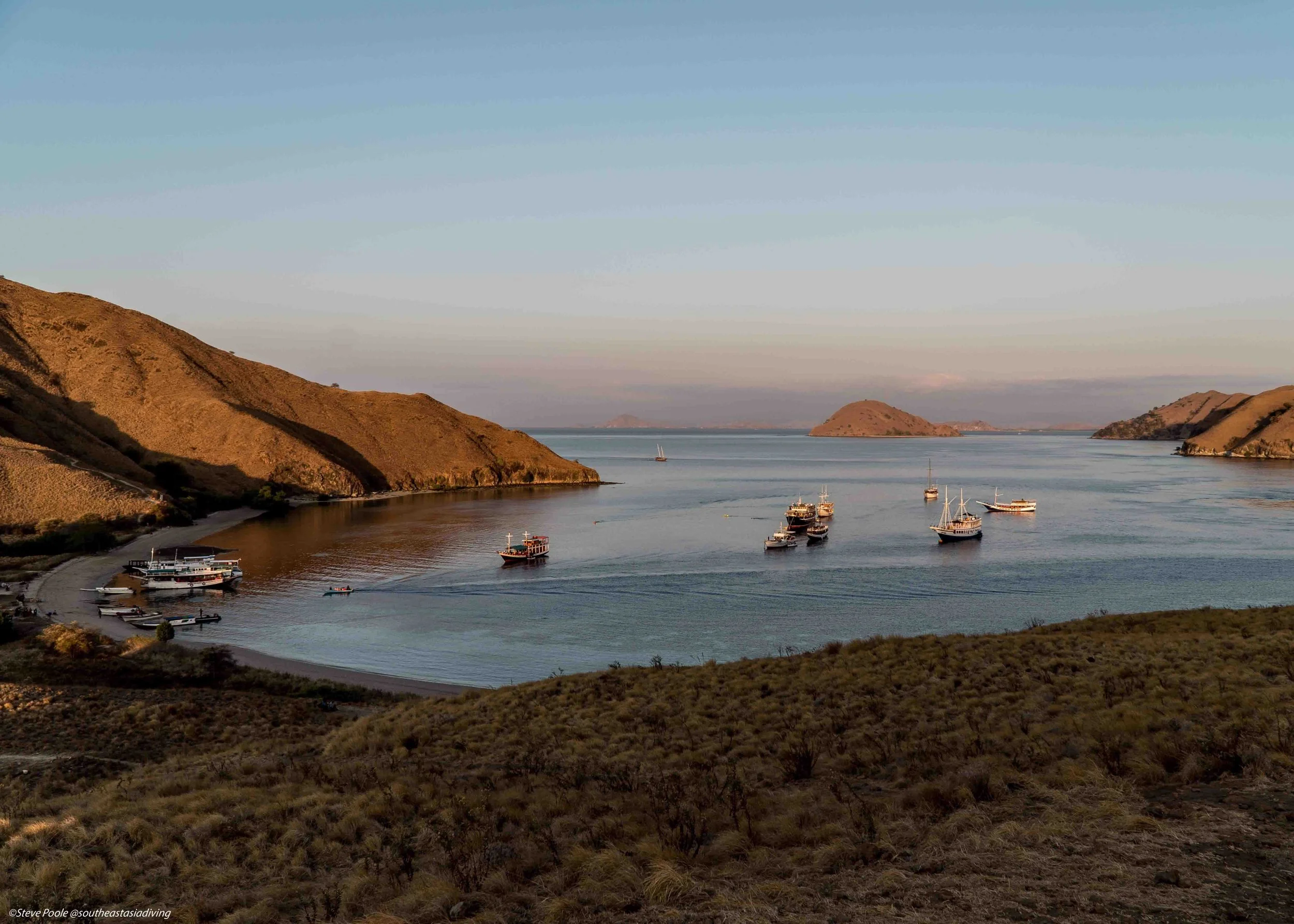
Komodo Nation Park, Indonesia
The hole in the rock is, without question, one of the crown jewels of Indonesian diving — a place where the ocean showcases just how wild and abundant it can be.
📍 Where Is Batu Bolong?
Batu Bolong sits at the very heart of Komodo National Park, positioned between Komodo Island and Tatawa Island in a narrow stretch of water known as the Lintah Strait. This strait is one of the park’s major marine highways — a place where the Indian Ocean and Pacific Ocean exchange water through powerful tidal surges.
Because of this unique placement, Batu Bolong is directly exposed to the full force of Komodo’s famously dynamic currents. Every tide cycle pushes massive volumes of seawater past the pinnacle, creating a constant conveyor belt of movement, nutrients, and marine life.
This exposed geography gives Batu Bolong three defining characteristics:
1️⃣ Powerful tidal movements
Water accelerates as it narrows between the islands, causing rapid shifts in current direction and speed.
2️⃣ Upwellings of cold, nutrient-rich water
These upwellings fuel the reef’s incredible coral growth and staggering fish biomass. Every descent feels like entering a living, breathing aquarium—because in many ways, that’s exactly what it is.
3️⃣ Current flow on multiple sides of the rock
Batu Bolong is essentially a steep underwater mountain rising from deep water. Currents strike it from several angles, wrapping around the structure and creating different conditions on every side.
It is this combination of geography and hydrodynamics that keeps Batu Bolong in near-pristine condition. Corals here flourish untouched, because currents make anchoring impossible and limit diver exposure to only one safe portion of the reef.
The other sides — particularly the western and southern flanks — are strictly off-limits. These areas can generate powerful down-currents capable of pulling divers rapidly downward. Experienced local guides avoid these zones entirely and ensure groups remain on the sheltered, manageable side of the pinnacle.
Remote, rugged, and shaped by the sea, Batu Bolong’s location is both the secret to its beauty and the reason behind its legendary, exhilarating dive conditions.
🕰️ History & Why It’s Famous
Long before Komodo became a globally recognised diving destination, Batu Bolong already had a reputation among adventurous early explorers. In the early days, only a handful of dive boats ventured into the central channels of the park — partly due to the area’s isolation, but mostly because the currents around Batu Bolong were considered unpredictable and, at times, downright intimidating.
Those who did brave the site quickly realised they had discovered something extraordinary.
Batu Bolong’s unique position in the Lintah Strait protects it in an unexpected way. The very currents that make the dive challenging also serve as its greatest guardians. Anchoring is impossible here, meaning the reef has avoided decades of physical damage that many other sites suffered. The result is one of the healthiest, most intact coral ecosystems in Indonesia — a layered garden of plate corals, staghorn forests, and massive bommies that look untouched by time.
As liveaboards and day boats began exploring Komodo more frequently, Batu Bolong’s name spread for three key reasons:
⭐ 1. Some of the healthiest coral in the world
Because boats cannot anchor and only the sheltered side is diveable, the reef has been naturally preserved. Coral cover here is astonishingly dense, vibrant, and structurally diverse. Every square metre seems alive with polyps, sponges, fans, and reef fish.
⭐ 2. Dramatic fish biomass and predator action
The upwellings that sweep past Batu Bolong deliver a constant supply of nutrients. This fuels enormous populations of anthias, fusiliers, surgeonfish, and chromis — which in turn attract larger hunters. Giant trevallies streak through schools, white-tip sharks cruise along the drop-offs, and napoleon wrasse make imposing, slow-motion appearances.
For many divers, Batu Bolong offers some of the highest fish density they will ever see.
⭐ 3. The iconic “don’t cross the middle” rule
Ask any Komodo dive guide about Batu Bolong, and you’ll hear this phrase immediately. The centre ridge of the pinnacle acts as a dividing line between safety and danger.
One side is a dynamic but manageable drift packed with life.
The other side — the sun-exposed western and southern flanks — can generate extreme down-currents known to drag divers rapidly toward depth.
Guides enforce this rule with absolute seriousness, and it has become an integral part of Batu Bolong’s lore.
Over the years, Batu Bolong has earned its status as a bucket-list dive site — celebrated for its pristine coral, explosive marine activity, and thrilling, current-driven conditions. Today it stands consistently among the top-ranked dive sites in Indonesia and Southeast Asia, admired by photographers, naturalists, thrill-seekers, and experienced divers from around the world.
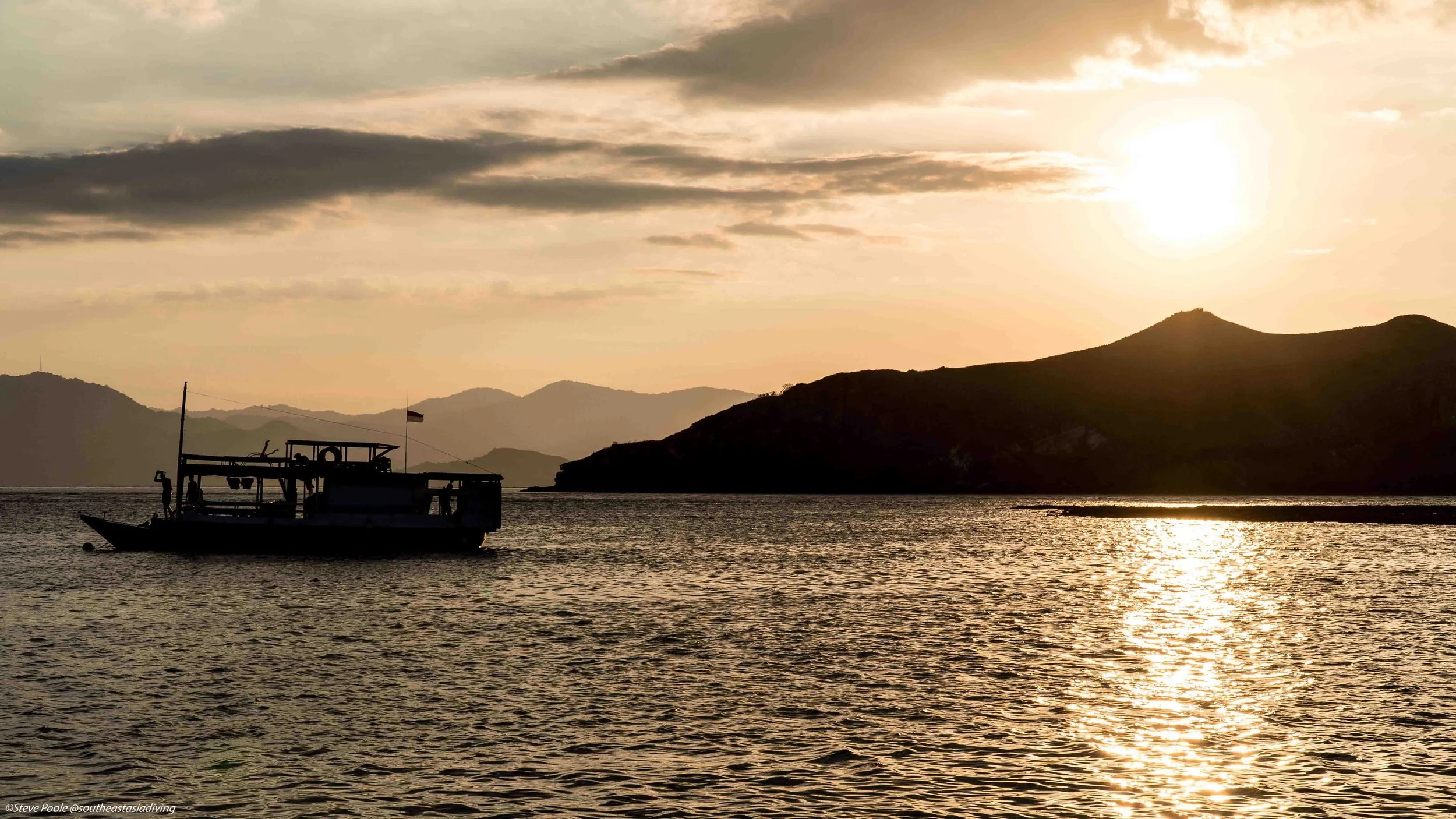
Beautiful Sunset over Komodo, Indonesia
🧭 Dive Overview
Batu Bolong is one of those rare dive sites where the conditions define the experience. The site itself is a steep, compact pinnacle rising from deep water, and while the reef is spectacular, it’s the currents that shape how — and where — you can dive.
Here’s what divers can expect when planning a dive at Batu Bolong:
Depth: 5–35 m (the pinnacle rises sharply from deeper water, but most activity happens between 10–22 m)
Visibility: 15–30 m, with the clearest conditions during the dry season
Currents: Strong, variable, and sometimes extreme depending on the tide
Skill Level: Intermediate to Advanced (strong buoyancy required)
Best Time to Dive: May–October (calmer seas, better visibility, more predictable currents)
Entry: Liveaboard or day boat; giant stride entry followed by a quick descent
Because of its location in the Lintah Strait, Batu Bolong is entirely shaped by tides and timing. Dive guides carefully study tide charts each day, looking for windows of milder flow — often around slack tide — before allowing divers to enter the water. Entering at the wrong moment can be dangerous, as the currents around the pinnacle can shift direction with surprising speed.
The dive is almost always conducted along the sheltered eastern side of the rock, where current is manageable and marine life abundant. The northern and southern faces, however, are well known for turbulent water movement, including powerful downward currents that can pull divers rapidly toward depth. These sides are strictly avoided, and experienced guides enforce clear boundaries underwater to ensure safety.
When timed correctly, Batu Bolong is nothing short of magical — a vibrant, bustling reef with some of the highest fish biomass in Indonesia. When timed poorly, it is one of Komodo’s most challenging sites. This delicate balance makes it one of the most exhilarating dives in the region and one that experienced divers rave about long after the trip ends.
🐠 Marine Life at Batu Bolong
If you’re looking for density, Batu Bolong might spoil you for every other reef. This is one of the few dive sites in the world where the sheer volume of marine life feels almost overwhelming — fish move in shimmering layers, predators sweep past in sudden bursts of speed, and every glance reveals a new pocket of activity. Batu Bolong feels alive in every direction.
⭐ Reef Fish & Schooling Action
The first thing divers notice is the movement — constant, swirling, pulsing. Sunlight cuts through the water and ignites clouds of orange anthias, which hover above coral terraces in glittering waves. Below them, huge schools of fusiliers and surgeonfish stream along the wall, shifting direction in perfect synchrony as currents change.
Mid-water is where the predators take over. Giant trevallies shoot through the schools with impressive force, scattering fish in a sudden flash of silver. Rainbow runners cruise in from the blue, while the deeper ledges host white-tip reef sharks patrolling with calm, quiet authority. Occasional visits from napoleon wrasse add a touch of prehistoric grandeur to the scene.
At times, the biomass is so intense that it feels like the reef is vibrating — a living, breathing ecosystem performing at full intensity.
⭐ Macro Surprises
Although Batu Bolong is famous for its wide-angle spectacle, macro enthusiasts will still find treasures tucked into sheltered areas of the reef.
Look closely and you may spot:
Leaf scorpionfish swaying like broken coral leaves
Tiny pygmy seahorses clinging to sea fans
A variety of nudibranchs in surprising colours
Cleaner shrimp, blennies, and juveniles hiding among coral branches
These little gems offer delicate contrast to the powerful wide-angle scenes happening all around them.
⭐ Pristine Coral Gardens
One of Batu Bolong’s greatest strengths is the health and diversity of its coral. Because anchoring is impossible and diver access is limited to only one protected side, the reef has remained incredibly intact.
Expect to see:
Terraced hard corals rising like natural architecture
Staghorn forests stretching across the slope
Plate corals forming multi-layered overhangs
Patches of soft corals adding colour in sheltered pockets
Bommies absolutely packed with reef fish
This level of coral integrity is becoming rare across Southeast Asia, which makes Batu Bolong feel all the more special — a glimpse into what untouched reefs once looked like.
🤿 The Diver Experience
A dive at Batu Bolong often begins with a giant stride into clear blue water, followed by a steady descent toward what looks, at first, like a small, jagged mountain rising from the depths. Within moments, the reef comes into focus — an explosion of colour and motion that seems to vibrate with life. This is where Batu Bolong reveals its true identity.
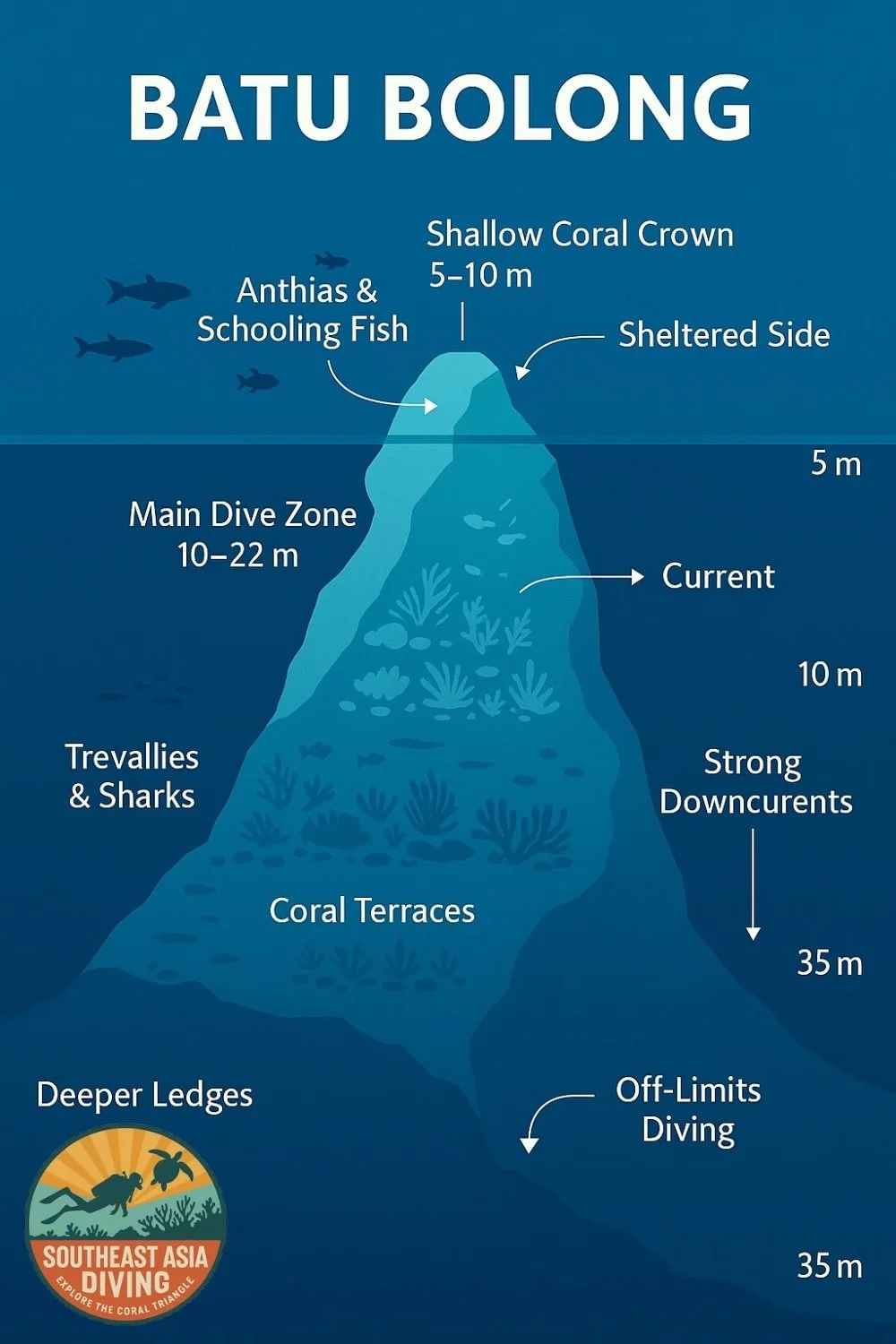
Most dive routes follow the sheltered eastern side, the only safe area for recreational divers. Here, currents are present but manageable, and it’s where the reef’s incredible biodiversity is concentrated. As you move along the slope, Batu Bolong unfolds like a living amphitheatre.
Divers can expect:
• A steep wall dropping into deep blue — look right and see the reef; look left and it’s endless ocean.
• Pockets of calm behind coral ridges — little sanctuaries where you can stabilize, observe, and take photos.
• Explosive fish activity on the sunlit upper slopes — anthias shimmer in the current, fusiliers stream past, and trevallies dart through like silver torpedoes.
• Predator–prey chases in mid-water — blink and you’ll miss the action as hunting ramps up during tide changes.
• Coral terraces packed with life — entire layers of staghorn, plate, and boulder corals form bustling condos for chromis, wrasse, and damselfish.
• Surge toward the top — as the tide shifts, water movement increases, adding natural rhythm and drama to your safety stop.
The reef feels ancient and alive, shaped entirely by water and motion.
But Batu Bolong also has a more serious side. The western and southern faces — the ones facing the full force of the strait — are strictly off-limits. These unprotected areas can produce intense down-currents and washing-machine turbulence capable of pulling divers downward or outward into open water. Even the most experienced guides treat these zones with deep respect.
Yet this is part of the site’s allure. Batu Bolong is exhilarating, beautiful, and humbling all at once — a place where the power of the ocean is always present, even in its calmest moments. It’s the kind of dive you finish buzzing, breathless, and fully aware that you’ve experienced something truly extraordinary.
📸 Photography Tips
Batu Bolong is a dream for underwater photographers — a place where every direction offers colour, life, and movement. But the same currents that make the reef so dynamic also create challenges. With the right preparation and technique, you can capture some of the most striking wide-angle images in Indonesia.
⭐ Wide-Angle Dominates
Batu Bolong is built for wide-angle photography. The sheer volume of fish, the towering coral structures, and the clear blue water all create ideal conditions for sweeping reef scenes.
Bring:
• A fisheye or ultra-wide lens to capture big coral structures and dense fish clouds
• Dual strobes if you're shooting stills with a housing — crucial for lighting large scenes
• High-output video lights if filming, especially useful below 15–20 m
Wide-angle allows you to stay close to the reef for colour and clarity, while still capturing the dramatic topography of the pinnacle.
⭐ Focus on the Upper Reef
The upper 5–15 metres of Batu Bolong offer the most photogenic conditions. This zone is often flooded with sunlight and packed with life.
Expect:
• Vivid coral colour thanks to strong natural light
• Massive schools of anthias and fusiliers swirling above coral terraces
• Bursting movement ideal for creating dynamic, layered images
• Minimal need for artificial lighting compared to deeper sections
This is where most wide-angle “wow shots” are taken — especially during slack tide when positioning is easier.
⭐ Be Current-Aware
Currents are part of the Batu Bolong experience. They can make photography challenging, but with smart technique, you can use them to your advantage.
Tips:
• Stay low and sheltered behind reef structures to stabilise your shot
• Avoid kicking too aggressively near coral — the reef is fragile, and small fin movements go a long way
• Let the current move you, then reposition when you reach a sheltered pocket
• Prepare your composition quickly — moments of calm can be brief
Knowing when to drift and when to hold position is key to capturing clear, sharp images.
⭐ Macro? Possible — but selective
Macro photography at Batu Bolong is absolutely worthwhile, but it requires intention. The currents make it impossible in exposed areas, so look for:
• Still pockets at 15–20 metres
• Sea fans with pygmy seahorses
• Leaf scorpionfish resting near coral heads
• Nudibranchs in protected cracks and ledges
It’s a site where you’ll likely carry a wide-angle setup — but you may still spot macro treasures worth pausing for.
⚠️ Safety Notes
Batu Bolong is one of the most thrilling dives in Komodo — but it’s also one of the most technically dynamic. Its position in the Lintah Strait exposes it to fast-moving tides, unpredictable current shifts, and powerful water movement on multiple sides of the pinnacle. Diving here safely requires awareness, respect, and the guidance of experienced professionals.
• Strong currents are common
Currents are part of Batu Bolong’s identity. They bring nutrients, create the biomass, and protect the reef — but they can also create challenging conditions. The biggest hazards are downward currents and side-flow currents that can push divers away from the reef or toward deeper water.
• Never cross the saddle
The rocky ridge at the top of the site looks shallow and harmless, but divers are strictly prohibited from crossing it.
Water funnels over the saddle with incredible force, and on the unprotected side, it can drop sharply into the notorious Komodo washing machines — turbulent mixing zones where divers can lose control of buoyancy quickly. Staying on the sheltered eastern side is non-negotiable.
• Stay close to your guide
Local guides are highly skilled and intimately familiar with Batu Bolong’s mood changes. They plan entries and routes based on tides, current direction, and years of experience. Follow them closely, maintain clear communication, and avoid straying above or outside the group.
• Good buoyancy is essential
Precise buoyancy control is critical here. Poor control can:
• push you into fragile coral
• pull you off the reef into moving water
• cause unnecessary finning that disturbs marine life or damages the ecosystem
Batu Bolong is not a dive for those still mastering neutral buoyancy or struggling with air consumption.
• DSMB is mandatory

Ascents are almost always done away from the rock, often drifting as you rise. With multiple boats in the area during peak season, a visible surface marker buoy is essential for safety and quick pick-up by your dive team.
Despite its reputation, Batu Bolong is safely accessible to confident, attentive divers under proper supervision. With respect for conditions and trust in your guide, it becomes one of the most rewarding and exhilarating experiences in Komodo — a dive that showcases the ocean’s power and beauty in equal measure.
📅 Best Time of Year
The best diving conditions at Batu Bolong occur during Komodo’s dry season, from May to October. During these months, the region experiences calmer seas, more predictable currents, and beautiful dive conditions that showcase the site at its full, dramatic potential.
Here’s what divers can typically expect during peak season:
• Clear water (20–30 m visibility)
The dry season brings cleaner, more stable water masses through the strait, giving Batu Bolong the kind of visibility that makes wide-angle photography shine.
• More stable currents
While Komodo always has current — it’s part of the magic — the dry season tends to be slightly more predictable. Guides can plan dive windows more easily, and slack tide often lasts a bit longer.
• Calmer surface conditions
The Lintah Strait can get choppy during shoulder seasons, but the mid-year months generally offer smoother surface entries and easier pick-ups.
• Strong sunlight for wide-angle shots
Komodo’s dry season is bright and clear. The upper reef of Batu Bolong glows in sunbeams, making the colours of the coral and anthias truly pop.
☔ What About the Wet Season (November–April)?
Batu Bolong can still be dived during the wet season, and many divers do visit during this time. However:
• Visibility can decrease, sometimes down to 10–15 metres
• Currents may shift more unpredictably, requiring more vigilance
• Surface chop and wind can make conditions harsher
• Cloudier skies reduce natural light for photography
That said, marine life remains abundant year-round, and some photographers enjoy the moodier lighting of the wet season for a different aesthetic.
In short:
If you want the classic Batu Bolong experience — crystal-clear water, glowing coral gardens, and dramatic fish density — May to October is the prime window.
If you’re visiting outside that period, the site is still spectacular, but expect more varied conditions.
💬 Final Thoughts
Batu Bolong is Komodo distilled into one dive: powerful, colourful, unpredictable, and overflowing with life. It is the kind of site that reminds you why Indonesia is regarded as one of the world’s greatest marine ecosystems. Few places offer such an intense blend of pristine coral, swirling fish clouds, hunting predators, and heart-pounding currents — all compressed into a single, dramatic pinnacle.
This is not a gentle drift or a quiet macro dive. Batu Bolong is an experience. The reef feels ancient and untouched, the water movement almost alive, and the sheer volume of marine activity can leave even seasoned divers speechless. You don’t just observe the reef here — you feel immersed in the heartbeat of the ocean itself.
Yet Batu Bolong also demands respect. Conditions can shift in moments, the currents have real force, and the margins for error are narrow. But under the guidance of skilled local dive leaders and with mindful, confident diving, the site becomes not just safe but truly extraordinary.
For many divers, Batu Bolong becomes one of those rare memories that lingers long after the trip ends — the kind you revisit again and again when thinking about why you fell in love with diving in the first place. It is a pinnacle in every sense of the word.
Dive it with awareness.
Dive it with a skilled guide.
Dive it with wonder.
And let Batu Bolong show you what a living, breathing reef can be.
❓ FAQ
Is Batu Bolong safe for beginners?
Generally, no.
Batu Bolong is recommended for intermediate to advanced divers because of its strong, changeable currents and the precise buoyancy control required to stay on the sheltered side of the pinnacle. Beginners may find the conditions overwhelming, and dive operators typically enforce experience requirements for safety.
Why can’t you cross the middle of the site?
The top “saddle” of Batu Bolong separates the safe, protected side from the exposed west and south faces.
These unprotected areas can experience powerful down-currents — fast-moving vertical currents that can pull divers downward and away from the reef. Even experienced divers avoid these zones.
Crossing the middle is one of Komodo’s most well-known “never do this” rules, and dive guides enforce it strictly.
What kind of marine life will I see?
Batu Bolong offers an extraordinary mix of both wide-angle and macro life. Common sightings include:
• Huge schools of anthias, fusiliers, and surgeonfish
• Hawksbill turtles cruising the coral terraces
• Giant trevallies and rainbow runners hunting in mid-water
• White-tip reef sharks patrolling deeper ledges
• Large napoleon wrasse
• Occasional nudibranchs, pygmy seahorses, and leaf scorpionfish in sheltered pockets
The density of marine life is one of the highest in Komodo — sometimes overwhelming in the best possible way.
Can I dive Batu Bolong year-round?
Yes — Batu Bolong can be dived in any season, and marine life remains abundant throughout the year. However:
• May–October (dry season) offers the best visibility, calmer seas, and more predictable currents.
• November–April (wet season) is still diveable, but conditions vary more and visibility can drop.
If you’re looking for ideal photography light and reliable water clarity, the dry season is the best window.
Do I need a reef hook at Batu Bolong?
No — reef hooks are not used here.
Divers stay on the sheltered side of the pinnacle where hooking in is unnecessary and potentially damaging to the fragile coral structures.
Do liveaboards dive Batu Bolong?
Yes, most Komodo liveaboards include Batu Bolong in their itineraries. Day boats from Labuan Bajo also visit regularly, depending on conditions.
What certification level do I need?
Advanced Open Water (or equivalent) is strongly recommended, along with experience in current, drift, or wall diving.