📸 The Ultimate Action Camera Buying Guide for Scuba Divers
🎥 How to choose the right underwater camera — from DJI to GoPro, SeaLife and more
Underwater video has never been easier — or more exciting. Today’s compact action cameras allow divers to capture moments that once required bulky housings and professional rigs. Whether you’re drifting over coral gardens, filming a manta ray sweeping past the reef, or zooming in on the mesmerizing behaviour of a tiny nudibranch, a small, travel-friendly camera can preserve memories with stunning clarity.
But while action cameras have improved dramatically, the underwater world is a uniquely challenging environment. Light disappears quickly, colours shift, currents shake your footage, and depth limits rapidly separate the good from the great. The action camera that works perfectly for hiking or mountain biking might struggle the moment you descend past 10 metres.
In other words: not all action cameras are created equal — especially for scuba diving.
This guide is here to simplify the process. We’ll walk through what divers should prioritise in a camera, break down the most important features for underwater use, and compare today’s top models — including the DJI Osmo Action 5, GoPro HERO series, Insta360, Akaso, and dedicated underwater systems like SeaLife.
Whether you're a new diver capturing your first reef scenes or a seasoned photographer looking for a reliable backup camera, this guide will help you choose a setup that fits your style, your budget, and the way you dive.
Let’s dive in.
This post may contain affiliate links. As an Amazon Associate, I earn from qualifying purchases at no extra cost to you.
🌊 What Makes a Great Action Camera for Scuba Diving?
Before diving into specific models, it’s important to understand the features that genuinely matter underwater. Action cameras behave very differently at depth — low light, colour loss, movement, and pressure all place unique demands on your gear. The specs printed on the box often don’t tell the full story.
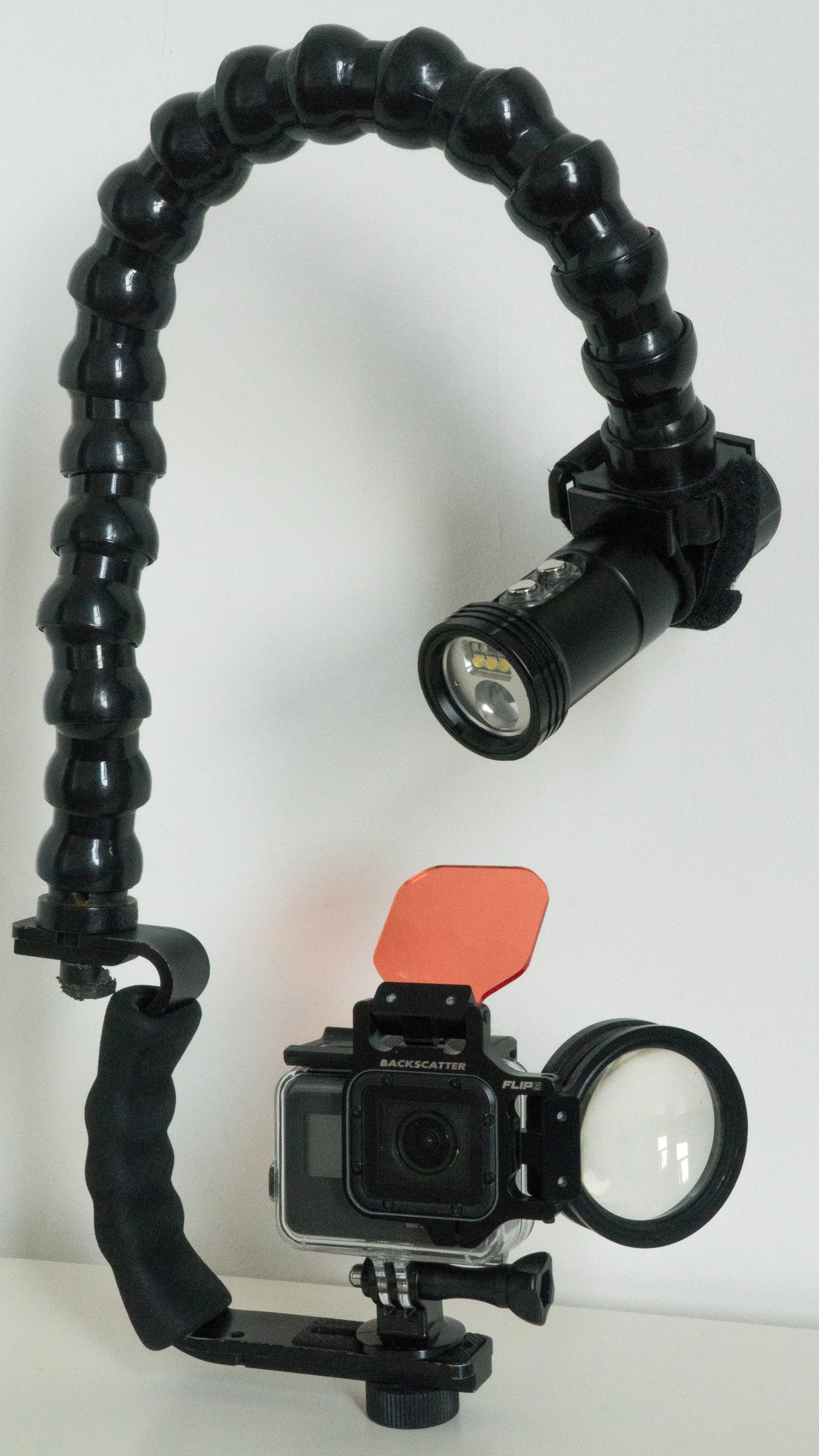
GoPro with Flip Adaptors and video light
Below are the features that truly make a difference once you submerge.
1️⃣ Depth Rating & Housing
Most action cameras are only waterproof for surface use or shallow snorkeling — typically 5–10 metres. That’s nowhere near enough for scuba diving, especially in places like Southeast Asia where dives regularly reach 18–30 metres.
To safely take your camera underwater, you need:
A dedicated housing rated to 30–60 m
Reliable O-rings that create a watertight seal
A secure locking mechanism that won’t pop open under pressure
Large, tactile buttons that work with gloves
Compatibility with trays, filters, and lights
Think of your housing as insurance. It protects both your footage and your investment. Even the best camera will fail if the housing fogs, leaks, or flexes under pressure.
2️⃣ Video Quality & Colour Performance
The underwater world is breathtaking — but cameras struggle to capture it without help. Water absorbs light differently than air:
Red goes first (loss starts around 5 metres)
Then orange
Then yellow
Contrast disappears
Everything shifts blue/green
To counter this, a great dive camera should offer:
4K (or higher) resolution for sharpness and cropping flexibility
Strong colour rendering or a dedicated underwater mode
High frame rates (60–120fps) for smooth motion and slow-motion shots
Good low-light handling to prevent grainy footage
Compatibility with red filters or video lights to restore natural colour
These features transform flat, washed-out footage into vibrant, cinematic scenes that actually match what your eyes see underwater.
3️⃣ Image Stabilization
Even the calmest dive includes movement:
gentle fin kicks
surge
drift currents
your own breathing
All of this creates shake.
High-quality stabilization is essential for underwater video. The best cameras use advanced algorithms to deliver:
horizon leveling
gimbal-like smoothness
reduced warping at the edges
Without stabilization, your footage will look chaotic, especially during drift dives or when filming fast-moving subjects like cuttlefish or trevallies.
4️⃣ Low-Light Capability
Underwater, it’s always low light — even at midday.
A great action camera needs to handle:
deeper reef sections
inside wrecks
caves and overhangs
cloudy conditions
early-morning and late-afternoon dives
Look for:
larger sensors
good dynamic range
clean noise performance
These qualities help preserve detail and colour where cheaper cameras simply produce grainy, muddy footage.
5️⃣ Accessory Support
As you grow as a diver and videographer, your camera should grow with you.
Look for systems that support:
video lights (the #1 upgrade for underwater footage)
colour filters
wide-angle or macro wet lenses
mounting trays for stability
dual-handle rigs for balanced shooting
A camera with strong accessory compatibility will take you from casual holiday footage to professional-level cinematics.
6️⃣ Ease of Use Underwater
Underwater photography is never just about the camera — it’s about staying safe while capturing the moment. Your device must be:
simple to operate with minimal menu-diving
equipped with large, easy-to-press buttons through the housing
visible even in bright tropical sun or low light
capable of switching modes quickly (photo → video → slow motion)
When buoyancy, depth, buddy communication, and environmental awareness all come first, your camera should support you — not distract you.
🎥 Top Action Cameras for Scuba Diving (2025 Guide)

Below are the top action cameras for scuba divers across all experience levels, budgets, and shooting styles. Each category reflects real-world underwater performance — not marketing claims — so you can choose a setup that truly works at depth.
🥇 1. Best All-Around Action Camera for Divers — DJI Osmo Action 5
The DJI Osmo Action 5 consistently stands out as the top all-purpose camera for scuba diving. It delivers the perfect balance of image quality, stabilization, ease of use, and low-light capability — all in a compact body ideal for travel and liveaboard diving.
Why It’s #1
Crisp 4K/5.3K video with excellent colour accuracy
Class-leading image stabilization — incredibly smooth during drifts
Rugged, compact build designed for active diving environments
Strong low-light performance, particularly on deeper reefs and dawn dives
Wide ecosystem of compatible housings, filters, trays, and underwater lights
Intuitive menus and buttons, easy to operate while managing buoyancy
Best for:
Reef dives, drift dives, liveaboards, travel divers, and anyone who wants a reliable underwater camera without fussing over complicated settings.
🥈 2. Best for Accessories & Broad Support — GoPro HERO Series
GoPro remains one of the most popular underwater cameras for a reason: it has a massive accessory ecosystem and decades of refinement behind its design. If you’ve used a GoPro before, you already know what to expect: consistency, reliability, and compatibility.
Why Choose GoPro
Huge range of housings, filters, trays, lights, and mounts
Proven stabilization and video quality
Reliable colour rendering with strong support for underwater filters
Widely recognized and supported around the world
Seamless travel camera for multi-sport use

Best for:
Divers who already own GoPro gear, those who want easy-to-find accessories, and anyone who values a familiar, well-supported camera system.
🌐 3. Best for Creative & 360° Footage — Insta360 Cameras
If you love creative underwater shots, diver perspectives, or cinematic vlogs, Insta360 is your best friend. Their dual-lens systems let you film in all directions at once, then reframe later — a massive benefit in the unpredictable underwater world.
Why Choose Insta360
360° capture eliminates the need to aim perfectly
Perfect for schools of fish, manta passes, wreck interiors, and diver POV
Excellent stabilization and motion smoothing
Powerful post-production tools for reframing and cinematic editing
Best for:
Travel vloggers, content creators, dive influencers, and divers who want flexible, immersive footage with minimal effort.
💸 4. Best Budget-Friendly Action Cameras — Akaso & Entry-Level Models
For divers who want underwater video without a large investment, Akaso and other budget action cams offer a surprisingly capable entry point.
What You Get
Basic 4K video (though not as sharp as premium brands)
Simple housings (always check depth ratings carefully!)
Decent quality for social media, casual travel, and holiday diving
Extremely affordable compared to major brands
Limitations
Weaker low-light performance
Less effective stabilization
Limited accessory compatibility
Best for:
Beginners, budget-minded divers, students, or anyone needing a lightweight, inexpensive backup camera.
🐠 5. Best Dedicated Underwater Camera — SeaLife Micro Series
SeaLife cameras are designed specifically for diving — not repurposed from land use. The result is a camera system perfect for divers who want simplicity, reliability, and strong underwater performance without needing to tinker.
Why SeaLife Works
Built exclusively for underwater shooting
No-flood design and extremely reliable housings
Excellent colour reproduction in tropical water
Wide-angle lenses calibrated for use underwater
Intuitive controls and seamless integration with video lights
Best for:
Reef photographers, macro enthusiasts, liveaboard divers, and anyone who prefers a “set it and forget it” underwater video solution.
🧳 6. Rugged Waterproof Compact Cameras — A Simple, Practical Alternative
While not as powerful as modern action cams, rugged waterproof compacts (from brands like Ricoh, Pentax, or Kodak) still meet the needs of casual divers and snorkelers.
Why You Might Choose One
Great for quick snapshots
No housing required for shallow use (but recommended for depth)
Very simple interface
Lightweight travel option
Not Ideal For
High-end video
Low-light environments
Fast-moving subjects
Best for:
Snorkelers, casual divers, non-video users, or those who simply want memories without investing heavily in gear.
PROS & CONS Of Each Camera
🥇 DJI Osmo Action 5 — Best All-Around Camera for Divers
The DJI Osmo Action 5 remains the top choice for most divers thanks to its combination of strong video quality, excellent stabilization, and rugged simplicity.
Pros
• Superb 4K or 5.3K video with accurate color
• Class-leading stabilization that handles surge and drift dives
• Compact, travel-friendly, and durable
• Better low-light performance than many action cameras
• Compatible with a wide range of housings, filters, trays, and video lights
Cons
• Higher cost than entry-level cameras
• Needs proper lighting or filters for best underwater color
Best for: Reef dives, drift dives, travel divers, and anyone wanting a reliable all-purpose underwater action cam.
🥈 GoPro HERO Series — Best for Accessory Support
GoPro remains one of the most popular underwater action cameras thanks to its enormous ecosystem and years of refinement.

Pros
• Huge accessory selection: housings, filters, mounts, trays, lights
• Excellent stabilization and video quality
• Great wide-angle look ideal for reef scenes
• Travel-friendly and recognized everywhere
Cons
• Cost increases once you add housing and lights
• Battery life may require spares on multi-dive days
Best for: Divers who already own GoPro gear or want maximum flexibility with accessories.
🌐 Insta360 — Best for Creative & 360° Footage
Insta360 shines for divers who want dynamic, reframable, cinematic footage.
Pros
• Captures 360°, so you never miss the action
• Perfect for mantas, schooling fish, swim-throughs, and POV shots
• Outstanding stabilization
• Flexible editing options after the dive
Cons
• Requires post-processing
• Larger file sizes and heavier editing workload
• Can get bulkier once placed in dive housings
Best for: Travel vloggers, social media creators, or divers who want creative, immersive underwater footage.
💸 Akaso & Budget Action Cameras — Best for New Divers
Great entry-level options for divers who are just starting to film underwater.
Pros
• Very affordable
• Lightweight and simple to use
• Basic 4K suitable for social media or casual footage
Cons
• Weaker stabilization
• Poor low-light performance
• Limited accessory support and inconsistent housing quality
Best for: Beginners, students, or divers who want a low-risk way to start recording underwater.

🐠 SeaLife Micro Series — Best Dedicated Underwater Camera
SeaLife builds cameras specifically for divers — simple, dependable, and optimized for underwater color.
Pros
• Flood-proof, sealed design
• Excellent color reproduction underwater
• Intuitive interface and buttons
• Works extremely well with underwater video lights
Cons
• Not ideal for land video
• Pricier than basic action cameras
Best for: Macro shooters, liveaboard divers, or anyone who wants a fuss-free dedicated underwater camera.
🧳 Rugged Waterproof Compact Cameras — Simple & Practical
Ideal for travelers who prefer snapshots over cinematic video.
Pros
• Simple to use
• Great for snorkelers or casual reef dives
• No housing needed for shallow depths (but recommended for deep diving)
Cons
• Not great for low light or fast movement
• Limited upgrade potential
Best for: Snorkelers, casual divers, or those who want a small backup camera.
🎯 Beginner-Friendly Recommendations
For total beginners or divers on a tight budget
💡 Choose a budget action camera (Akaso).
Affordable, easy to learn with, and good enough to develop basic video skills.
For snorkelers or shallow reef divers
💡 Choose a simple waterproof compact or budget action cam.
Perfect for casual footage without investing heavily.
For traveling divers who want reliable, excellent-quality results
💡 Choose the DJI Osmo Action 5.
Great stabilization, color, durability, and low-light performance.
For divers who already own mounts or want the biggest accessory ecosystem
💡 Choose the GoPro HERO series.
Endless customization options.
For vloggers, creators, and social media divers
💡 Choose Insta360.
Reframe footage afterward and never miss a shot.
For macro enthusiasts and serious underwater shooters
💡 Choose the SeaLife Micro series or a DJI with lights.
Ideal for reefs, critters, and reliable color reproduction.
For divers who want a lightweight backup
💡 Choose a budget action cam or waterproof compact.
Great for travel or as a secondary camera.

🔦 🔧 Pro Tips for Underwater Video Success
Getting amazing underwater video isn’t just about the camera you choose — it’s how you use it. These tips will help you get smoother, clearer, more colourful footage on every dive.
✔️ 1. Add a Video Light or Red Filter
Water strips out red, orange, and yellow tones quickly.
A light restores color at depth, while a red filter helps correct the blue/green cast.
✔️ 2. Get Close to Your Subject
Stay within 1–2 metres for the best clarity and color.
The further away you are, the more washed-out and hazy your footage will look.
✔️ 3. Slow Down and Control Your Buoyancy
Good buoyancy equals smooth footage.
Hover, move slowly, and avoid fin kicks that cause sudden camera shake.
✔️ 4. Use Two Hands or a Tray
A tray or dual-handle rig creates stability and reduces wobble in currents, surge, or drift dives.
✔️ 5. Shoot Upward When Possible
Angle your camera slightly upward toward blue water.
This adds contrast, highlights marine life, and creates more cinematic shots.
✔️ 6. Use Higher Frame Rates for Action
60fps or 120fps helps capture fast-moving fish, trevally hunts, or turtles cruising past.
✔️ 7. Practice Before Your Trip
Familiarity matters.
Learn how to switch modes, adjust settings, and operate the housing before reaching the dive site.
✔️ 8. Think in Short Clips
Shoot 5–10 second clips instead of long, continuous shots.
This gives you more variety and easier editing later.
✔️ 9. Keep Your Lens and Port Clean
Fogging or smudges ruin footage.
Use anti-fog inserts, keep O-rings clean, and check the lens before every entry.
✔️ 10. Enjoy the Dive
Some of the best moments happen when you’re relaxed and present.
Capture what you can — but experience the dive first.
💬 Final Thoughts
Underwater videography has never been more accessible, and today’s action cameras make it possible for divers of every experience level to bring home incredible memories. Whether you’re filming a manta ray gliding overhead, capturing the neon colours of a coral garden, or documenting macro critters hiding among the reef, the right camera setup turns every dive into a story you can relive again and again.
The best camera isn’t always the most expensive one — it’s the one that fits your style, your budget, and the type of diving you love. The DJI Osmo Action 5 excels as the all-round champion, GoPro offers unmatched accessory support, Insta360 delivers creative possibilities, SeaLife provides underwater-specific reliability, and budget cameras make underwater video accessible to everyone.
Most importantly, remember that great footage starts with great diving skills: buoyancy, awareness, and slowing down enough to let the ocean reveal its magic.
Choose a camera that inspires you, build a simple setup that works for your dives, and enjoy the process of capturing the underwater world — one clip at a time.