🌊 DEEP DIVE SERIES: Richelieu Rock — Thailand’s Iconic Purple Wonderland
Few dive sites in Southeast Asia command the same legendary status as Richelieu Rock. Rising dramatically from the deep Andaman Sea, this isolated horseshoe-shaped pinnacle sits far from any island or coastline, surrounded by nothing but blue. Approach it by boat and you’ll see… nothing. No land. No reef. No hint of what lies beneath. And then, the moment you descend, Richelieu Rock appears like a revelation.
A sudden explosion of life and colour materialises from the blue: soaring walls of purple and red soft corals, clouds of glassfish that shift like liquid silver, and dense schools of reef fish swirling in every direction. Every crack and crevice is alive — a macro lover’s dreamscape filled with harlequin shrimp, ghost pipefish, tiger tail seahorses, and the tiniest of critters hiding in the coral branches.
But Richelieu Rock isn’t just a macro site. It's a biological magnet. The pinnacle rises from deep water, pulling nutrients upward and attracting larger marine life. On any given dive, you might witness bigeye trevallies erupting into bait balls, cuttlefish performing mesmerizing colour displays, or — if the season is right — a whale shark gliding past the reef with effortless grace.
The pace here is electric yet hypnotic, chaotic yet perfectly balanced. It’s a place where the small and the spectacular collide, where divers are constantly torn between staring into the blue for pelagics or pressing their faces into the reef to find hidden treasures.
Richelieu Rock is widely regarded as Thailand’s best dive site, but to divers around the world, it’s more than that — it’s an underwater cathedral of colour, energy, and biodiversity. A site so rich and alive that even a single dive feels like several rolled into one.
Welcome to Thailand’s most iconic underwater masterpiece.
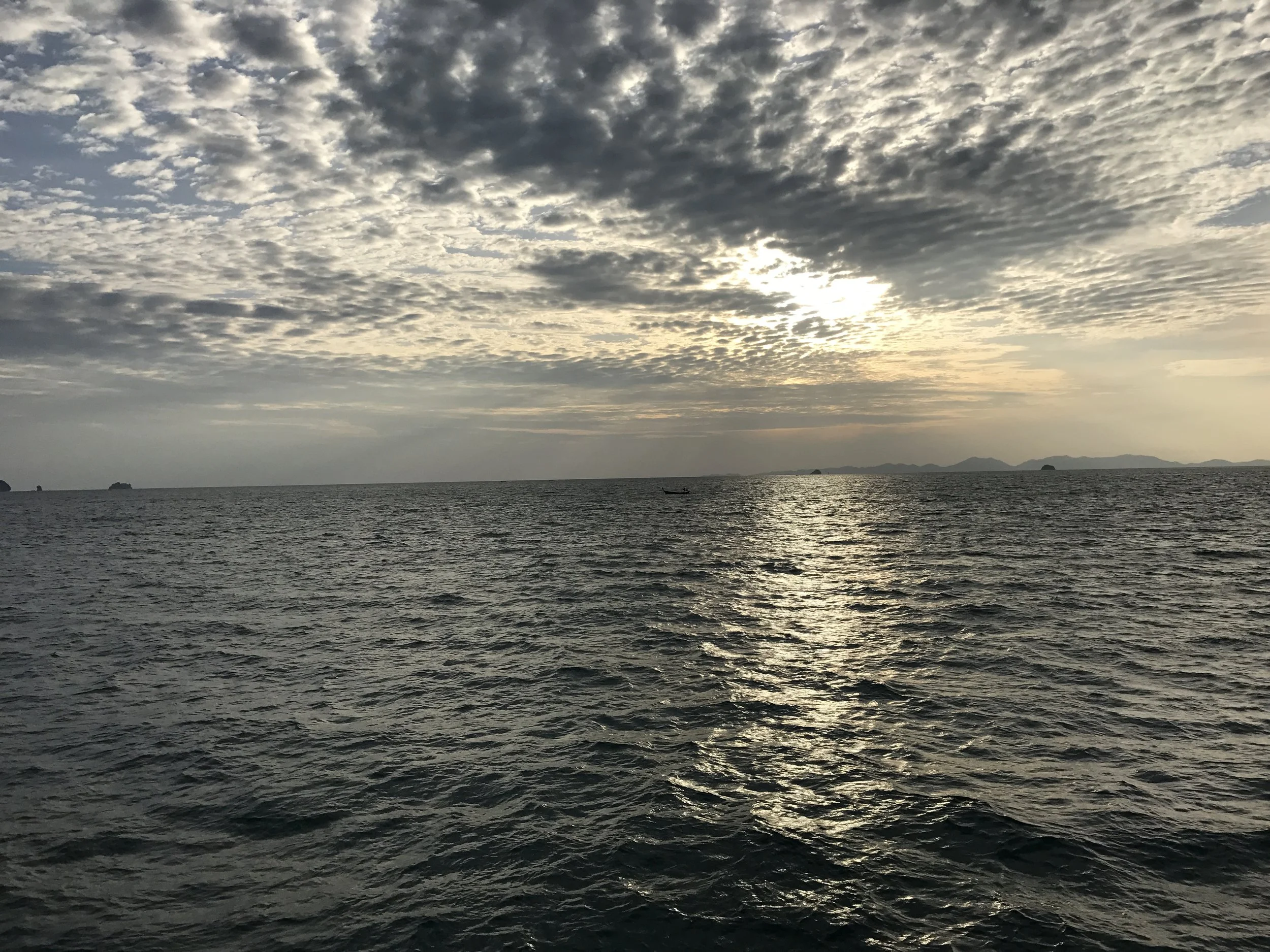
Richelieu Rock sits 60km off of the west coast of Thailand
📍 Where Is Richelieu Rock?
Richelieu Rock lies within the Surin Islands National Park, positioned roughly 60 km off the west coast of Thailand in the open Andaman Sea. Its remote location places it far from any island shelter, reef system, or coastline — a lone oasis of life rising from deep water. This isolation is exactly what makes it so extraordinary.
Because the pinnacle sits directly in the path of nutrient-rich ocean currents, it has two defining characteristics:
1️⃣ Exceptional Biodiversity
The constant flow of water delivers a steady stream of nutrients, allowing soft corals, sea fans, and sponges to flourish. This creates a habitat so vibrant that both macro critters and pelagic species are drawn to the site in staggering numbers.
2️⃣ Dynamic, Ever-Changing Conditions
Being fully exposed to the open sea means currents can switch direction quickly and vary dramatically from one side of the pinnacle to the other. These shifting conditions contribute to the site’s energy and its remarkable density of marine life, but they also demand awareness and good buoyancy control from divers.
🌊 A Pinnacle That Appears Out of Nowhere
At high tide, Richelieu Rock sits completely submerged. Boats hover over an empty patch of ocean, giving divers the surreal experience of a pure blue-water descent. As you drop through the water column, a faint purple shimmer gradually appears, sharpening into a fully formed cathedral of soft corals.
At low tide, the very tip of the rock breaks the surface — a rough, coral-encrusted sliver of stone that gives no indication of the thriving ecosystem beneath.
This dramatic reveal is one of the reasons Richelieu Rock feels so magical.
🚤 How to Get There
Almost all divers reach Richelieu Rock from the south, using well-established dive hubs:
• Liveaboards (most popular)
Departing from Khao Lak, these boats offer early-morning access, fewer crowds, and multiple dives at optimal times of day. Liveaboards are widely regarded as the best way to experience the site.
• Full-Day Speedboat Trips
Departing from Khao Lak or Ranong, these fast boats make Richelieu Rock accessible to divers who don’t have time for a liveaboard itinerary. The crossings can be choppy but are quick and efficient.
Regardless of how you arrive, surfacing from a dive at Richelieu Rock is unforgettable:
open ocean in every direction, nothing but blue, and the gentle rise and fall of the sea beneath your fins. It feels remote, untouched, and vividly alive — a true ocean wilderness.
🕰️ History & Why It’s Famous
Richelieu Rock’s story sits at the intersection of legend, exploration, and sheer underwater spectacle. Although local fishermen had known of the pinnacle for generations — often referring to it simply as “the purple rock” — it was the work of one man that brought it international fame: Jacques Cousteau.
🌍 Cousteau’s Influence
According to diving lore, Cousteau discovered the site in the 1980s while exploring the Andaman Sea aboard the Calypso. He was reportedly guided toward the area by fishermen who spoke of an unusual rock teeming with fish. When he descended and saw the spectacle below, Cousteau described it as one of the most vibrant and biodiverse pinnacles he had ever encountered.
Whether every detail of the tale is literal or part of dive folklore, one thing is certain:
Cousteau’s fascination put Richelieu Rock on the world map.
🔴 Where the Name Comes From
There are two commonly repeated explanations for the origin of its name:
1️⃣ The Cardinal Connection
Some believe the site was named after Cardinal Richelieu, the 17th-century French statesman, because the reef’s red and purple soft corals resemble the rich colours of his garments.
2️⃣ The Fishermen’s Description
Others say Cousteau heard local fishermen refer to the rock using a Thai phrase describing its red-violet colouration and loosely translated it into “Richelieu Rock.”
Whatever the truth, the name has stuck — and today it’s synonymous with world-class diving.
🐋 A Magnet for Life
Richelieu Rock quickly gained a reputation not just for its beauty but for its extraordinary biodiversity. It sits alone in deep water, which creates a perfect recipe for marine life:
Nutrient-rich currents bathe the pinnacle
Soft corals flourish
Small fish gather in massive schools
Predators patrol the edges
Macro creatures hide in every crevice
Pelagic visitors use the rock as a cleaning or feeding waypoint
This combination created an underwater ecosystem so vibrant that early dive pioneers declared it one of the best dive sites in the world.
🦈 The Whale Shark Era
In the 1990s and 2000s, Richelieu Rock gained particular fame as an epicenter for whale shark encounters in Thailand. Divers flocked from around the world for the chance to see these gentle giants circling the pinnacle during the February–April season.
While whale shark sightings now vary year to year, the possibility remains — and the thrill of scanning the blue for that unmistakable spotted silhouette adds electricity to every dive.
🌟 A Protected Underwater Jewel
Today, Richelieu Rock forms part of the Surin Islands National Park, and it benefits from regulated access, set seasons, and conservation efforts. These protections help preserve the soft corals, manage boat traffic, and maintain high ecological quality despite its popularity.
Its status as Thailand’s number one dive site has only solidified with time. Ask any diver who has been, and you’ll hear the same sentiment:
“It’s incredible. You have to see it at least once.”
🧭 Dive Overview
Richelieu Rock is a site that blends beauty with intensity — a colourful, coral-covered oasis rising from deep blue water, shaped by currents and constantly shifting conditions. Here’s what divers can expect when planning a dive at Thailand’s most iconic pinnacle.
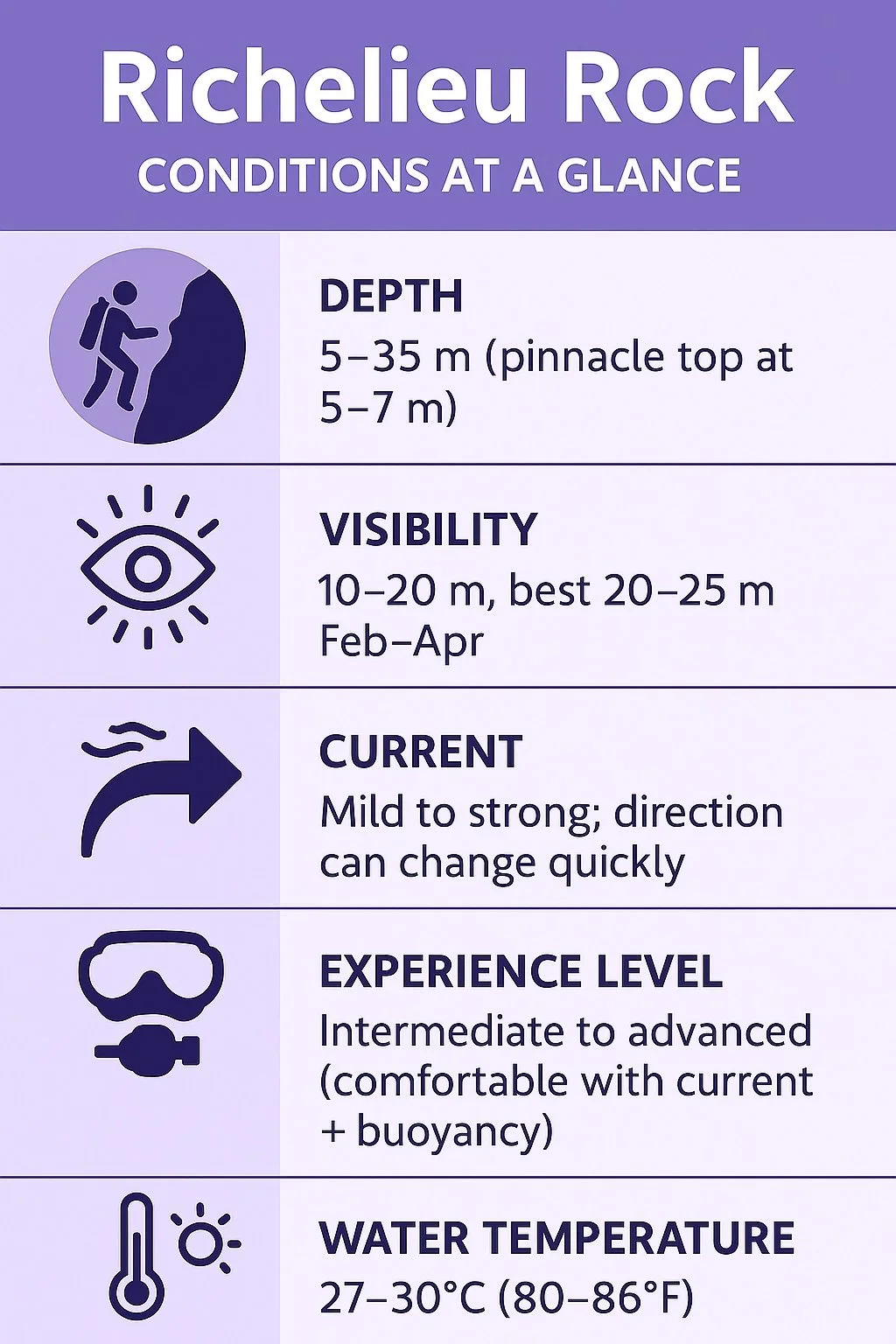
📏 Depth: 5–35 m
The top of the rock sits just below the surface at high tide, around 5–7 metres, making it ideal for safety stops surrounded by schooling fish and soft corals.
The deeper slopes descend to 28–35 metres, where you’ll find larger sea fans, hunting predators, and pockets rich with macro critters.
Beyond the rock, the seabed falls away dramatically — a reminder that this pinnacle rises from truly deep water.
👁 Visibility: 10–25 m
(Best February–April)
Visibility varies with tides, plankton levels, and surface conditions. During peak season (Feb–April), 20–25 metres is common, creating that dreamy purple-and-teal panorama Richelieu Rock is known for.
Even on a 10–15 m day, there’s so much life at close range that the site still feels spectacular.
🌊 Currents: Mild to Strong
(Direction can shift unexpectedly)
One of Richelieu Rock’s defining features is its ever-changing current patterns. You may experience:
gentle drifts across the outer wall
sudden pulses of current around the horseshoe’s curve
calm pockets in sheltered ledges
occasional surge near the shallow top
Experienced guides usually assess conditions during descent and adapt the route accordingly. Good buoyancy control makes the dive far more enjoyable.
🎒 Skill Level: Intermediate to Advanced
Richelieu Rock isn’t technically difficult, but it requires awareness:
blue-water descents
varying currents
depth changes
boat traffic at the surface
precious, delicate soft corals that must not be touched
Confident buoyancy, stable finning, and controlled descents are essential.
That said, experienced beginners with good guidance can still enjoy the site safely.
📅 Best Time to Dive: February – April
(Peak visibility + highest chance of whale sharks)
The site is open from November to April, but conditions truly shine during late season:
water clarity improves
currents settle into predictable patterns
plankton levels increase — drawing whale sharks
Liveaboards often time their itineraries around these optimal months.
🚤 Entry: Boat Only (Giant Stride)
All dives here start with a giant stride from a liveaboard or high-speed day-trip boat. Descents are typically done in the blue, using a buoy line or descending as a group.
Surface management is important due to:
boat traffic
swell
open-ocean conditions
A surface marker buoy (DSMB) is mandatory for safety.
🌐 Why Conditions Matter Here
More than almost any other Thai dive site, Richelieu Rock is defined by its conditions:
currents that speed up around the horseshoe
deep drop-offs just metres from the reef
nutrient-rich water that feeds an explosion of life
Understanding the site’s dynamics isn’t just interesting — it directly shapes:
your route
your bottom time
your safety stop
your photography strategy
your overall experience
Done right, it’s a smooth, exhilarating dive that feels like exploring a living, breathing underwater city.
🐠 Marine Life at Richelieu Rock
If you dive Richelieu Rock expecting to see “a bit of everything,” you won’t be disappointed. The site is astonishingly alive — an underwater crossroads where tiny macro wonders, vibrant reef species, and fast-moving pelagics all converge. Few places in Thailand offer such density, diversity, and drama in a single dive.
🌟 Macro Highlights
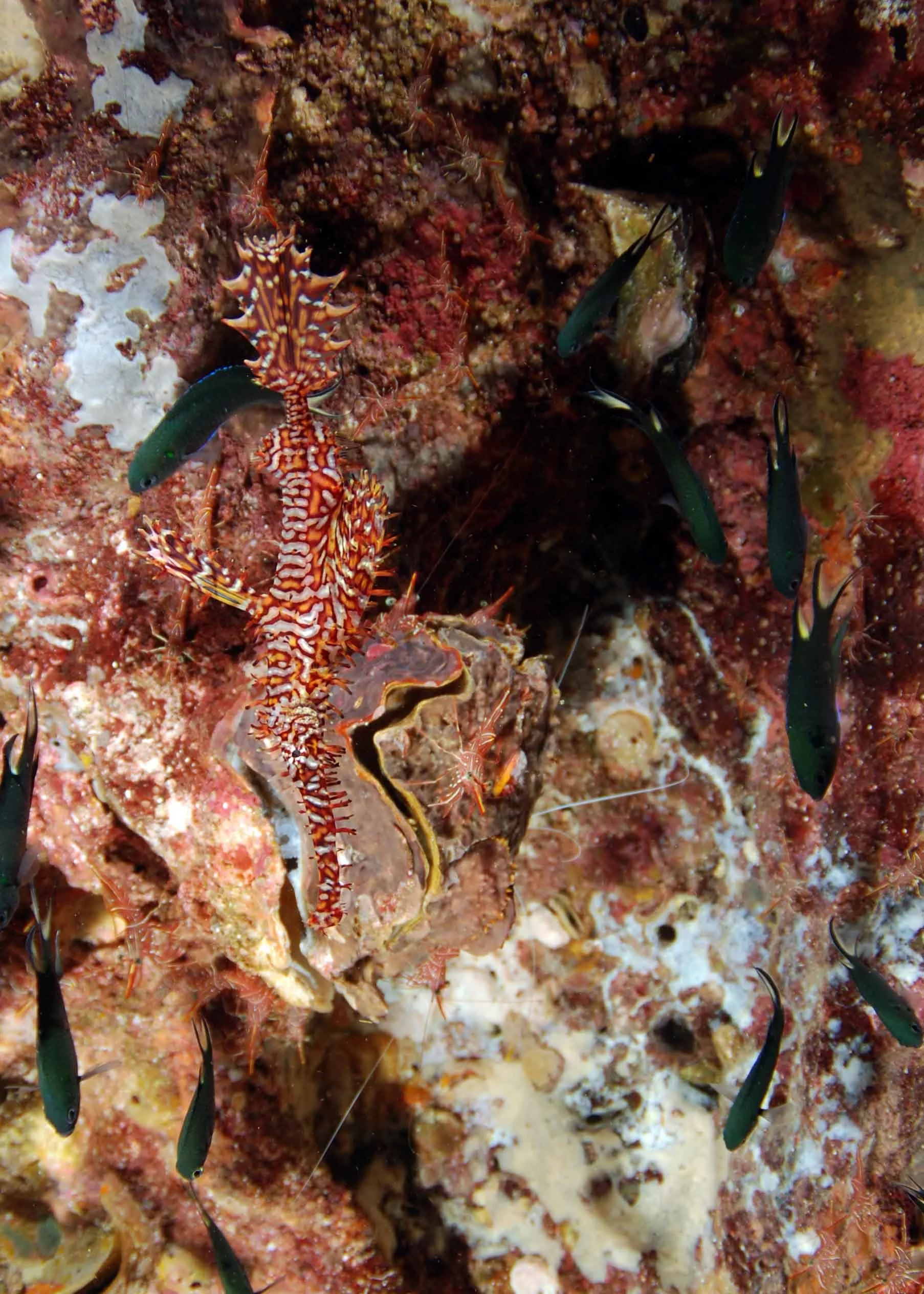
You can spot the ornate ghost pipefish at Richelieu Rock
For macro lovers, Richelieu Rock is nothing short of a dream. Every crack, crevice, and coral branch hides something extraordinary, and guides here are absolute experts in finding the tiniest treasures.
Expect to encounter:
Harlequin shrimp – often in pairs, their colourful, petal-like patterns dancing beneath overhangs
Ornate & robust ghost pipefish – drifting upside-down among soft corals or hovering near feather stars
Tiger tail seahorses – wrapped tightly around seafans, perfectly camouflaged in oranges, yellows, or deep browns
Hairy shrimp – smaller than a grain of rice, hiding in algae patches for those with trained eyes
Zebra morays – poking their striped heads from coral rubble
Frogfish – occasional but thrilling finds, motionless and perfectly disguised
Cuttlefish eggs – tucked safely into protected pockets, often guarded by attentive adults nearby
Macro diving here can feel like a treasure hunt — slow, methodical, incredibly rewarding.
If macro photography is your focus, stay close to your guide. They know every hiding place.
🌈 Reef Life: A Symphony of Colour & Movement
The moment you approach the pinnacle, colour fills your field of vision. Richelieu Rock’s soft corals — in purples, pinks, reds, and magentas — form one of the most spectacular underwater displays in Southeast Asia. The reef feels like a living tapestry, constantly shifting as fish weave in and out of the coral branches.
Expect:
Swirling glassfish clouds that part like silver fabric when predators approach
Lionfish hunting with slow, deliberate elegance
Schools of snapper and fusiliers moving in shimmering waves
Large cuttlefish, especially during mating season, flashing iridescent colours and patterns
Thriving anemone gardens, each home to bustling anemonefish families
The reef life here is rich, layered, and captivating. Even without a single pelagic sighting, Richelieu Rock feels like a complete, unforgettable dive.
🦈 Pelagics & Big Encounters
While the macro and reef life alone would make Richelieu Rock famous, its position in open water also attracts large pelagics, offering dramatic encounters when conditions align.
Potential highlights include:
Seasonal whale sharks (Feb–April)
These gentle giants sometimes circle the pinnacle, feeding and cruising effortlessly past mesmerized divers.Manta rays
Occasionally seen soaring along the outer edges of the rock.Great barracuda
Lone individuals or small groups often patrol the blue.Bigeye trevallies
These predators sweep through glassfish clouds, creating glittering, spiralling storms of silver.
When pelagics appear, the atmosphere of the dive shifts instantly — the blue water becomes a stage where size, speed, and grace take over. It’s the kind of moment you remember long after the dive ends.
🤿 The Diver Experience
A dive at Richelieu Rock begins long before you reach the reef. As you roll in for a free descent, the world goes silent except for the bubbles rising past your ears. There is no reef below you, no hint of the rock’s location — only an endless expanse of deep blue. It’s one of the most surreal and thrilling descents in Thailand.
Then, around 10–12 metres, something starts to take shape.
A faint blur.
A shift in colour tone.
A suggestion of structure.
Within seconds, the pinnacle materialises into view: a towering wall of purple soft corals, whipped gently by the current, bursting with life. It’s a transition that never gets old — one moment nothing, the next a spectacular underwater metropolis.
🐟 Following the Horseshoe
Most dives follow the natural curve of Richelieu Rock’s horseshoe-shaped structure, each section offering its own unique rhythm and visuals.
🌊 The Outer Walls
The outer edge drops steeply into deeper water, making it the best place to scan the blue for trevallies, barracuda, mantas,or even whale sharks.
Here, the current often runs faster, bringing in nutrients and pelagic hunters.
🐠 The Inner Bowl
Tucked into the inside curve of the horseshoe is a calmer microcosm:
swarming baitfish
thick soft coral growth
countless macro hiding spots
This is where guides point out ghost pipefish, seahorses, harlequin shrimp, and other tiny wonders.
🌸 The Pinnacle Top (5–8 m)
The shallow crown of the reef is a dream for safety stops — soft corals swaying, schools of fish swirling — but it can come with strong surge. Holding position here feels like riding the breath of the ocean itself.
🌬 What to Expect Underwater
💨 Changing Currents
Richelieu Rock is famous for its dynamic water movement. You may drift effortlessly along one side, then turn a corner and slip into a sudden pocket of calm.
🛏 Surge Near the Surface
The top of the rock can behave like a giant underwater bell — rising and falling with the swell above. It’s exhilarating, but requires mindfulness.
🐟 Biomass Like Nowhere Else in Thailand
There are moments when the fish density becomes so thick that:
your field of vision narrows
the reef disappears behind clouds of glassfish
predators explode suddenly into bait balls
the entire scene feels like a single organism in motion
It’s the kind of sensory overload divers dream about.
📸 Busy Photography Traffic
During peak season, photographers flock to Richelieu Rock. Expect strobes firing, divers hovering carefully over macro subjects, and occasional “traffic jams” around popular critter hideouts.
Respect, patience, and good positioning make all the difference here.
🌟 A Dive You Feel as Much as You See
Experiencing Richelieu Rock often feels like juggling three realities at once:
the macro world of tiny, intricate creatures
the reef world of colour, texture, and movement
the blue world of pelagic surprises
It’s a site where you genuinely wish you had three sets of eyes — one for each.
Every diver who surfaces from Richelieu Rock surfaces slightly changed: awed, buzzing with energy, and wondering how so much life can exist on a single isolated rock in the middle of the sea.
📸 Photography Tips for Richelieu Rock
Richelieu Rock is one of those rare dive sites where every metre offers a photo opportunity. Whether you love wide-angle scenes bursting with colour or the tiniest macro details, this pinnacle delivers both extremes — often on the same dive.
Because conditions can shift quickly and subjects are abundant, having a plan (and good buoyancy!) will help you make the most of every frame.
🔍 For Macro Photographers
Macro lovers could spend an entire dive within a 5-metre radius here. Rich coral growth and countless crevices create perfect hideouts for miniature subjects.
Recommended Gear
60 mm or 105 mm macro lens
Focus light
Optional snoot for artistic lighting
Where to Look
Under ledges for harlequin shrimp
Along sea fans for tiger tail seahorses
Among soft corals for ghost pipefish (especially ornate & robust)
On algae patches for hairy shrimp
In rubble or sponges for zebra morays or frogfish
Tips for Success
Move slowly and hover low — sudden fin kicks scatter silt and fish.
Let your guide lead — their critter-spotting skills here are legendary.
Use controlled, precise lighting to avoid blowing out delicate textures.
Shoot from eye level when photographing seahorses or pipefish for a more natural, intimate composition.
Macro photography at Richelieu Rock is a game of patience. Slow down, breathe, and let the reef reveal its secrets.
🌅 For Wide-Angle Photographers
Richelieu Rock is famous for its Purple Cathedral look — soft corals in vivid reds, pinks, and violets covering the walls. Pair this with swirling fish schools and you have endless wide-angle possibilities.
Recommended Gear
Fisheye or wide-angle lens
Dual strobes for lighting large scenes
Dome port for full reef coverage
What to Shoot
Purple soft corals with a diver silhouette
Glassfish tornadoes exploding across the reef
Cuttlefish changing colour dramatically
Trevally hunts in low light
The pinnacle emerging from the blue during descent
Tips for Success
Stay down-current of the coral walls to avoid kicking up sediment.
Shoot upward to isolate coral branches against blue water.
Use strobes sparingly for soft corals — too much light can flatten colour.
Watch for fleeting pelagic moments — keep half an eye on the blue.
Wide-angle at Richelieu Rock can feel like shooting in a cathedral of colour. Capture the scale and the vibrancy without rushing.
🎥 Video Tips
Richelieu Rock is incredibly cinematic — and incredibly busy.
For smooth footage:
Stabilize your body before stabilizing your camera.
Begin recording before approaching a subject to avoid start-up wobble.
Use slow, deliberate movements for panning shots.
Let trevally or bait balls come to you — chasing equals shaky footage.
Best moments to film
Cuttlefish interactions
Predator–prey behaviour around glassfish schools
Safety stop scenes atop the pinnacle surrounded by anthias
Blue-water approaches to the reef
⚠️ Photography Etiquette Matters Here
Richelieu Rock is dense with life — and dense with photographers.
Keep low and maintain neutral buoyancy.
Avoid resting on coral or touching the reef.
Take turns on popular subjects like harlequin shrimp.
Communicate clearly with other photographers to avoid fin-in-frame frustration.
Good etiquette ensures the reef stays healthy and you come home with better shots.
⚠️ Safety Notes
Richelieu Rock is one of Thailand’s most rewarding dive sites — but also one of its most dynamic. To fully enjoy the experience, divers should approach the site with good awareness, solid buoyancy skills, and respect for the ever-changing conditions.
🌊 1. Expect Changing Currents
The exposed location means currents can shift quickly:
One side of the pinnacle may be calm while another is fast-moving.
Currents may increase mid-dive, especially around corners of the horseshoe.
Descending and ascending in the blue requires confidence and team awareness.
Always follow your guide’s route — they adjust in real time based on the flow.
📉 2. Watch Your Depth
At Richelieu Rock, the reef structure drops steeply into deep water:
The walls descend quickly to 30–35 m.
Just a few fin kicks away from the reef, depth can increase sharply.
Maintain situational awareness, especially during photography or when focusing on macro subjects near ledges.
🎈 3. Use a DSMB (Surface Marker Buoy)
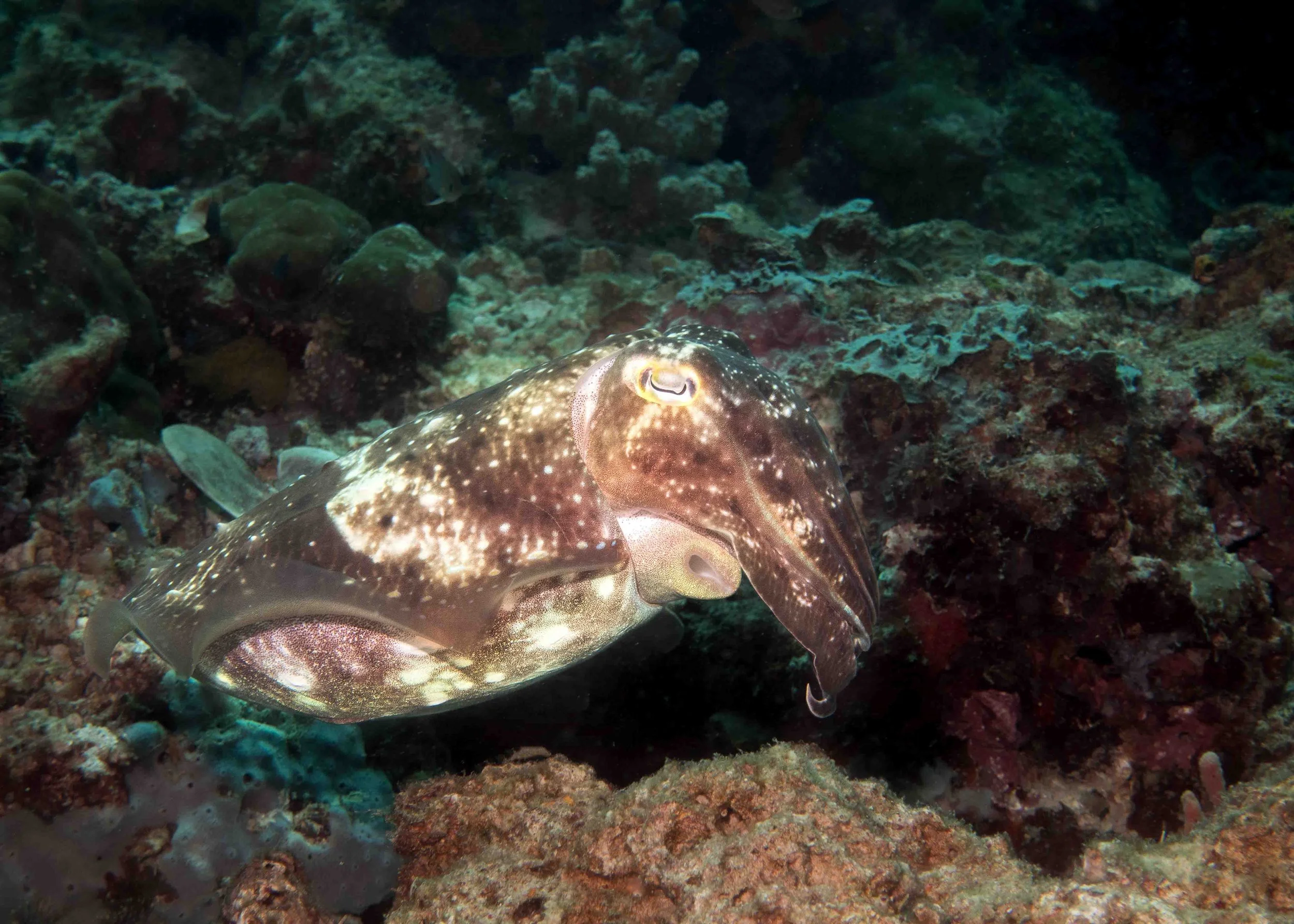
Cuttlefish are a common sighting at Richelieu Rock
This is mandatory at Richelieu Rock:
You’ll ascend in open water with boats nearby.
Conditions can include chop, swell, or reduced visibility.
A DSMB ensures boat crews see you long before you reach the surface.
🌬 4. Prepare for Surge in the Shallows
The top of the pinnacle (5–8 m) is spectacular for safety stops but can experience:
strong surge
oscillating movement
difficulty holding position
Stay neutrally buoyant and avoid grabbing coral for stability.
🔋 5. Monitor Air and NDL Closely
Because the site is captivating and conditions can require effort:
NDL can drop quickly at deeper sections
Air consumption may increase when swimming against current
Stunning macro finds often distract divers for long stretches
Check gauges frequently and communicate with your buddy.
🪸 6. Protect the Reef
Richelieu Rock’s soft corals are extraordinarily delicate. Even a light brush of a fin can cause long-term damage.
Best practices:
Maintain perfect buoyancy around soft corals and sea fans
Avoid pushing off the reef
Keep gear streamlined to prevent accidental contact
Photography traffic is high here — model impeccable reef etiquette.
🧭 7. Experience Level Matters
Beginners can dive Richelieu Rock with excellent supervision, but:
Confident buoyancy
Controlled descents
Good finning technique
Comfort in blue-water conditions
…are all strongly recommended.
The site rewards skill with a safer, calmer, and more immersive experience.
📅 Best Time of Year
Richelieu Rock is open to divers only during the Andaman Sea dry season, which runs from November to April. Each part of the season offers something slightly different, but the site’s conditions truly shine during late dry season.
🌤 November – January: Clear Water & Consistent Conditions
The national park reopens
Seas are calmer
Visibility is improving (12–20 m typical)
Currents are generally manageable
This is a great time for reef life, macro creatures, and comfortable diving.
🌞 February – April: Peak Visibility & Whale Shark Season
This is the best time of year to dive Richelieu Rock.
Expect:
Visibility up to 20–25 m
Increased biomass as plankton rises
Higher chance of whale shark encounters
Predictable currents
Warm water and calm seas
It’s also high season for liveaboards — early booking is essential.
❌ May – October: Closed Season
Richelieu Rock lies within the Surin Islands National Park, which closes during the monsoon period due to:
strong winds
rough sea conditions
low visibility
conservation efforts
The closure protects both marine life and diver safety.
⭐ The Bottom Line
If you want the absolute best combination of:
blue water
active marine life
stable conditions
photographic opportunity
chance of whale sharks
…then February to April is the golden window.
📊 Conditions at a Glance
Perfect for your infographic:
Depth: 5–35 m
Visibility: 10–25 m
Current: Mild to strong, occasionally swirling
Experience Level: Intermediate–Advanced
Entry: Giant stride from boat
Best Time: February–April
💬 Final Thoughts
Richelieu Rock is the kind of dive site that imprints itself on you — the kind you think about long after you’ve rinsed your gear and hung your wetsuit to dry. It’s not just a pinnacle rising from deep water; it’s a living, breathing ecosystem, packed with colour, movement, and marine life so dense it feels almost unreal.
Every dive here feels different.
Some days, the current sweeps you effortlessly along walls of purple soft corals.
Other days, the water hangs still and clear, allowing you to linger over the smallest of macro treasures.
And sometimes — when conditions align — the blue around you comes alive with trevallies, barracuda, or even a whale shark cruising past with quiet, majestic simplicity.
What makes Richelieu Rock special isn’t just the variety of life, but the intensity of it. The way macro photographers can spend an entire dive focused on a 2-metre patch of reef. The way pelagic hunters erupt into bait balls without warning. The way soft corals sway like underwater gardens in slow, rhythmic movement. The way the pinnacle emerges from the deep during descent like a secret revealed.
It’s a place where patience is rewarded, awareness is essential, and wonder is guaranteed.
Whether you arrive by liveaboard at sunrise or by speedboat on a bright afternoon, Richelieu Rock offers a diving experience that feels both wild and intimate — a reminder of how vibrant, powerful, and fragile the ocean can be.
Dive it slowly.
Dive it mindfully.
Dive it with respect.
And let this legendary purple pinnacle show you why it remains one of the most unforgettable dive sites in all of Southeast Asia.
❓ FAQ
Can beginners dive Richelieu Rock?
Technically yes — but it’s recommended for intermediate to advanced divers.
The site involves blue-water descents, changing currents, and delicate coral formations. Newer divers can participate safely with:
a skilled guide
good buoyancy control
comfort in open-ocean conditions
If you're freshly certified, gain a little more experience first before tackling this site.
Do I need nitrox to dive Richelieu Rock?
You can dive it on air, but nitrox is strongly recommended.
Reasons:
Extends your bottom time at 18–30 m
Helps keep NDLs comfortable on repetitive dives
Reduces nitrogen loading on busy liveaboard days
Just remember to monitor your MOD and oxygen exposure.
Is Richelieu Rock crowded?
During peak season (Feb–April), yes — it’s one of Thailand’s most famous dive sites. The best ways to minimise crowds:
join a liveaboard for early-morning access
dive during shoulder season (Nov–Jan)
stay close to your guide, who will navigate the quieter pockets
Despite the crowds, there’s so much to see that the experience still feels rich and unspoiled.
What are the currents like?
Variable.
Currents can be:
mild and gentle
strong and directional
swirling around corners
calm inside the horseshoe
Expect change — and dive your plan accordingly. Always listen to your guide during briefings.
Will I see whale sharks?
Richelieu Rock is one of Thailand’s best places for whale sharks, especially from February to April.
But sightings are never guaranteed. Even without whale sharks, the reef life is so vibrant that divers rank it among Asia’s top pinnacles regardless.
What’s the best way to get there — liveaboard or day trip?
Both options work:
Liveaboard:
Earlier access → fewer crowds
Relaxed surface intervals
Multiple dives per day
Best for photographers and experienced divers
Day trip:
Great for travellers short on time
Fast speedboats from Khao Lak or Ranong
Usually 2–3 dives at the site
If you want the best experience, liveaboards win — but day trips still offer spectacular dives.
Is surge really an issue at the top?
Sometimes, yes.
The 5–8 m zone can experience noticeable back-and-forth motion during certain tides or surface swell. It’s manageable with decent buoyancy but tricky for new photographers trying to frame macro subjects during safety stops.
How deep is the site?
The top sits around 5–7 m, making safety stops scenic and easy.
The lower slopes extend to 28–35 m.
Just beyond the reef, the seabed drops into even deeper water — so watch your depth and stay connected to the structure.
What’s the water temperature?
Generally 27–30°C (80–86°F) during the open season.
A 3 mm wetsuit or even a shorty is fine for most divers.
Is Richelieu Rock suitable for macro photographers?
Absolutely — it’s one of the best macro sites in Thailand. You can expect:
ghost pipefish
seahorses
harlequin shrimp
hairy shrimp
zebra morays
rare nudibranchs
Some photographers spend entire dives without moving more than a few metres.