You can be staring directly at a pygmy seahorse while scuba diving—and still not see it.
That’s part of the magic.
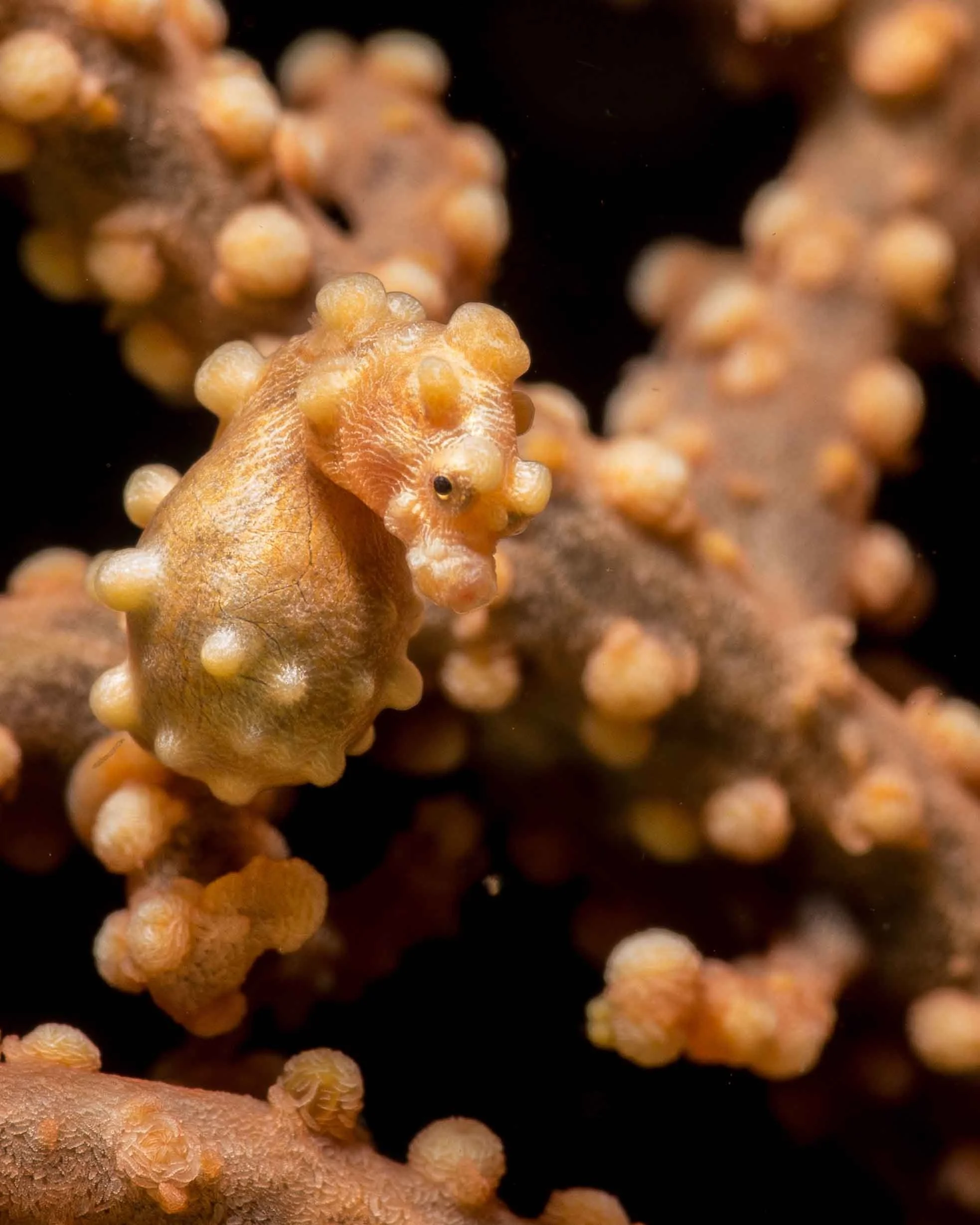
A Pregnant Barbiganti Pygmy Seahorse seen in Anilao, Philippines
At first glance, it looks like nothing more than a piece of coral—a sea fan swaying gently in the current, just another detail in an already busy reef. Your guide pauses, points, and you move closer, scanning the surface. For a moment, there’s nothing there. And then, almost all at once, it appears: a tiny eye, a curled tail, a perfectly camouflaged body that had been in front of you the entire time.
In that instant, the reef changes.
Pygmy seahorses aren’t just another species to spot—they’re a completely different kind of diving experience. They shift your focus away from the obvious and onto the subtle. Instead of scanning for movement and large shapes, you start noticing texture, pattern, and the smallest inconsistencies in the reef. It’s a transition from wide-angle diving to macro awareness, and once it happens, it’s hard to go back.
For many divers, especially in places like Raja Ampat or Anilao, seeing a pygmy seahorse for the first time is a turning point. You begin to realize how much you’ve been missing—how entire ecosystems exist on a scale so small they’ve been invisible to you all along. Without a trained eye or a knowledgeable guide, you could swim past them on every dive and never know they were there.
That’s what makes pygmy seahorses so compelling. It’s not just their size or their camouflage, but the way they quietly change how you see the underwater world. Once you’ve found one, you don’t just add it to your list—you start diving differently.
Before you can start spotting them, though, it helps to understand what you’re actually looking for. Because despite how often they’re talked about in diving circles, pygmy seahorses remain one of the least understood—and most specialized—creatures on the reef.
🐠 What Is a Pygmy Seahorse?
Pygmy seahorses are among the smallest vertebrates in the ocean, and easily one of the most remarkable.
Most species grow to less than 2 cm (about the size of your fingernail), with some even smaller. But what they lack in size, they more than make up for in specialization. These tiny seahorses are perfectly adapted to blend into their surroundings, evolving alongside specific host corals in a way that makes them almost impossible to distinguish at first glance.
Their bodies don’t just match the color of the coral—they replicate its texture and structure. The small bumps and nodules on their skin mimic the polyps of gorgonian sea fans so precisely that even experienced divers can struggle to pick them out without help. It’s camouflage taken to an extreme.
Pygmy seahorses were only discovered relatively recently, in the late 1960s, when scientists examining a gorgonian sea fan in a lab noticed tiny seahorses clinging to it—creatures that had gone completely unnoticed in the wild. Since then, multiple species have been identified across the Indo-Pacific, each closely associated with a specific type of coral host.
What makes them even more fascinating is how tied they are to that environment. Many pygmy seahorses spend their entire lives on a single sea fan, rarely moving more than a few centimeters. In some cases, removing them from that host coral can be fatal—they are that finely adapted to their surroundings.
So while they may look like miniature versions of the seahorses you already know, pygmy seahorses are something else entirely: a species shaped by extreme specialization, hidden in plain sight on reefs you’ve probably already dived.
🔬 How Pygmy Seahorses Were Discovered
For something so iconic in the diving world today, pygmy seahorses were discovered surprisingly late—and almost by accident.
In the late 1960s, scientists studying gorgonian sea fans collected specimens for laboratory analysis. When one of these sea fans was brought back and examined more closely, researchers noticed something unusual: tiny seahorses clinging to the branches, perfectly matched in color and texture.
Until that moment, they had gone completely unnoticed in the wild.
The species was later formally described as Hippocampus bargibanti, named after Georges Bargibant, a researcher who first observed them while working in New Caledonia. What made the discovery so remarkable wasn’t just their size, but the realization that these animals had likely been hiding in plain sight on reefs for decades—missed by divers and scientists alike.
What followed was a shift in how marine researchers—and eventually divers—looked at coral reefs.
Once scientists knew what to look for, more species began to emerge across the Indo-Pacific. Each one showed the same incredible pattern: a close relationship with a specific host coral, and camouflage so precise it bordered on invisible.
Even today, new pygmy seahorse species are still being identified, a reminder of just how much of the ocean remains unexplored—especially at the smallest scales.
It also explains why spotting one feels so different.
You’re not just seeing a rare animal—you’re seeing something that, for most of human history, we didn’t even know existed.
🎨 Why They’re So Hard to Spot
Pygmy seahorses are masters of camouflage—but that description almost undersells just how effective it really is.
They don’t just blend into their surroundings in a general sense. Their bodies are specifically adapted to match a single type of host coral, often down to the exact shade, texture, and even the tiny polyp structures on the surface of a gorgonian sea fan. The small bumps on their skin mirror the coral’s polyps so closely that what you’re looking at isn’t contrast—it’s near-perfect visual duplication.
From a diver’s perspective, that creates a unique challenge.
Your eyes are naturally drawn to movement, contrast, and recognizable shapes. Pygmy seahorses offer none of those. They remain almost completely still, gripping the coral with a curled tail, and their outline breaks up so effectively that there’s nothing obvious to “lock onto.” Instead of standing out, they disappear into the pattern of the reef.
Even when you’re staring directly at one, your brain often filters it out.
That’s why spotting a pygmy seahorse is less about eyesight and more about perception.
Until you’ve seen one, you don’t really know what you’re looking for. A sea fan is just a sea fan. But once a guide points it out—once you’ve traced the shape, found the eye, followed the curve of the body—something clicks. The next time you look at a similar coral, you start scanning differently. More slowly. More deliberately.
And suddenly, what once looked empty starts to reveal detail.
It’s also why most divers see their first pygmy seahorse thanks to a skilled guide. These guides often know the exact coral colonies where individuals live, sometimes returning to the same sea fan dive after dive. Without that local knowledge, the chances of finding one on your own are surprisingly low—even in places where they’re relatively common.
But once you’ve seen one, it changes things.
You begin to recognize the habitat. The patterns. The subtle inconsistencies. And while they never become “easy” to find, it does start to feel like they’re everywhere—hidden in plain sight, waiting for you to slow down enough to notice.
That shift in perception is what makes the difference.
Once you understand why pygmy seahorses are so difficult to see, the next step is learning how to actually spot one for yourself—because at that point, it becomes less about luck and more about knowing where and how to look.
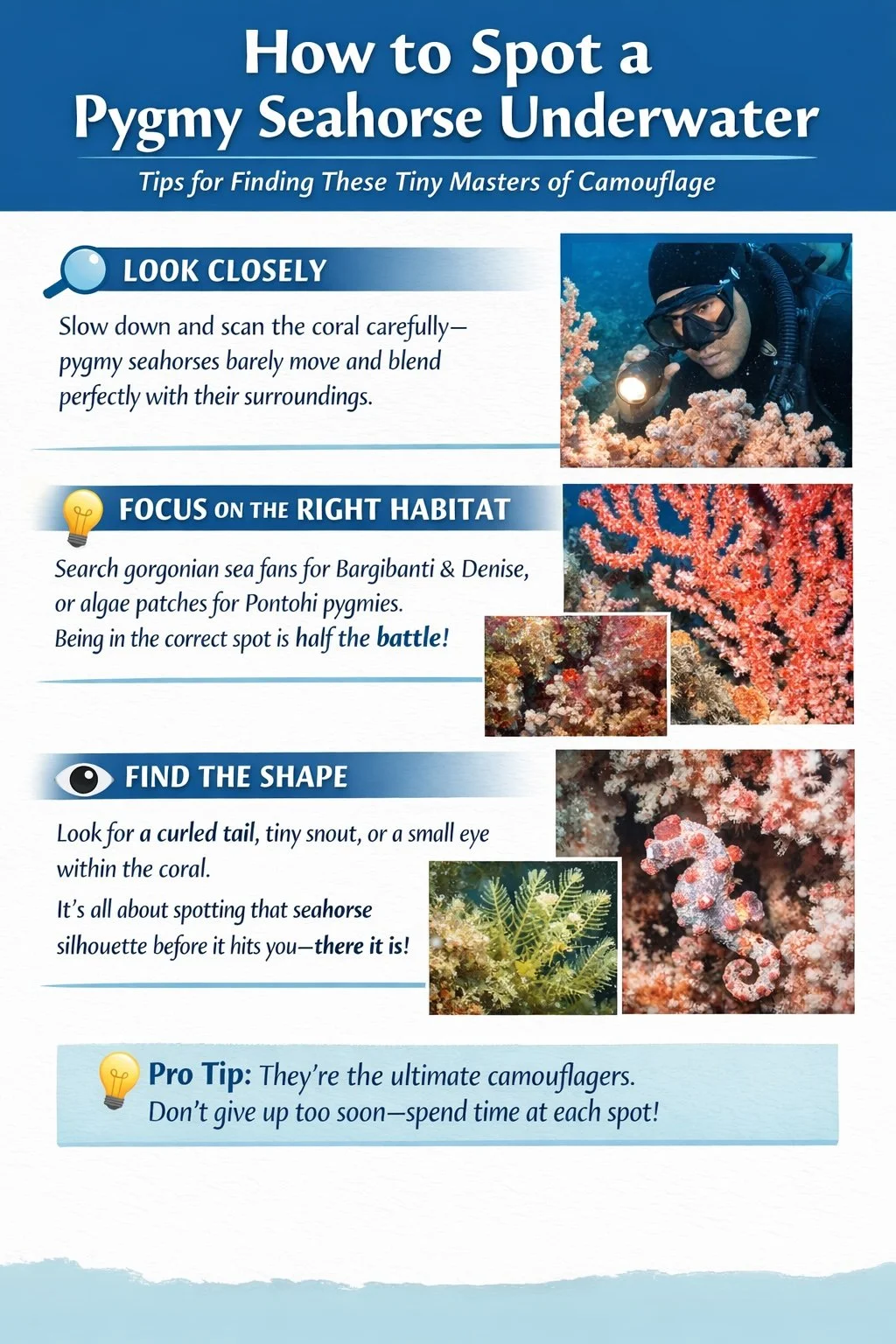
🔍 What Your Eye Should Look For
Once you understand why pygmy seahorses are so difficult to see, the next step is learning how to actually spot one for yourself—because at that point, it becomes less about luck and more about knowing how to look.
When you’re scanning a sea fan, don’t search for a “seahorse” shape right away.
Instead, focus on small inconsistencies in the pattern of the coral.
Look for subtle details like a tiny eye that appears more defined than the surrounding texture, a slight break in the otherwise uniform pattern of polyps, or the faint curve of a curled tail gripping the fan. Sometimes it’s not even a clear shape—just something that feels slightly “off” compared to everything around it.
That’s your cue to slow down and look closer.
At first, these details are incredibly easy to miss. Your brain isn’t used to processing information at that scale, and everything blends into a single texture. But once you’ve seen one clearly—once you’ve followed the outline and understood what you’re actually looking at—it becomes much easier to recognize those same cues again.
💡 Pro tip:
After your guide points out a pygmy seahorse, don’t immediately move on. Look away, reset your eyes, and then try to find it again yourself. That simple exercise is one of the fastest ways to train your vision—and it’s what turns that first lucky sighting into a repeatable skill.
🌍 Where to Find Pygmy Seahorses
Pygmy seahorses are found across the Indo-Pacific, particularly in the biodiversity hotspots of Southeast Asia.
But knowing where they exist isn’t quite the same as knowing where you’re likely to see one.
They’re highly dependent on specific host corals, and even in the right regions, sightings often come down to local knowledge, patient guides, and a bit of luck. Some destinations, however, consistently stand out—not just for their biodiversity, but for how reliably divers encounter pygmy seahorses.
🇮🇩 Raja Ampat (Indonesia)
One of the best places in the world to find pygmy seahorses—and somewhere I’ve seen them multiple times.
With its incredible biodiversity and abundance of gorgonian sea fans, Raja Ampat offers ideal habitat, especially on current-swept reef slopes. On dives here, it’s not uncommon for guides to know specific sea fans where individuals live, often tucked away just a little deeper than the main action.
Even then, they’re easy to miss unless you know exactly what you’re looking for.
🇵🇭 Anilao (Philippines)
A macro photography haven, and one of the most reliable places to see pygmy seahorses.
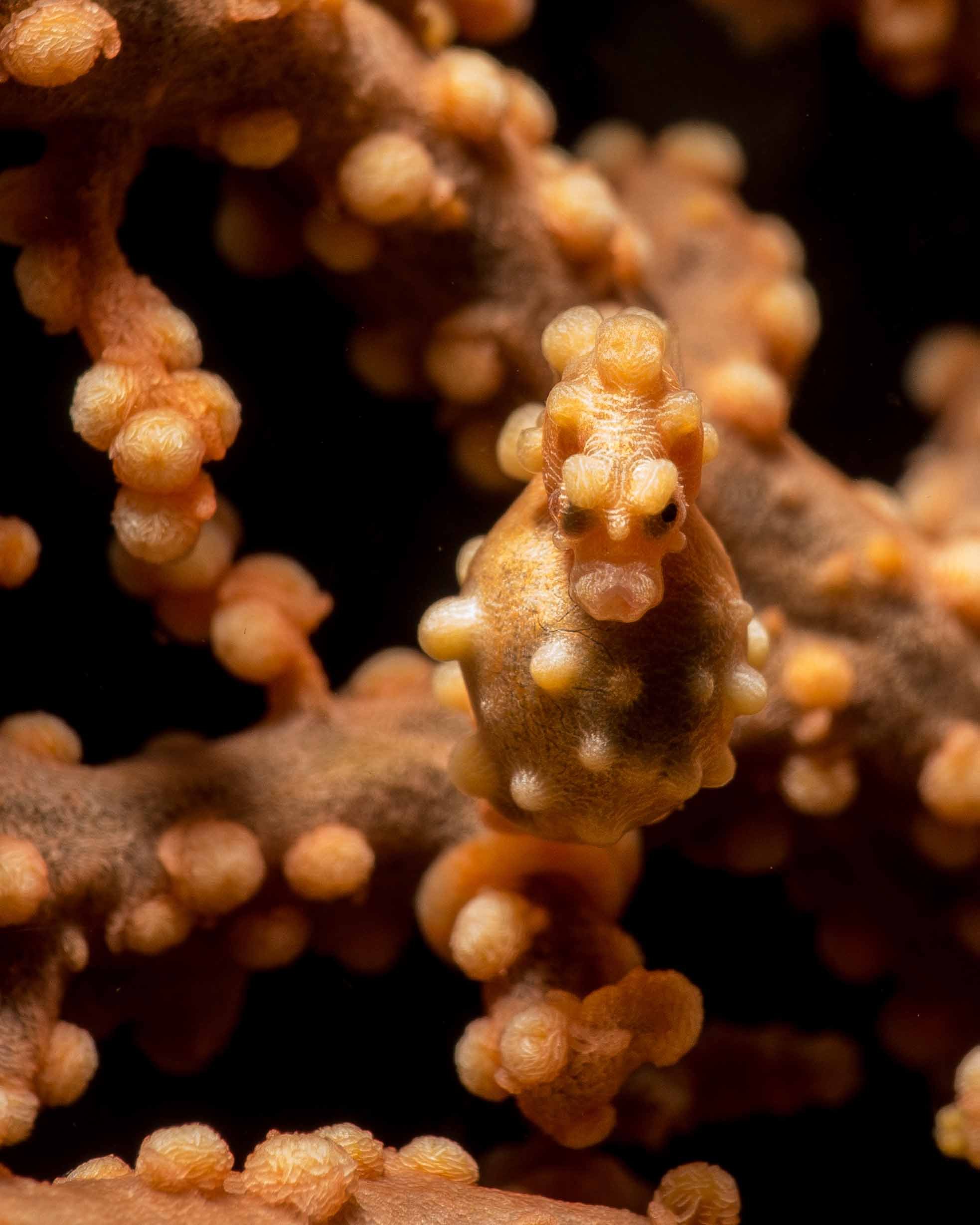
I’ve seen them here as well, and what stands out most is the consistency. Dive guides in Anilao are incredibly skilled at locating them, often returning to the same individuals on specific sea fans. Combined with relatively accessible dive sites and a strong focus on macro diving, it’s one of the easiest places in the world to get a proper look—and a good photo.
🇮🇩 Lembeh Strait (Indonesia)
Best known for muck diving, Lembeh might not be the first place that comes to mind for pygmy seahorses—but they are there.
In addition to its famous sandy slopes and critters, Lembeh also has reef sections where pygmy species can be found, particularly if you’re diving with a guide who knows where to look.
🇲🇾Mabul Island (Malaysia)
A lesser-known—but once reliable—location for pygmy seahorses.
I’ve personally seen them here on multiple trips (2017 and 2019), typically on deeper sea fans around the reef edges. However, they’ve been much harder to find in recent years, which may reflect changes in conditions, coral health, or simply the challenge of locating them consistently.
It’s a good reminder that while pygmy seahorses are widespread, sightings are never guaranteed—and can shift over time.
🇵🇬 Papua New Guinea
Less visited, but incredibly rich in marine biodiversity.
Note: This is an affiliate link, which means I may earn a small commission if you choose to purchase—at no extra cost to you. Always check the policy details carefully to ensure it covers your specific diving activities.
In more remote areas of Papua New Guinea, pygmy seahorses are present on healthy reef systems with abundant gorgonian corals. With fewer divers and relatively untouched reefs, the potential for sightings is high—though, as always, it depends on local expertise.
👉 If you’re diving in any of these regions, there’s a good chance pygmy seahorses are there.
The real question isn’t whether they exist—it’s whether you’ll be able to spot one.
📊 Typical Depth & Habitat
While pygmy seahorses can be found across a range of reef environments, they are most commonly associated with very specific habitats—and knowing this dramatically increases your chances of spotting one.
They are typically found between 10 and 30 meters, although some species can appear slightly shallower or deeper depending on local conditions.
Their preferred habitat is gorgonian sea fans, usually on reef slopes or walls where there is moderate current. These sea fans provide both structure and camouflage, and each pygmy seahorse is usually matched to a specific type of coral.
In practical terms, that means you’re most likely to find them:
On healthy reef slopes or drop-offs
Attached to large, well-developed sea fans
In areas with some current, but not extreme flow
Often slightly deeper than the main reef action
Even within the right depth range, they won’t be everywhere—only on the “right” coral.
💡 Key takeaway:
If you’re not looking at sea fans, you’re unlikely to find pygmy seahorses. But once you start focusing on the right habitat at the right depth, your chances increase dramatically.
📸 How to Photograph Pygmy Seahorses
Photographing pygmy seahorses is one of the most challenging—and rewarding—types of underwater photography.
At first, it feels almost impossible. The subject is tiny, perfectly camouflaged, and often positioned on a moving sea fan in current. But once everything comes together—focus, composition, lighting—you can capture some of the most unique images in diving.
It’s a true test of both technique and patience.
The starting point is the right lens.
A 90mm macro lens (or equivalent) is ideal, giving you enough working distance to avoid getting too close while still filling the frame with detail. In many cases, especially in places like Anilao, adding a wet diopter can take things even further into super macro territory—revealing textures and features you wouldn’t otherwise see.
But gear only gets you so far.
Buoyancy is everything.
You’ll often be hovering inches away from a delicate sea fan, sometimes in light current, trying to hold position without touching anything. Even the smallest movement can shift your framing—or worse, damage the coral. Good buoyancy control isn’t just helpful here, it’s essential
Lighting is where most shots are made—or lost.
Because pygmy seahorses sit on highly textured backgrounds, it’s easy to overwhelm the scene with too much light. A more controlled approach almost always works better.
One effective technique is to use a single strobe positioned slightly above the subject, angled down to create gentle shadow and separation. If you’re using two strobes, try bringing them in tight and low, keeping power reduced and angling them carefully so you’re lighting the subject without blasting the surrounding water.
Small adjustments in angle make a huge difference.
Keeping your strobes slightly wider and angled outward also helps avoid lighting the water directly in front of your lens, which reduces backscatter and keeps the image clean.
Just as important is knowing when not to shoot.
It’s easy to get caught up firing shot after shot, but pygmy seahorses are sensitive, and repeated close-range flashes can stress them—especially when multiple divers are taking turns. Minimizing your strobe use, spacing out shots, and being selective with when you press the shutter not only protects the subject, it often leads to better, more intentional images.
And then there’s patience.
Pygmy seahorses don’t move much—but the conditions around them do. The sea fan sways, the current shifts, your angle changes slightly. Getting a clean shot often means waiting for that brief moment when everything aligns.
Sometimes, the best decision is to stop shooting entirely and just watch.
⚠️ Ethical Diving Guidelines
With subjects this small and this specialized, how you behave in the water matters just as much as the photo you’re trying to take.
Pygmy seahorses are fragile, and their entire world is tied to a single coral. Stressing them—or damaging their habitat—has real consequences.
That means avoiding contact with the coral or the animal, never using pointers aggressively, and being mindful with your lighting. Limiting strobe use, keeping power low, and giving the subject time between shots all help reduce stress.
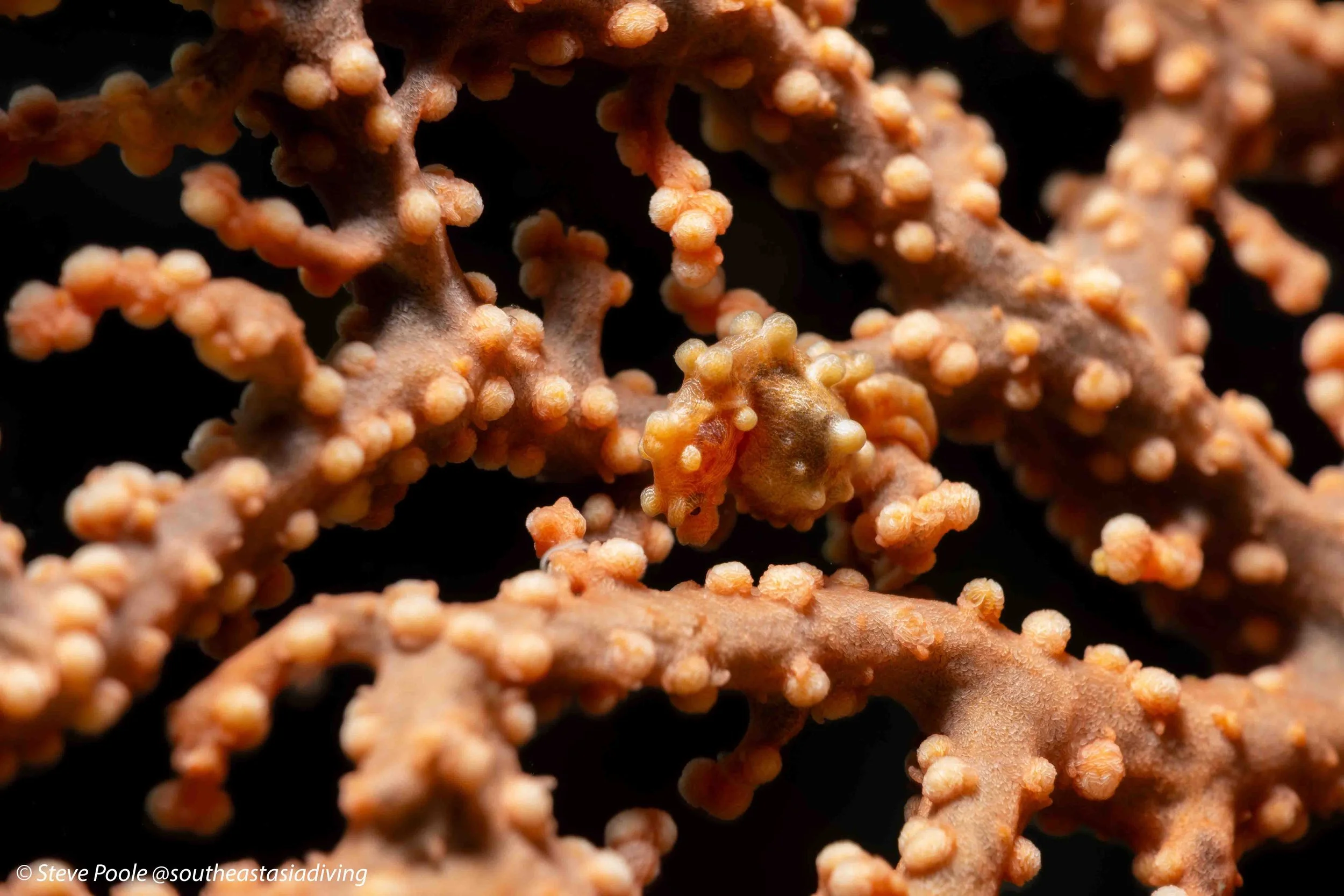
This photo shows a wider angle against the seafan
Above all, maintain control. Good buoyancy and awareness do more to protect the reef than anything else.
👉 The goal isn’t just to get the shot—it’s to leave the reef exactly as you found it.
🧠 Fun Facts About Pygmy Seahorses
Pygmy seahorses might be tiny, but they’re packed with some of the most fascinating adaptations in the ocean.
Many individuals spend their entire lives on a single coral, rarely moving more than a few centimeters from where they first settle. That coral isn’t just a home—it’s their entire world.
Each species is also adapted to a specific host. Their color, texture, and even body shape are matched so precisely to a particular type of gorgonian sea fan that placing them on a different coral would make them instantly visible—and vulnerable.
Despite how well-known they are today among divers, pygmy seahorses were only discovered relatively recently, and new species have been identified within the last few decades. It’s a reminder of just how much of the ocean—especially at the smallest scale—remains unexplored.
And perhaps most impressively, they are considered one of the best examples of camouflage in the marine world. Not just blending in, but effectively becoming part of their environment in a way that challenges even trained eyes to detect them.
🌊 Final Thoughts
Pygmy seahorses remind you that diving isn’t just about the big, dramatic moments.
It’s not always about sharks, mantas, or huge schools of fish. Sometimes, the most unforgettable encounters are the ones you almost miss entirely—hidden in plain sight, waiting for you to slow down enough to notice.
They change the way you dive.
You stop rushing. You start paying attention to detail. You begin to see the reef differently—not as a wide, sweeping scene, but as a collection of tiny, intricate worlds layered on top of each other.
And once that shift happens, it stays with you.
Because once you’ve truly seen a pygmy seahorse—not just pointed at it, but found it, followed its shape, and understood how it fits into its environment—you realize just how much you’ve been swimming past all along.
And from that point on…
You never look at a reef the same way again.
❓ FAQ: Pygmy Seahorses
How big are pygmy seahorses?
Most pygmy seahorses are under 2 cm long—smaller than your fingernail—making them some of the smallest vertebrates in the ocean.
Are pygmy seahorses rare?
They’re not necessarily rare, especially in biodiversity hotspots like Southeast Asia—but they are extremely hard to spot due to their incredible camouflage and small size.
Where is the best place to see pygmy seahorses?
Destinations like Raja Ampat, Anilao, and parts of Indonesia and Papua New Guinea are among the best places to encounter them, particularly on dives with experienced local guides.
What depth are pygmy seahorses found at?
They are most commonly found between 10 and 30 meters, usually on gorgonian sea fans along reef slopes or walls.
Can beginner divers see pygmy seahorses?
Yes—especially with a good guide. You don’t need advanced diving skills, but patience and good buoyancy control definitely help.
Do pygmy seahorses move around?
Very little. Most individuals stay anchored to a single coral for their entire lives, using their curled tail to grip onto the sea fan.
Why are pygmy seahorses so hard to see?
Their bodies are perfectly adapted to match the color, texture, and structure of their host coral. Combined with their tiny size and minimal movement, this makes them extremely difficult to detect—even when you’re looking directly at them.