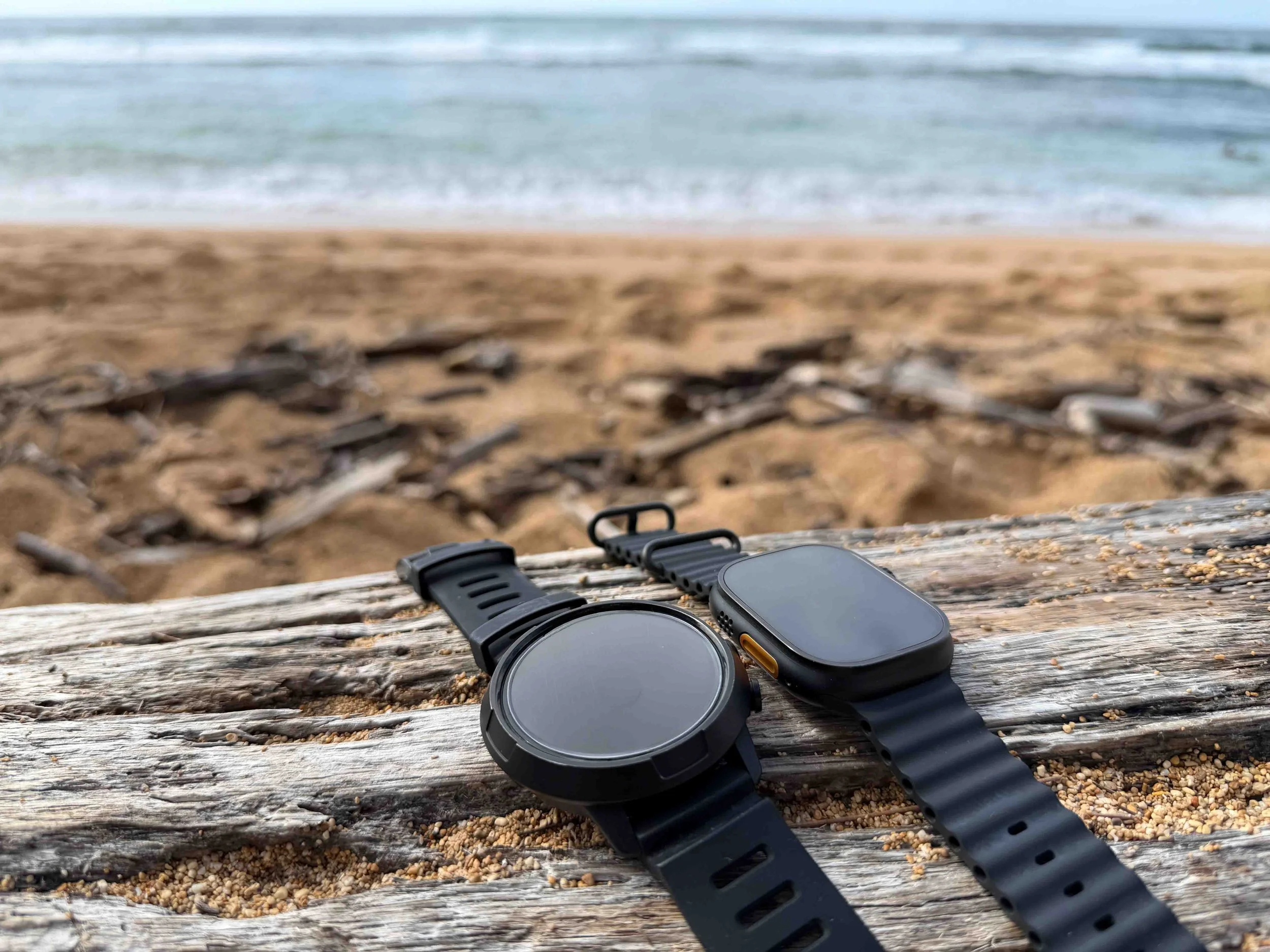
Suunto D5 and Apple Watch Ultra 3 on the beach in Kauai, Hawaii
Before heading to Florida for my first dive in almost eighteen months, I packed my gear as I always do: camera housing, strobes, spare O-rings, lenses and my trusted Suunto D5. Almost as an afterthought, I also activated Oceanic+ on my Apple Watch Ultra 3.
I wasn’t expecting much.
I’ve used dedicated dive computers for years, and I have always seen them as exactly that: specialist equipment designed to perform one important job. However sophisticated the Apple Watch might be on land, I assumed that underwater it would feel like a smartwatch trying to imitate a proper dive computer.
The plan was never to replace my Suunto D5. I prefer to dive with a backup computer anyway, so I wanted to see whether the Apple Watch could fill that role while allowing me to continue wearing the same watch I use every day.
Ten dives later, including dives at Blue Heron Bridge in Florida and around Kauai, my opinion has changed.
The Apple Watch has not replaced my Suunto D5, but it has proved itself to be a far more capable recreational dive computer than I expected.
How I Compared Them
This was not a desk-based comparison of specifications. I wore both computers simultaneously on ten recreational dives, allowing me to compare their displays, controls, dive profiles and recorded data under the same conditions.
That matters because two computers can look broadly similar on paper while behaving very differently underwater. Wearing both meant I could see whether they agreed on the fundamentals: depth, dive duration, average depth, temperature and the overall shape of each profile.
Short video showing the Apple Watch Ultra 3
In most respects, they did.
What the Dive Logs Showed
Two dives illustrate the comparison particularly well.
Kauai dive
On a dive in Kauai, the computers recorded:
| Measurement | Suunto D5 | Apple Watch Ultra (Oceanic+) |
|---|---|---|
| Dive time | 57:44 | 57:56 |
| Maximum depth | 25.6 m | 26 m |
| Average depth | 14.9 m | 14 m |
| Water temperature | 25°C bottom temperature | 25°C maximum and minimum |
| Dive profile | Rapid initial descent, deepest section early in the dive and a progressive move into shallower water | Nearly identical overall profile, including the early maximum depth and gradual final ascent |
| Overall agreement | The two computers recorded effectively the same dive, with only minor differences caused by rounding and how the data is displayed. | |
On this more conventional recreational dive, the two computers were separated by only 12 seconds. Maximum depth, average depth, temperature and the overall shape of the profiles were also closely aligned, providing a strong contrast with the larger timing difference recorded during the extremely shallow Blue Heron Bridge dive.
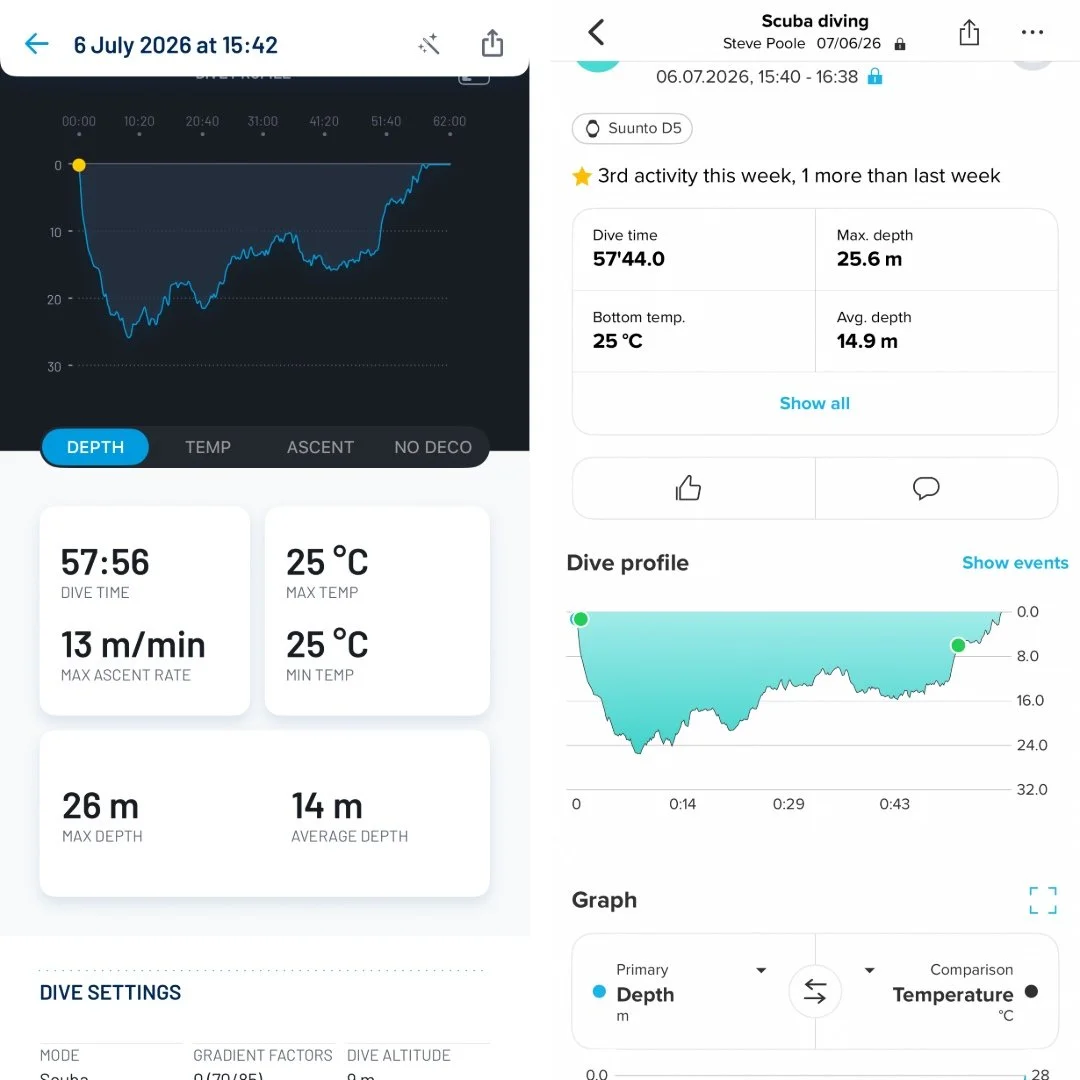
Dive profiles for Niihau in Kauai, Hawaii
The profiles followed almost exactly the same pattern: a rapid descent, the deepest section early in the dive, a shallower middle period and a gradual final ascent.
The 12-second difference in dive time is negligible. Maximum depth differed only because one device displayed a decimal measurement while the other rounded to the nearest metre. Average depth was also very close.
For a relatively conventional recreational dive, the two computers essentially recorded the same event.
Blue Heron Bridge dive
Blue Heron Bridge produced a more interesting result because it was extremely shallow and included time close to the surface.
| Measurement | Suunto D5 | Apple Watch Ultra (Oceanic+) |
|---|---|---|
| Dive time | 1:54:57 | 2:01:11 |
| Maximum depth | 6.8 m | 7 m |
| Average depth | 4.3 m | 4 m |
| Water temperature | 29°C bottom temperature | 28–29°C range |
| Maximum ascent rate | Not shown in screenshot | 11 m/min |
| Overall profile | Cleaner, more visually smoothed profile | More granular changes in shallow depth shown |
Both computers recorded effectively identical maximum and average depths. The main difference was dive duration, with the Apple Watch logging 6 minutes and 14 seconds more than the Suunto D5. This appears to reflect how each computer treated the very shallow or near-surface portions of the dive, rather than a meaningful disagreement about the dive profile itself.
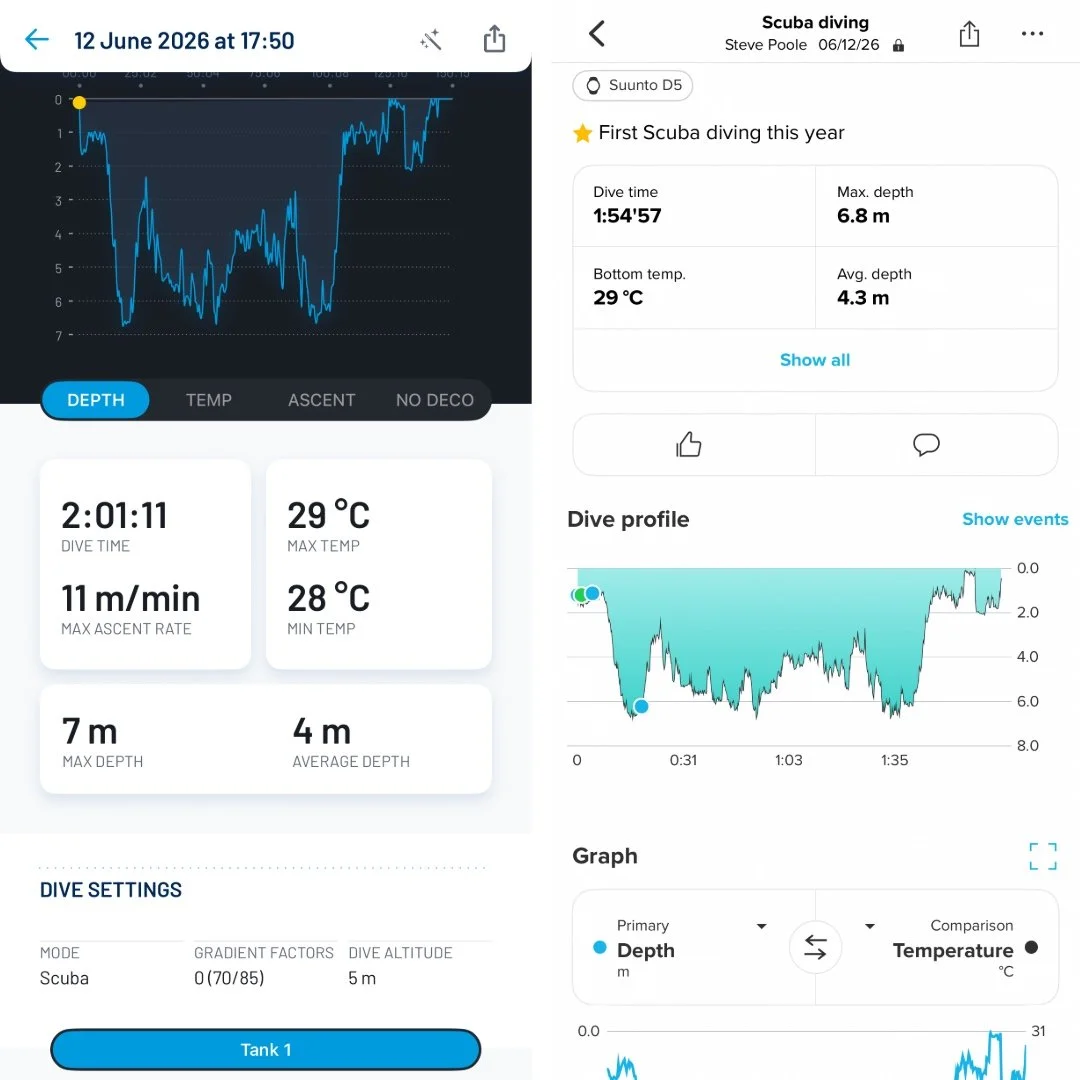
Dive profiles side by side for my dives at Blue Heron Bridge
Once again, the maximum and average depths were effectively the same, and both profiles showed the same movements through the dive. The main difference was duration: the Apple Watch recorded just over six minutes more than the Suunto.
The screenshots suggest that the Apple Watch included more of the very shallow or near-surface portions at the beginning and end of the dive. The Suunto appears to have applied a different threshold for deciding when the dive had started and finished.
Without the manufacturers’ exact start-and-stop logic, I cannot say precisely why the difference occurred. However, the close agreement in depth and profile suggests that this was primarily a difference in how each computer defined the boundaries of a very shallow dive, rather than one of them inaccurately recording what happened underwater.
That distinction is important. On the deeper Kauai dive, where the descent and ascent were more clearly defined, the recorded times were separated by only 12 seconds.
The Apple Watch Display Was Better Than I Expected
My biggest surprise came almost immediately.
I assumed the Apple Watch display would be one of its weaknesses. Instead, it became one of its strongest qualities. The screen was bright, crisp and extremely easy to read underwater. In some conditions, I found it brighter and easier to glance at than the display on the Suunto D5.
That does not mean the D5 is difficult to read. It is a clear and capable dive computer. The Apple Watch display is simply excellent.
As an underwater photographer, this matters. When I am handling a large camera housing, positioning strobes, managing buoyancy and watching a subject, I do not want to spend several seconds interpreting my computer. I want to glance at my wrist, understand the information immediately and return my attention to the photograph.
Oceanic+ presents the essential information cleanly, without making the screen feel overloaded.
Oceanic+ Is Intuitive to Use
The software also impressed me.
Changing from air to Nitrox and back again was straightforward and required only a few taps. This sounds like a small point, but anyone who has worked through the menus on some entry-level dive computers will know that changing a gas mix is not always as intuitive as it should be.
I have found the process more cumbersome on computers such as the entry-level Suunto Zoop. Oceanic+ feels like modern software: clear, visual and relatively difficult to get lost in.
That ease of use could be particularly valuable for occasional divers who may not remember a complicated sequence of button presses between trips.
Why It Works So Well as a Backup
I have always liked diving with redundancy, especially when travelling. Dive equipment gets knocked around, batteries fail and computers occasionally develop problems at inconvenient moments.
The Apple Watch fits naturally into that approach because I wear it every day. My backup computer is therefore already on my wrist, already charged and already travelling with me.
I am not carrying another dedicated device that spends most of the year in a drawer. I am using something that already forms part of my daily routine and can become a fully functional recreational dive computer when I need it.
For me, this may be the Apple Watch’s strongest role. It has not displaced the Suunto D5 as my primary computer, but it has changed what I consider an ideal backup.
The Advantage Continues After the Dive
The Apple Watch also continues doing something the D5 is not designed to do: recording the rest of my day.
It tracks my heart rate, estimated calories burned, general activity and wider fitness data. None of that is essential dive information, and it should not be confused with the information needed to manage a dive safely. However, I find it genuinely interesting.
I am currently training for the New York City Marathon, so I already pay attention to activity, workload and recovery. Seeing how a dive fits into the rest of my day gives me a broader picture than a dedicated dive log alone.
The Suunto tells me about the dive. The Apple Watch connects the dive to the rest of my health and activity data.
Where the Suunto D5 Still Wins
Despite how much the Apple Watch impressed me, the Suunto D5 remains my primary dive computer.
The D5 feels more solid and purpose-built. Its physical buttons are easy to use underwater, including with gloves, and the entire device has been designed around diving rather than adapting an everyday smartwatch for underwater use.
The most significant advantage for me is air integration. My D5 can connect to a tank transmitter and display my cylinder pressure directly on my wrist. The Apple Watch does not offer this, and I would miss it if I attempted to use the watch as my only computer.
The D5 also offers more dive-specific flexibility and feels better suited to frequent diving, intensive multi-day trips and divers who want a broader range of specialist functions.
The Apple Watch is a very capable recreational computer. The Suunto still feels like a dedicated piece of dive equipment.
It Is Not Intended for Every Type of Diving
The Apple Watch Ultra with Oceanic+ is designed around recreational scuba diving and has a 40-metre operating limit for that use.
That will be sufficient for most recreational dives, but it makes the watch an unsuitable replacement for the dedicated computers used in technical diving. Divers planning staged decompression, mixed-gas diving or depths beyond the recreational limit need equipment designed specifically for those demands.
I would also personally favour the Suunto for an intensive liveaboard or a long multi-day diving trip. If I were making three or four dives a day in Raja Ampat, the Red Sea or the Maldives, I would prefer the purpose-built controls, air integration and familiar dive-focused design of the D5.
The Apple Watch would still come with me, but primarily as my backup.
The Oceanic+ Subscription Question
The subscription model is one of the Apple Watch’s clearest disadvantages.
Buying an Apple Watch Ultra does not automatically give you unrestricted access to all of Oceanic+’s scuba functions indefinitely. Regular divers therefore need to consider the continuing cost rather than comparing the hardware price alone with a traditional dive computer.
However, the model also creates an interesting opportunity for occasional divers.
Someone who dives only during one holiday each year may not want to purchase a dedicated computer that sits unused for the remaining eleven months. A short-term Oceanic+ subscription allows that diver to activate the full recreational scuba functionality for the trip and stop paying afterwards.
That does not necessarily make the Apple Watch a cheap dive computer, especially if somebody is buying the watch specifically for diving. But for a person who already owns one, the ability to activate it only when required is genuinely useful.
Comparing the Dive Profiles
The post-dive presentation also differs.
The Suunto profile is clean and easy to interpret. It gives a clear visual summary of the dive without making the graph feel too busy.
The Apple profile appears more detailed and visually angular, showing many of the small changes in depth throughout the dive. This is particularly noticeable at Blue Heron Bridge, where slight rises and falls were recorded throughout the long, shallow profile.
I would not conclude from the screenshots alone that one device samples depth more frequently than the other. The difference could also result from smoothing, graph scale or how each app renders the stored data. What can be said confidently is that they present the information differently while still showing the same overall dive.
The Suunto graph is arguably easier to read at a glance. The Apple graph makes the small depth changes more visible.
| Apple Watch Ultra (Oceanic+) | Suunto D5 |
|---|---|
| ✅ Outstanding bright OLED display underwater | ✅ Purpose-built dive computer |
| ✅ Excellent backup dive computer | ✅ Air integration available |
| ✅ Very intuitive Oceanic+ interface | ✅ Physical buttons work well underwater |
| ✅ Simple Nitrox configuration | ✅ No subscription required |
| ✅ Tracks heart rate, fitness and recovery | ✅ Better suited to frequent diving |
| ✅ Always on your wrist as an everyday watch | ✅ Better for liveaboards and advanced diving |
| ❌ Oceanic+ subscription required | ❌ No everyday smartwatch features |
| ❌ No air integration | ❌ Display not as bright as the Apple Watch |
| ❌ Recreational diving only (40 m limit) | ❌ Another device to carry every day |
| If you are... | Best choice | Why |
|---|---|---|
| A recreational diver who already owns an Apple Watch Ultra | Apple Watch Ultra | Oceanic+ gives you a capable recreational dive computer without needing to buy or carry another device. |
| An occasional holiday diver | Apple Watch Ultra | You can activate Oceanic+ for your diving trip rather than paying for a dedicated computer that may remain unused for most of the year. |
| A frequent recreational diver | Suunto D5 | It is purpose-built for diving, requires no ongoing subscription and is better suited to regular use. |
| A liveaboard diver | Suunto D5 | Its dedicated controls, air integration and dive-focused design make it the stronger choice for repetitive multi-day diving. |
| An underwater photographer | Apple Watch Ultra | The bright OLED display is extremely easy to read at a glance while handling a camera housing and strobes. |
| A diver who wants air integration | Suunto D5 | The D5 can connect to a wireless tank-pressure transmitter, while the Apple Watch Ultra cannot. |
| A fitness-focused diver | Apple Watch Ultra | It continues tracking heart rate, activity, calories and broader fitness data after the dive. |
| A diver who prefers physical buttons | Suunto D5 | Its dedicated controls feel more traditional and may be easier to operate underwater, particularly when wearing gloves. |
| A technical diver | A dedicated technical dive computer | The Apple Watch Ultra is intended for recreational diving, while the Suunto D5 is also not a full technical diving computer. |
| Someone who wants a backup dive computer | Apple Watch Ultra | It works particularly well as a backup because it is already on your wrist and closely matched the Suunto D5 across my ten test dives. |
So Which Would I Choose?
After ten dives with both computers, I do not think the answer is as simple as declaring one the winner.
The Suunto D5 is the better dedicated dive computer for me. It feels more robust, provides air integration and offers the dive-focused experience I prefer as my primary system.
The Apple Watch Ultra is the better all-round device. It has an excellent underwater display, intuitive software and the ability to integrate the dive with the health and activity information I already use every day.
Most importantly, the actual dive data gave me confidence. Across both deeper and extremely shallow dives, the Apple Watch recorded depths, temperatures and profiles that closely matched the Suunto. The most notable discrepancy was the longer recorded duration at Blue Heron Bridge, which appears to reflect a difference in how the two devices treated time spent close to the surface.
Would I buy an Apple Watch Ultra solely to use as a dive computer? Probably not.
Would I recommend Oceanic+ to a recreational diver who already owns a compatible Apple Watch? Absolutely.
Would I use it for technical diving or as my first choice for an intensive liveaboard? No.
Would I trust it as my backup recreational dive computer? Based on my first ten dives, yes.
The Apple Watch did not convince me to retire my Suunto D5. It did something more useful: it proved that the computer already on my wrist can provide a capable, convenient and credible second source of dive information.
And that is far more than I expected from it.
Frequently Asked Questions
Is the Apple Watch Ultra a good dive computer?
Yes, for recreational diving. After using the Apple Watch Ultra with Oceanic+ alongside my Suunto D5 on ten dives, I found it consistently recorded almost identical dive profiles, depths and temperatures. It offers a bright, easy-to-read display and an intuitive interface that works well underwater. However, it lacks some of the advanced features found on dedicated dive computers, such as air integration.
Can the Apple Watch Ultra replace a dedicated dive computer?
It depends on the type of diving you do.
For recreational diving, many divers will find it perfectly capable. However, if you regularly dive from liveaboards, use air integration or are progressing into technical diving, a dedicated dive computer still offers clear advantages.
Personally, I continue to use my Suunto D5 as my primary computer, with the Apple Watch Ultra serving as an excellent backup.
How accurate is the Apple Watch Ultra underwater?
In my experience, very accurate.
Across ten dives, maximum depth, average depth and overall dive profiles closely matched my Suunto D5. The largest difference I observed was on a very shallow dive at Blue Heron Bridge, where the Apple Watch logged around six minutes longer, most likely because it included more of the time spent near the surface.
Does Oceanic+ require a subscription?
Yes.
Oceanic+ uses a subscription model to unlock its full scuba diving functionality.
For divers who only take one or two diving holidays each year, this can actually be an advantage, as you can subscribe only when you need it rather than purchasing a separate dive computer that spends most of the year unused.
Can the Apple Watch Ultra be used with Nitrox?
Yes.
Oceanic+ supports Nitrox and I found switching between air and Nitrox to be quick and intuitive. In fact, I found it easier than navigating the menus on some traditional entry-level dive computers.
Does the Apple Watch Ultra support air integration?
No.
Unlike the Suunto D5, the Apple Watch Ultra cannot connect to a wireless tank pressure transmitter. If air integration is important to you, a dedicated dive computer remains the better option.
What is the maximum diving depth of the Apple Watch Ultra?
When used with Oceanic+, the Apple Watch Ultra is designed for recreational scuba diving to a maximum operating depth of 40 metres (130 feet).
It is not intended for technical diving or decompression diving beyond recreational limits.
Is the Apple Watch Ultra easy to read underwater?
Absolutely.
One of the biggest surprises during my testing was just how bright and clear the OLED display remained underwater. In many situations, I actually found it easier to glance at than my Suunto D5, particularly while using a large underwater camera housing.
Does the Apple Watch Ultra log dive profiles?
Yes.
Oceanic+ records detailed dive profiles, depths, temperatures and ascent rates. When I compared the dive logs directly with my Suunto D5, both devices produced remarkably similar profiles, although the Apple Watch tended to display slightly more detail in the graph.
Which is better: Apple Watch Ultra or Suunto D5?
They serve slightly different purposes.
The Suunto D5 is a purpose-built dive computer with features such as air integration and a diving-first design.
The Apple Watch Ultra is an outstanding everyday smartwatch that also happens to be a very capable recreational dive computer.
For me, they complement each other rather than compete directly.
Should I buy an Apple Watch Ultra just for diving?
Probably not.
If your only goal is scuba diving, there are excellent dedicated dive computers available for less money.
However, if you already own an Apple Watch Ultra—or you're considering buying one for its fitness and smartwatch features—adding Oceanic+ gives you an excellent recreational dive computer without needing another device on your wrist.
What did I learn after using both dive computers on ten dives?
The biggest lesson was that the Apple Watch Ultra consistently matched my Suunto D5 far more closely than I expected. Maximum depth, average depth and dive profiles were remarkably similar across both shallow and deeper dives.
It didn't convince me to retire my Suunto D5, but it absolutely convinced me that the Apple Watch Ultra deserves a permanent place in my dive kit as a backup computer.