Kauai vs Southeast Asia Diving: What Nine Dives in Hawaii Taught Me
After eighteen months away from diving following treatment for leukaemia, I went to Kauai expecting a gentle return to the water, and maybe a chance to see how Hawaii's diving stacks up against the Southeast Asia sites that shaped me as a diver and photographer. What I found instead was a destination that isn't trying to compete with Southeast Asia at all, and nine dives that reminded me why I fell in love with this sport in the first place.
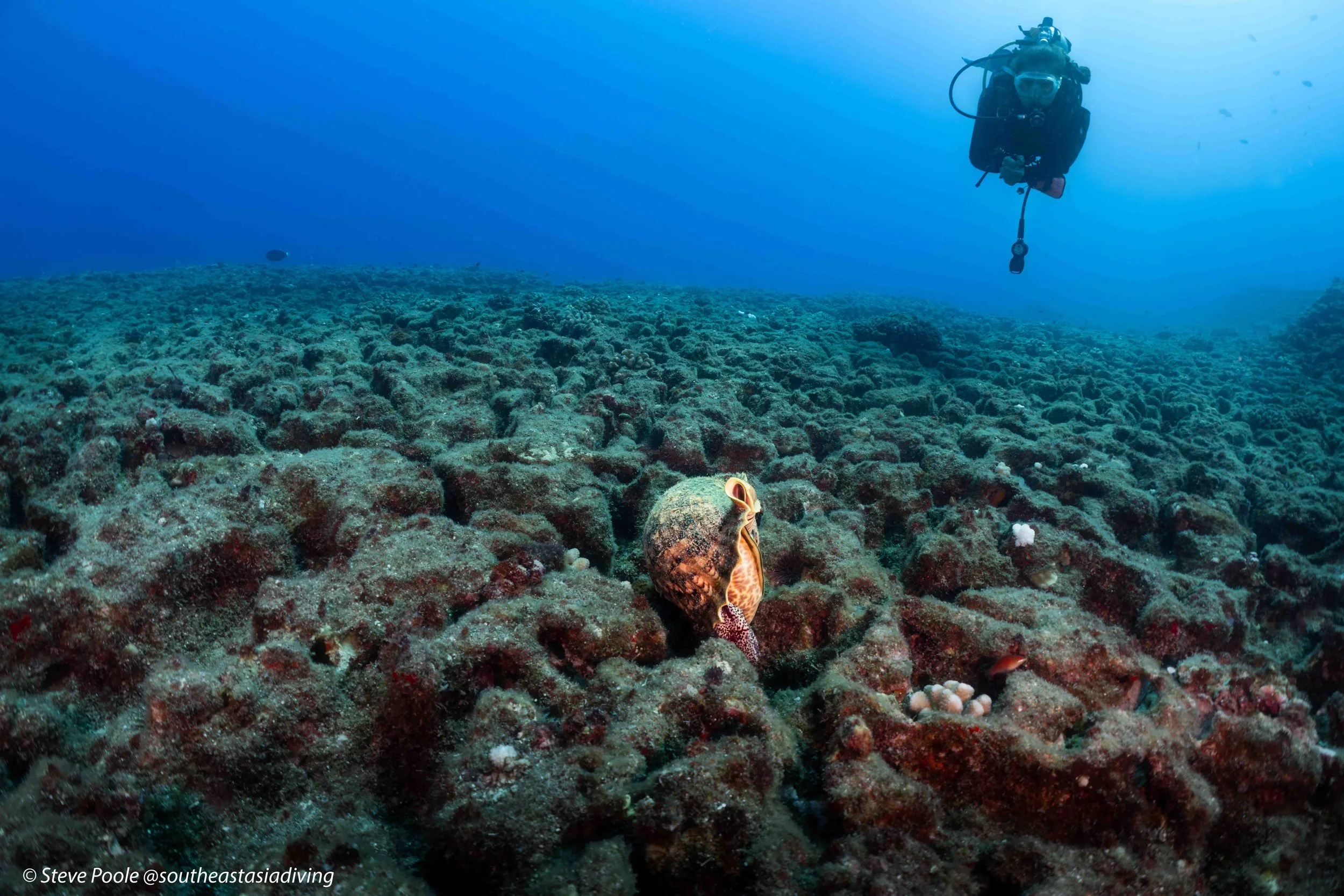
A Triton Snail at Lehua Crater, Niihau
If you're deciding between a Hawaii dive trip and a Southeast Asia one, or just wondering how Kauai compares to places like Raja Ampat, Sipadan or Komodo, here's what nine days in Poipu taught me, along with the honest trade-offs.
Returning to the Ocean
There are some dive trips that begin months before you ever enter the water, while you're still researching destinations, scrolling through underwater photographs and counting down the days until departure. This wasn't one of them.
After eighteen months away from diving, I wasn't chasing bucket-list encounters or hoping to create the perfect portfolio, and my expectations were deliberately modest. I simply wanted to enjoy being underwater again.
Before heading to Hawaii, I spent a few days in Florida diving Blue Heron Bridge, which felt like the perfect place to shake off the rust. Those dives weren't about rare marine life or ticking another destination off my list, but about rebuilding confidence, and my buoyancy returned surprisingly quickly, so that by the end of the trip I felt comfortable underwater once again.
My photography was another story. Looking back through those first images, there were far more failures than keepers, and after eighteen months away from the camera I'd forgotten how quickly good habits disappear. Some fish vanished before I found focus, while others looked sharp on the back of the camera only to reveal soft eyes when I viewed them properly on the computer. One mistake kept appearing over and over again, since my shutter speed was often just a little too slow for moving subjects. Turtles gliding effortlessly past me, reef fish darting between volcanic rocks, and I was convinced I'd captured the moment, only to discover later that the slightest movement had robbed the image of the sharpness I was hoping for.
It was frustrating, but also strangely reassuring, because underwater photography isn't something you simply pick up where you left off. Like diving itself, it rewards time, patience and repetition, and every missed shot was simply part of finding my rhythm again.
By the time I boarded the long journey from upstate New York, where I'm now based, to Hawaii, I wasn't expecting perfection anymore. I was simply looking forward to spending another week underwater, and this time I packed both my wide-angle and macrolenses and ports, in the hope I might get a bit of both. That decision turned out to be a masterstroke.
Why Kauai for Diving?
Getting to Kauai is no small undertaking. Crossing the United States, changing planes and then flying another five hours across the Pacific quickly reminds you just how isolated Hawaii really is, and adding a full underwater camera system, housing, strobes and dive gear into the equation certainly doesn't make it the easiest dive holiday to pack for.
As I sat somewhere over the Pacific, I caught myself wondering whether the diving would justify the journey, since I'd heard plenty of opinions over the years. "Hawaii is beautiful above the water." "The diving's nice." "If you've dived Southeast Asia, don't expect too much."
Kauai, in particular, rarely features on lists of the world's great dive destinations. Most divers think immediately of Oahu or the Big Island, while Kauai is better known for the dramatic cliffs of the Nā Pali Coast, Waimea Canyon and lush green mountains than for what lies beneath the waves. Ironically, that quieter reputation was exactly what appealed to us, since we weren't looking for the busiest island or the biggest resorts. We wanted somewhere that felt relaxed, where diving could sit alongside hiking, photography and simply enjoying the island, so we based ourselves in Poipu on the south shore, where most of Kauai's diving takes place, and booked nine dives with Fathom Five.
I arrived expecting dramatic volcanic landscapes, crystal-clear water and plenty of sea turtles, and assumed my wide-angle lens would define the week. I couldn't have been more wrong.
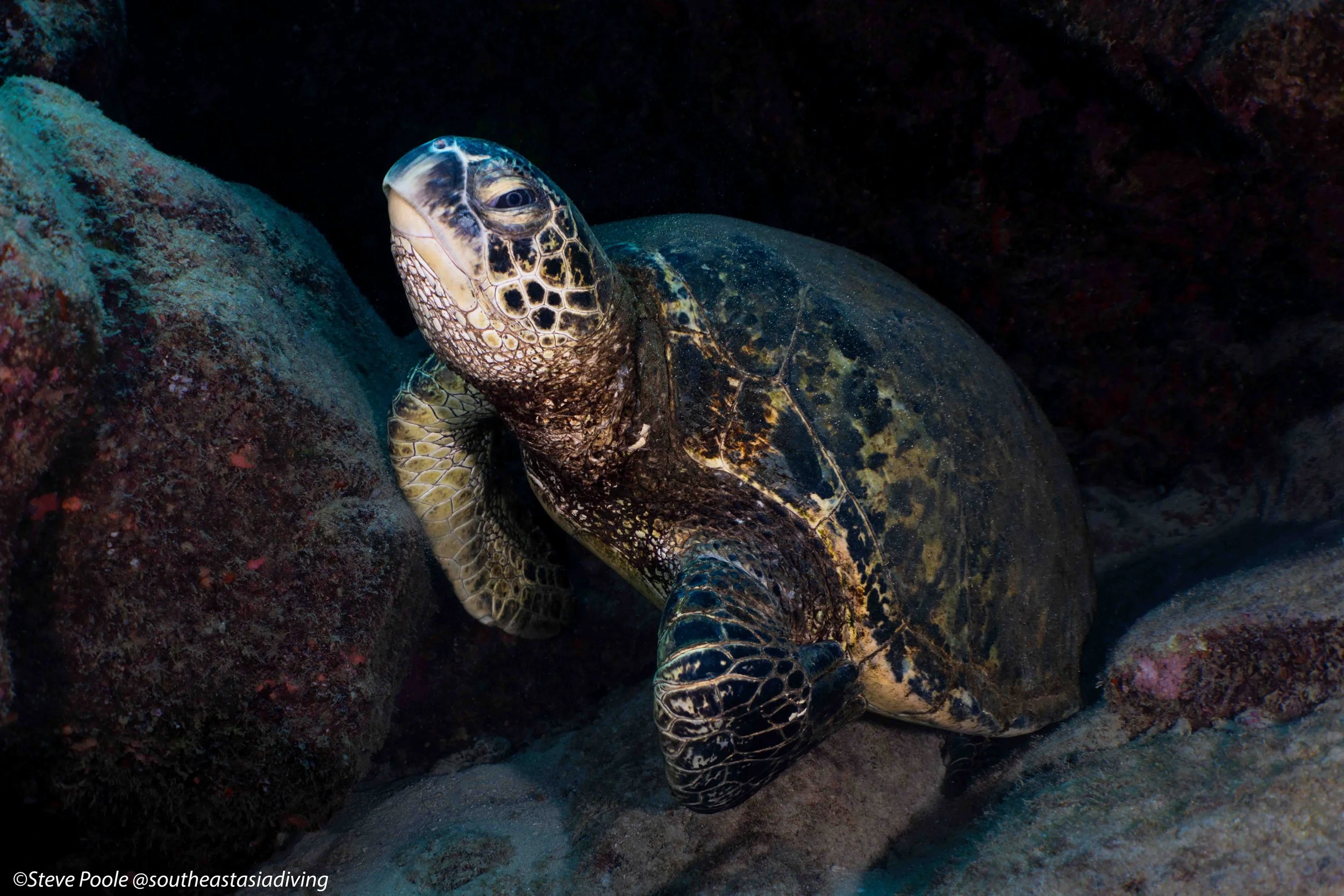
A resting Green Turtle
Returning to Diving at Koloa Landing
Our first two dives were shore dives at Koloa Landing, and I honestly don't think there could have been a better introduction to diving in Hawaii. My real return to diving had technically already happened at Blue Heron Bridge, a single, shallow two-hour dive that was more about easing back in than testing myself, so Koloa Landing was really my first proper dive back. The entry is straightforward, the conditions are often forgiving and the site gives you time to settle into the pace of Hawaiian diving without feeling rushed, which after such a long break was exactly what I needed.
That first dive came with its own lesson, though not the one I expected. Somewhere during the entry I'd knocked my lens into manual focus without realising it, and spent the entire dive wondering why nothing would come sharp no matter what I did. It wasn't until I was back on the surface, reviewing a memory card full of soft, unusable frames, that I worked out what had happened. It was a frustrating way to start, but also a useful reminder that after eighteen months out of the water, even the basics deserve a proper check before you descend.
Beyond the camera trouble, I almost immediately stopped thinking about diving altogether, which is probably the biggest compliment I can give any dive site. Instead of worrying about weighting, buoyancy or camera settings, I found myself simply enjoying being underwater again. Schools of fish drifted across the reef, turtles appeared with surprising regularity, and I remembered how much I enjoy slowing down underwater, since diving has always been one of the few places where the rest of the world quietly disappears.
The camera continued to keep me humble in the dives that followed. Every evening became a familiar routine: download the images, open Lightroom, celebrate a handful of photographs, and laugh at far more. One fish would be perfectly sharp except for the eye, a turtle would have beautiful light but just enough motion blur to notice, or a composition would have worked beautifully had the subject waited another half second. I realised my shutter speed was still set for the photographer I had been eighteen months earlier, not the one I had become after such a long break. Every dive taught me something, and gradually I increased my shutter speed for moving subjects, trusted my strobes a little more, and stopped trying to force every photograph. By the end of the week, the percentage of keepers had improved considerably, not because Kauai had suddenly become easier to photograph, but because I was slowly rediscovering instincts that only come from time underwater.
Exploring Kauai's South Shore
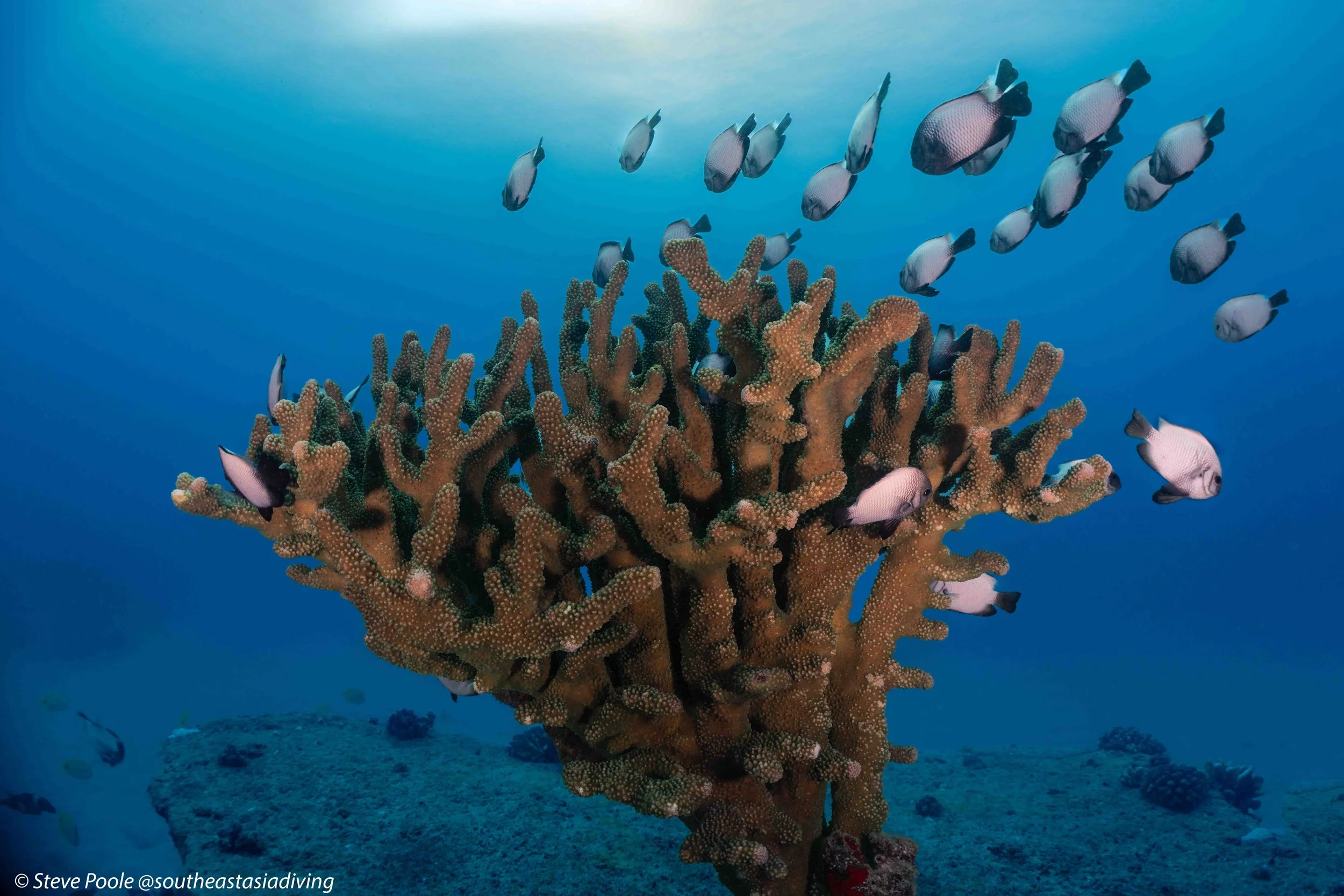
A branching coral with endemic Damselfish
July turned out to be a wonderful time to visit. Water temperatures hovered around 26°C, making long dives comfortable in a wetsuit, and visibility was generally excellent, though above the surface the Pacific regularly reminded us that calm seas should never be taken for granted. The trade winds often produced a lively swell, and more than once the boat ride became an adventure in its own right, so that descending beneath the surface felt like entering an entirely different world, where the movement disappeared and the volcanic reefs stretched away into calm blue water.
One of the first things that struck me was the style of diving itself. Having dived extensively around mainland America, I'd become used to a very self-sufficient approach, where divers generally prepare their own equipment, carry their own cylinders and take responsibility for much of the practical side of the dive. Kauai felt different: the team at Fathom Five helped prepare equipment, organised entries and exits, and quietly took care of many of the small details that allow guests to simply enjoy the experience. It reminded me far more of the full-service dive operations I'd grown used to across Southeast Asia, and while neither approach is better than the other, simply a different reflection of local diving culture, it immediately felt familiar.
Sheraton Caves – Where Everything Changed
If I had to choose one dive that defined the trip, it would probably be Sheraton Caves. The volcanic formations are unlike anything I'd photographed before, with huge swim-throughs carved through ancient lava, sunlight filtering through cracks overhead, and green sea turtles drifting lazily through the caverns as though divers simply didn't exist. This was exactly what I'd travelled to Hawaii expecting to photograph: wide-angle scenes, dramatic landscapes, big animals.
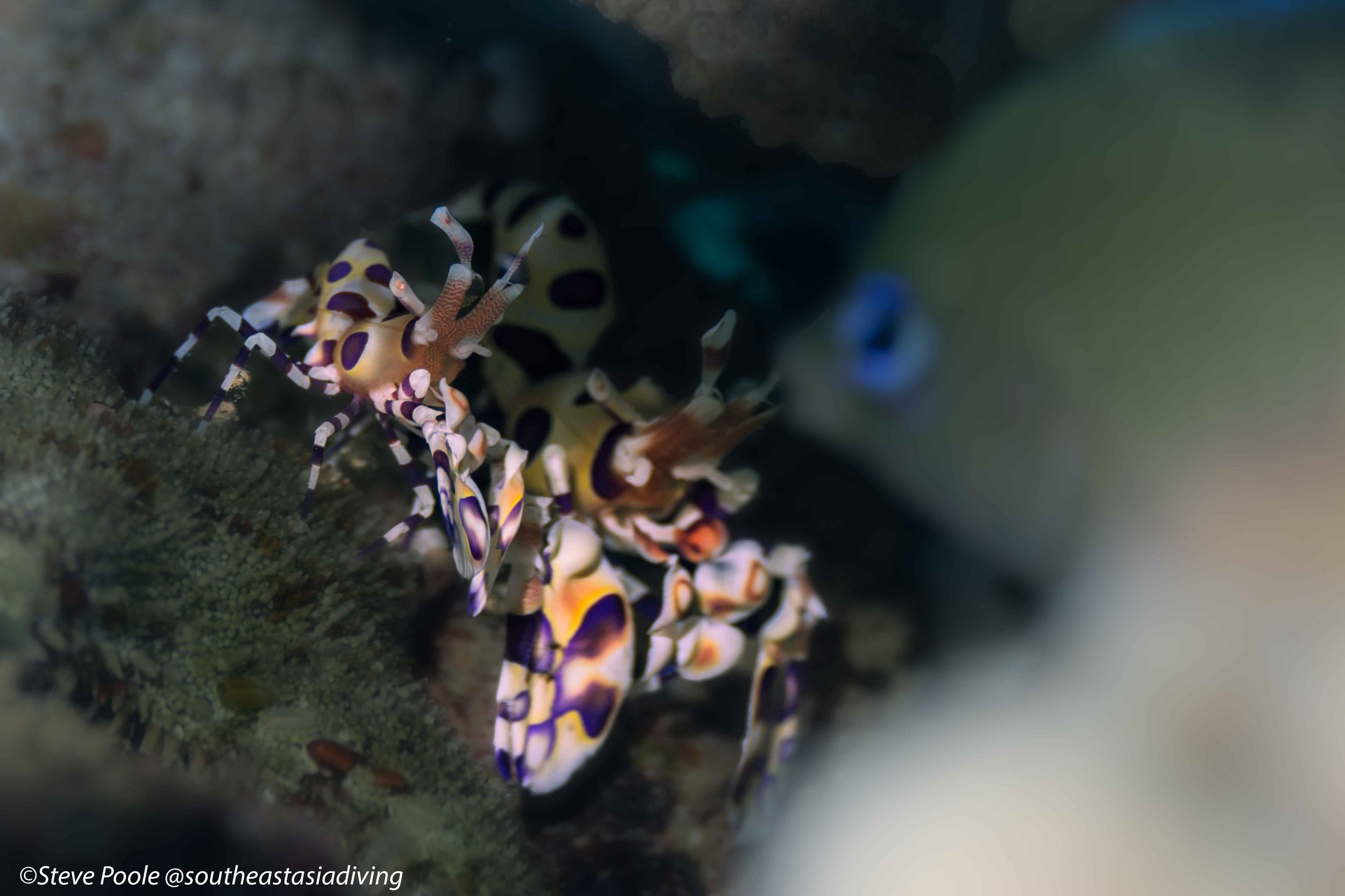
I was astounded to see Harlequin fish on 3 out of 9 dives!
Yet somewhere during those dives, my attention shifted, and instead of looking out into the blue, I found myself peering beneath ledges and studying cracks in the volcanic rock. That's when Kauai delivered its biggest surprise, and the decision to pack my macro gear paid off in full. A beautifully patterned harlequin shrimp became one of my favourite encounters of the week, followed by a wonderfully camouflaged frogfish, almost invisible until our guide pointed it out, and then nudibranchs and countless tiny reef creatures that rewarded patient observation. I had travelled all the way to Hawaii expecting to spend the week shooting wide-angle images, and instead, some of my favourite photographs were of subjects small enough to fit comfortably in the palm of my hand.
Niʻihau – Worth Every Mile
Then came Niʻihau, and even reaching the island feels like an expedition. The crossing takes around two and a half hours each way, carrying you further and further into open ocean until Kauai gradually disappears behind you, and by the time Niʻihau appears on the horizon, you already feel as though you're somewhere genuinely remote.
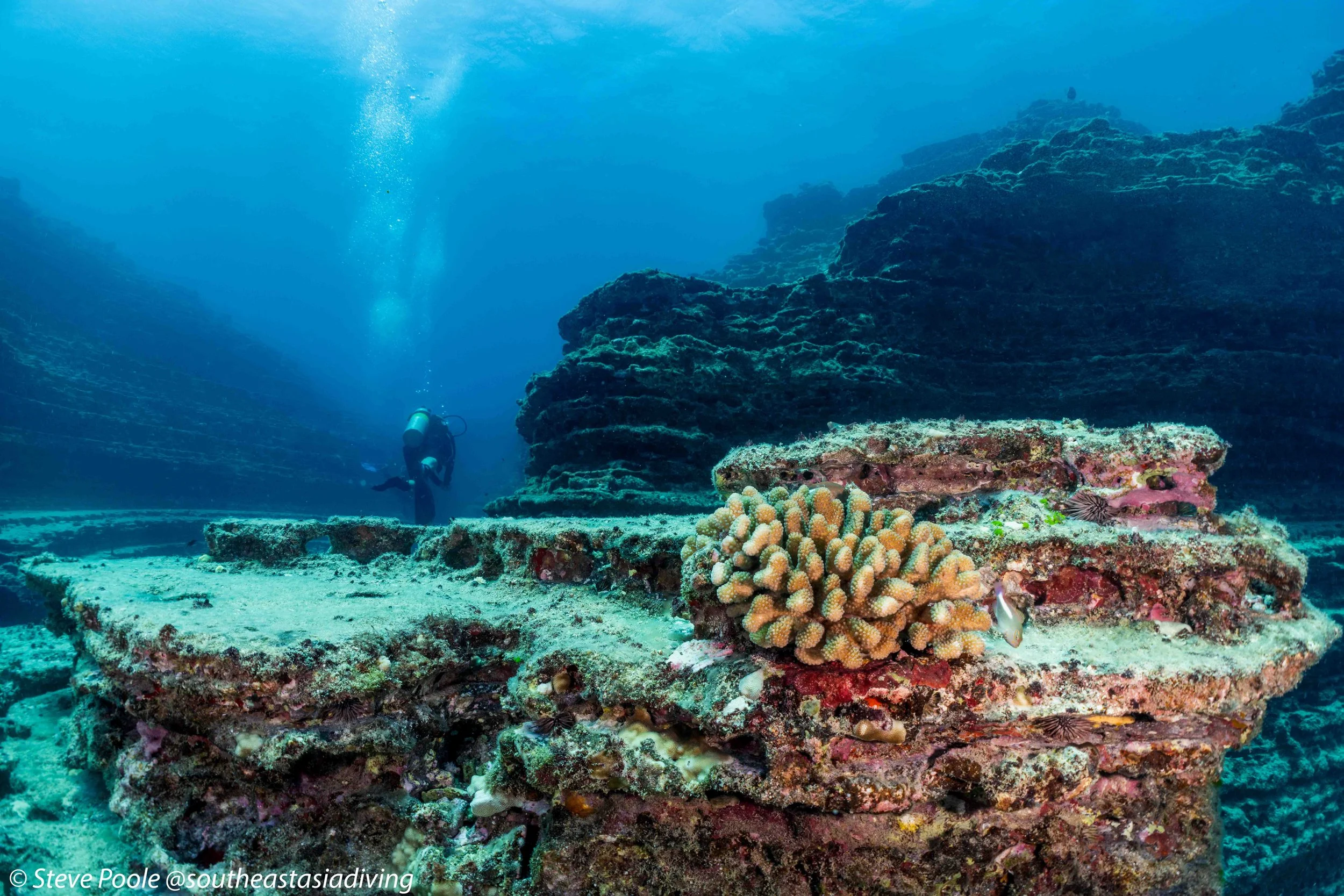
The return journey was another matter altogether. The Pacific had built throughout the day, and the ride home became one of the roughest boat journeys I've experienced, a world away from the generally calm crossings I'd become used to throughout Southeast Asia. Every minute was worth it. I've been fortunate enough to dive in some extraordinary places over the years, including Raja Ampat, Sipadan, Komodo and the Galápagos, but Niʻihau genuinely felt unlike anywhere else, with towering volcanic walls disappearing into deep blue water and massive arches and swim-throughs emerging from nowhere. Monk seals glided effortlessly through the water while reef sharks cruised the drop-offs and turtles continued to appear with remarkable regularity. It didn't look or feel like Southeast Asia, and it didn't need to.
Hawaii vs Southeast Asia Diving: The Real Differences
Throughout the trip, I kept making comparisons without even realising it. My years diving across Southeast Asia had quietly become my benchmark: the biodiversity of Raja Ampat, the schooling fish of Sipadan, the endless macro opportunities around Mabul and the vibrant reefs of Indonesia had become the standard against which every new destination was measured.
Kauai taught me that I was asking the wrong question. Hawaii isn't trying to compete with Southeast Asia, because it offers something entirely different.
Marine abundance. Southeast Asia overwhelms you with abundance. Healthy coral reefs stretch into the distance, marine life seems to appear everywhere you look, and the sheer diversity of subjects can keep underwater photographers occupied for a lifetime.
Accessibility and dive frequency. Southeast Asia is also incredibly accessible, and once you're there, diving is affordable enough that multiple dives a day for weeks at a time are realistic, something that's much harder to justify in Hawaii.
Landscape and character. Hawaii, by contrast, feels raw. The volcanic landscape shapes every dive, the reefs are younger, the scenery more dramatic, and the wildlife feels inseparable from the islands themselves. Monk seals, turtles and sharks aren't attractions here; they're simply part of an ecosystem that has evolved in remarkable isolation.
Dive culture. Even the dive culture reflected those differences, since Kauai reminded me more of Southeast Asia than mainland America in the way dives were run, with a relaxed, full-service approach that immediately felt familiar after years of diving across Malaysia and the wider region.
Cost. There is one comparison that's impossible to ignore. Hawaii is expensive, and boat dives, accommodation and flights all add up quickly, particularly if you're travelling from the east coast of the United States, whereas Southeast Asia remains, in my opinion, one of the greatest values in world diving. That doesn't make Hawaii poor value; it simply makes Southeast Asia exceptional.
| Category | Kauai, Hawaii | Southeast Asia |
|---|---|---|
| Overall diving style | Dramatic volcanic landscapes, lava formations, lava tubes and endemic wildlife. Every dive feels unmistakably Hawaiian. | Incredible biodiversity, colourful coral reefs and huge variety across multiple countries and ecosystems. |
| Marine life | Green sea turtles on almost every dive, Hawaiian monk seals, reef sharks, endemic fish and occasional pelagic species. | Huge schools of fish, reef sharks, manta rays, whale sharks (seasonal), pygmy seahorses, nudibranchs, frogfish, octopus and exceptional biodiversity. |
| Macro photography | Surprisingly rewarding. Frogfish, harlequin shrimp, nudibranchs and cryptic reef life reward patient photographers willing to slow down. | Among the best in the world. Destinations such as Anilao, Lembeh, Mabul and Tulamben are internationally renowned for macro photography. |
| Wide-angle photography | Volcanic caverns, lava swim-throughs, dramatic underwater topography, turtles and deep blue water. | Colourful coral reefs, schooling fish, soft corals, wrecks, dramatic walls and large pelagic species. |
| Underwater scenery | Ancient volcanic formations unlike anywhere else I've dived, creating a dramatic and distinctive underwater landscape. | Healthy coral reefs dominate, with each destination offering its own unique mix of walls, pinnacles, wrecks, seagrass beds and coral gardens. |
| Water temperature | Approximately 26°C (79°F) in July. Comfortable in a 3–5 mm wetsuit. | Typically 27–30°C (81–86°F) throughout much of the year, often suitable for a 3 mm wetsuit or rash vest. |
| Visibility | Generally excellent, although surface swell and weather can influence conditions. | Often exceeds 20–30 metres (65–100 ft), depending on destination and season. |
| Dive operations | Relaxed and friendly. More full-service than much of mainland USA, with crews helping prepare equipment and making diving feel effortless. | Highly service-oriented, with staff typically handling tanks, equipment and logistics throughout the trip. |
| Shore diving | Excellent. Koloa Landing is one of Hawaii's premier shore dives and ideal for underwater photographers. | Varies by destination, but excellent shore diving exists in places such as Tulamben, Amed and parts of Malaysia. |
| Boat diving | Comfortable day boats serving Kauai's south shore and Niʻihau. Surface conditions can sometimes be lively. | Everything from small local boats to luxury liveaboards exploring some of the world's most remote dive sites. |
| Big animal encounters | Green sea turtles, Hawaiian monk seals and reef sharks are regular highlights. | Manta rays, whale sharks, sharks, dolphins, turtles and seasonal pelagic encounters depending on the destination. |
| Photography difficulty | Moderate. Volcanic rock creates spectacular backdrops but can make macro subjects surprisingly well camouflaged. | Varies considerably, with many calm reefs and specialist macro destinations making underwater photography highly rewarding. |
| Cost | High. Flights, accommodation and diving are significantly more expensive than most Southeast Asian destinations. | Outstanding value. One of the most affordable regions in the world for high-quality scuba diving. |
| Best for | Divers seeking volcanic scenery, lava tubes, turtles, monk seals and a quieter Hawaiian island experience. | Divers looking for maximum biodiversity, colourful reefs, world-class underwater photography and exceptional value for money. |
| Ideal diver | Perfect for divers wanting dramatic underwater landscapes and an unforgettable Hawaiian adventure where diving is part of a wider holiday of hiking, beaches and spectacular scenery. | Ideal for divers who want the greatest marine biodiversity, endless photography opportunities, frequent diving and some of the best value scuba holidays in the world. |
My Take
After almost a decade of diving across Southeast Asia, I arrived in Kauai expecting to spend the week comparing it to places like Raja Ampat, Sipadan and Komodo. By the end of the trip, I'd realised that was the wrong comparison to make.
Southeast Asia remains my favourite diving region in the world. The biodiversity, affordability and sheer variety are difficult to beat, and it's the region that shaped me as both a diver and an underwater photographer.
But Kauai isn't trying to be Southeast Asia.
It offers something entirely different: dramatic volcanic landscapes, endemic marine life, lava tubes, monk seals and a sense of isolation that's unlike anywhere else I've dived. Rather than replacing Southeast Asia, it complemented it, reminding me that some of the most memorable dive trips come not from finding somewhere "better", but from discovering somewhere wonderfully different.
If you can only choose one destination and your priority is diving alone, I'd still recommend Southeast Asia. If you're looking for an incredible all-round adventure that combines world-class scenery above and below the water, Kauai deserves a place high on your list.
Final Thoughts
When I looked back through my photographs after returning home, I realised something. My favourite images weren't necessarily the sharpest, and they weren't always the rarest subjects either. Some of them still had tiny imperfections, a fish just beginning to turn away, a turtle that could have been fractionally sharper, a reminder that I still had plenty to relearn after so long away from underwater photography. And strangely, I wouldn't change that, because those photographs tell the real story of the trip: not one of perfection, but of rediscovery.
Hawaii didn't replace Southeast Asia in my affections, and I never expected it to. Even though I'm no longer based there, Southeast Asia still feels like a home away from home beneath the surface, and I know I'll keep returning there for years to come. What Kauai gave me was something different: a reminder that extraordinary diving doesn't have to look the same everywhere. Sometimes it's walls of coral and astonishing biodiversity, and sometimes it's ancient lava formations, turtles gliding through cathedral-like swim-throughs, and a harlequin shrimp hiding in plain sight. Sometimes it's a two-and-a-half-hour boat ride across open ocean to a place that feels wonderfully wild.
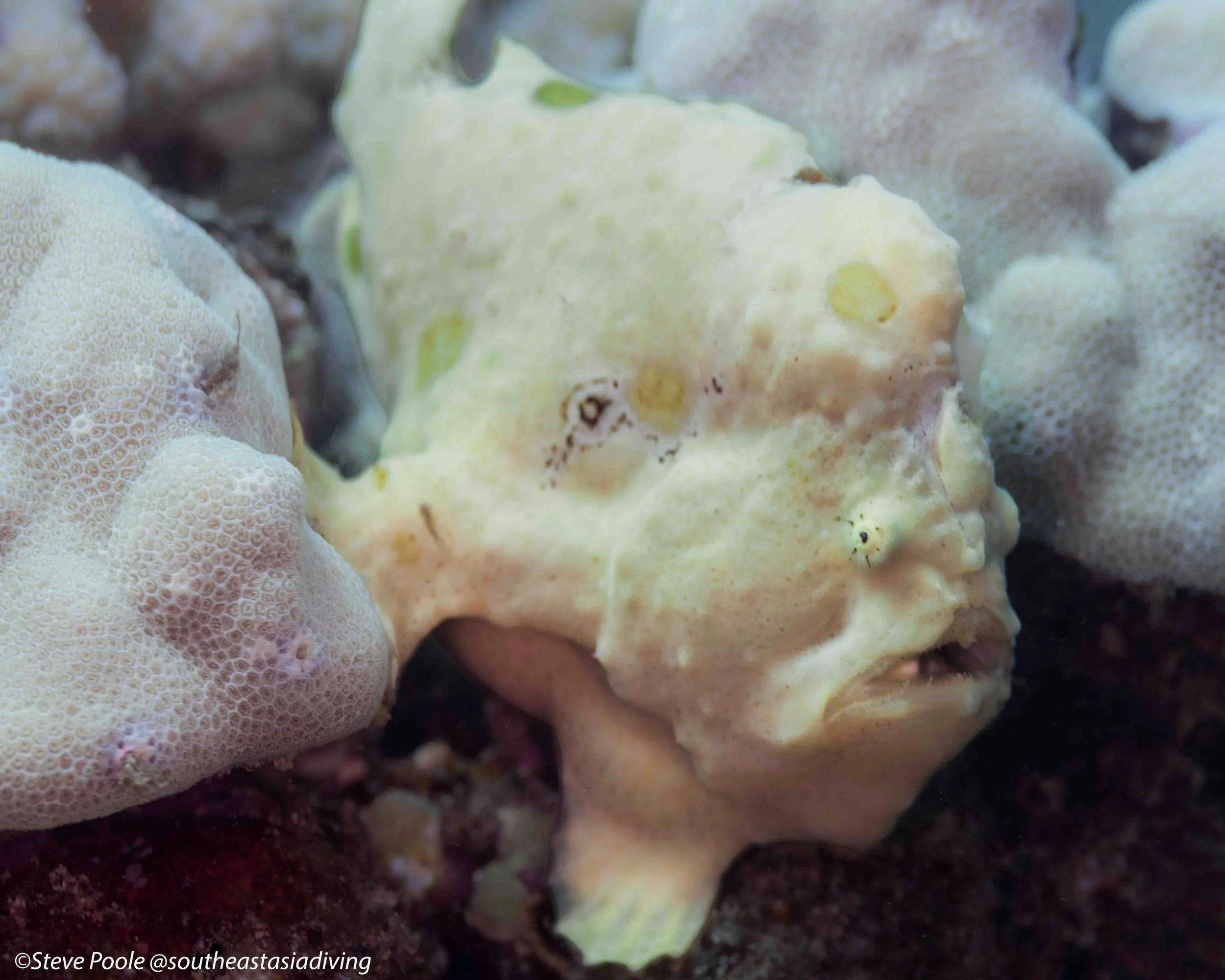
Everybody’s favourite - a frogfish!
Most of all, it reminded me why I fell in love with diving in the first place, not because every dive is perfect or every photograph is a keeper, but because every time you descend beneath the surface, there's the chance to discover something you weren't expecting. And, for me, that feeling never gets old.
FAQs: Kauai vs Southeast Asia Diving
Is Kauai good for scuba diving?
Yes, though it's a different style of diving than most people expect from Hawaii. Kauai's reputation rests more on its scenery above the water than its dive sites, but shore dives like Koloa Landing and boat dives like Sheraton Caves offer a genuine mix of dramatic volcanic terrain, resident turtles, and surprisingly rich macro life for anyone willing to look closely.
How does diving in Kauai compare to Southeast Asia?
Southeast Asia generally wins on sheer abundance: healthier, more extensive reefs, a greater density and diversity of marine life, and diving affordable enough to do multiple times a day for weeks. Kauai can't match that volume, but it offers a rawer, more isolated character, with volcanic landscapes, monk seals, and dive sites that feel wonderfully undeveloped by comparison. It's less "which is better" than "what are you looking for."
Is diving in Hawaii more expensive than Southeast Asia?
In my experience, yes, noticeably so. Between flights, accommodation, and boat dive prices, a Hawaii trip adds up quickly, especially travelling from the US east coast. Southeast Asia remains one of the best-value dive destinations in the world, which makes it easier to justify longer trips and more dives per day.
What's the best dive site in Kauai?
Sheraton Caves stood out as the best around Kauai itself, with its lava swim-throughs, resident turtles, and unexpectedly good macro life, including a harlequin shrimp and a well-camouflaged frogfish. For something more remote and other worldly, the crossing to Niʻihau is a serious undertaking but delivers dramatic walls, monk seals, and reef sharks that feel genuinely wild.
Is Niʻihau diving worth the boat ride from Kauai?
Yes. The crossing is around two and a half hours each way and can get rough, particularly on the return, but the diving on the other side, towering volcanic walls, big swim-throughs, monk seals, and reliable turtle and shark sightings, made it one of the standout dive experiences I've had anywhere, Southeast Asia included.
Do I need a wide-angle or macro lens for diving in Kauai?
Both, if you can manage it. I arrived expecting big, wide-angle scenery, and Kauai delivers that at sites like Sheraton Caves, but the macro life, shrimp, frogfish, and nudibranchs tucked into the volcanic rock, turned out to be just as rewarding. Packing both lens and port setups meant I wasn't caught out either way.
What time of year is best for diving in Kauai?
I dived in July, when water temperatures sat around 26°C, comfortable in a wetsuit, and visibility was generally excellent. Trade winds can still produce a lively swell on the surface, so be prepared for a bumpier boat ride than the conditions below the surface would suggest.