Diving Kauai's South Shore: Koloa Landing, Sheraton Caverns & Three Fingers
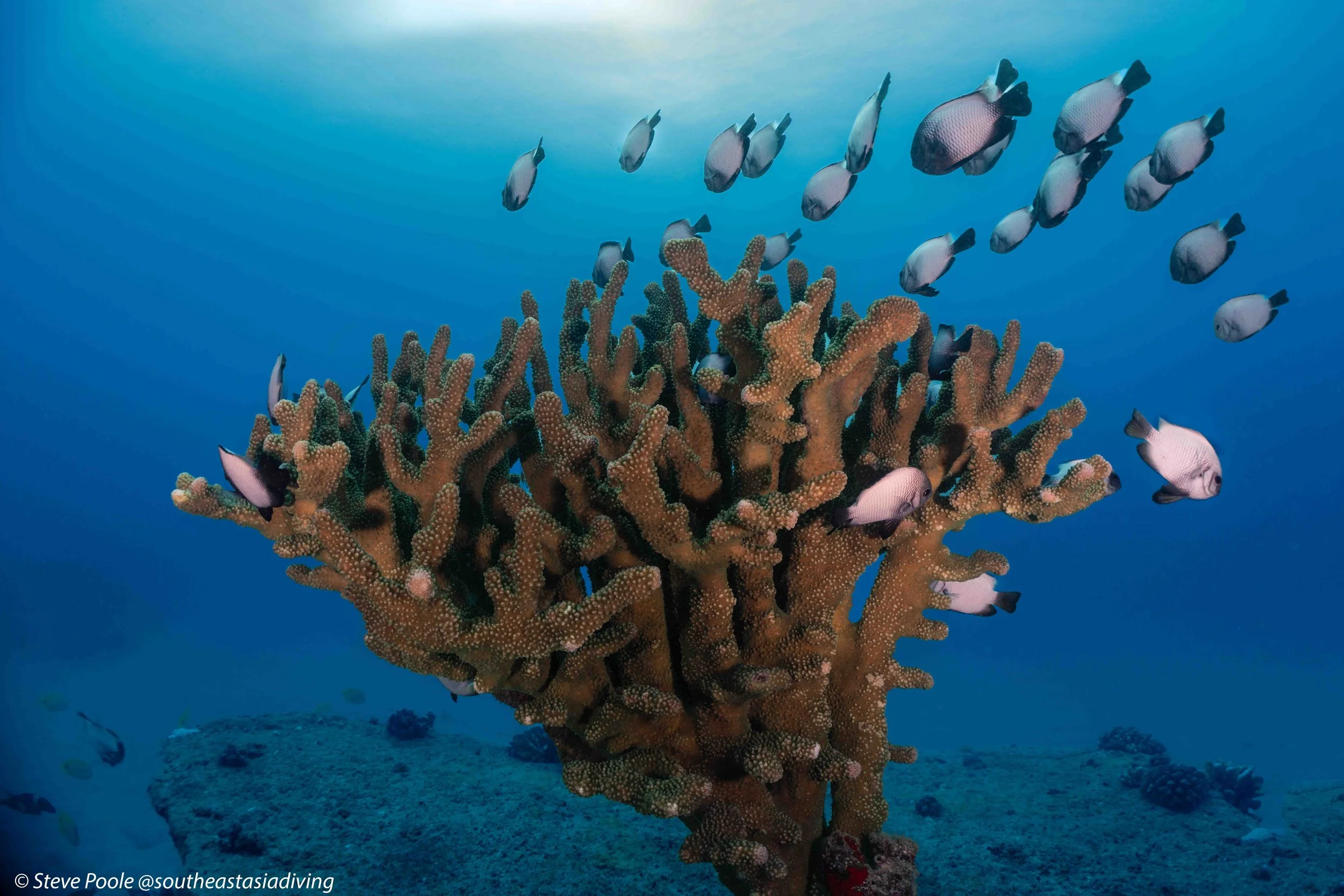
Coral with endemic Hawaiian Damselfish
Three days, six dives, countless turtles, and a reminder that Hawaii isn't just about dramatic lava landscapes.
After a couple of days exploring Kauai and recovering from the long journey from upstate New York, it was finally time for Laura and me to get back underwater. This trip mattered more than most: it followed an eighteen-month stretch away from diving, and a single warm-up dive at Blue Heron Bridge in Florida had barely scratched the rust off before we flew out to Hawaii. This was the trip I'd genuinely been looking forward to all year, even if I wasn't entirely sure my fins, or my finning, were quite ready for it.
The south shore of Kauai offers something quite different from both Southeast Asia and much of mainland US diving. Instead of colourful coral reefs stretching into the distance, the underwater landscape here is shaped by ancient lava flows, with swim-throughs, caverns and dramatic volcanic formations creating a completely different feel beneath the surface. I'd expected wide-angle scenery to dominate my camera, but as the days unfolded it was the macro life that kept surprising me.
We dived with Fathom Five Divers, a small, family-run outfit based in Old Koloa Town, over three separate days. The plan was simple: start gently with two relaxed shore dives at Koloa Landing, head out by boat a few days later to explore Damsel Land and Sheraton Caverns, then, after an unforgettable trip to Niʻihau, which deserves an article all of its own, finish the holiday with one more day on the south shore because we'd enjoyed it so much the first time.
Koloa Landing – The Perfect Way to Ease Back In
Our first dives, on 2 July, were at Koloa Landing, one of Hawaii's most popular shore dives and about as gentle a reintroduction to diving as you could ask for. The site sits in Hanakaʻape Bay, once Kauai's main whaling harbour, and it's still possible to spot old anchor chains scattered among the reef, a quiet reminder of the bay's working past. The entry is an easy walk down a boat ramp rather than a slog across rocks, and the reef forms a natural U-shape that's sheltered enough to dive comfortably in almost any conditions, which is exactly why it's become the go-to warm-up site for divers across the island.
Our guide, Rebecca, was new to the Fathom Five team but immediately put us at ease, keeping both dives calm and unhurried. After the long flights and a couple of days exploring the island, I wasn't looking for anything challenging. I simply wanted an easy dive to get comfortable again, check my camera setup, and enjoy being back underwater. It was also the first outing for my Apple Watch and the Oceanic+ app, which I'd started using for dive logging since our last post on the subject.
Eighteen months out of the water turns out to be plenty of time to forget things you'd assumed were second nature. My buoyancy felt a touch off for the first few minutes, my finning was clumsier than I remembered, and even basic pre-dive habits, checking settings, running through the gear, took a beat longer than they should have. None of it was serious, and Koloa Landing is about as forgiving a site as you could ask for while you find your feet again, but it was a humbling reminder that diving skills, like anything else, fade a little when you leave them unused.
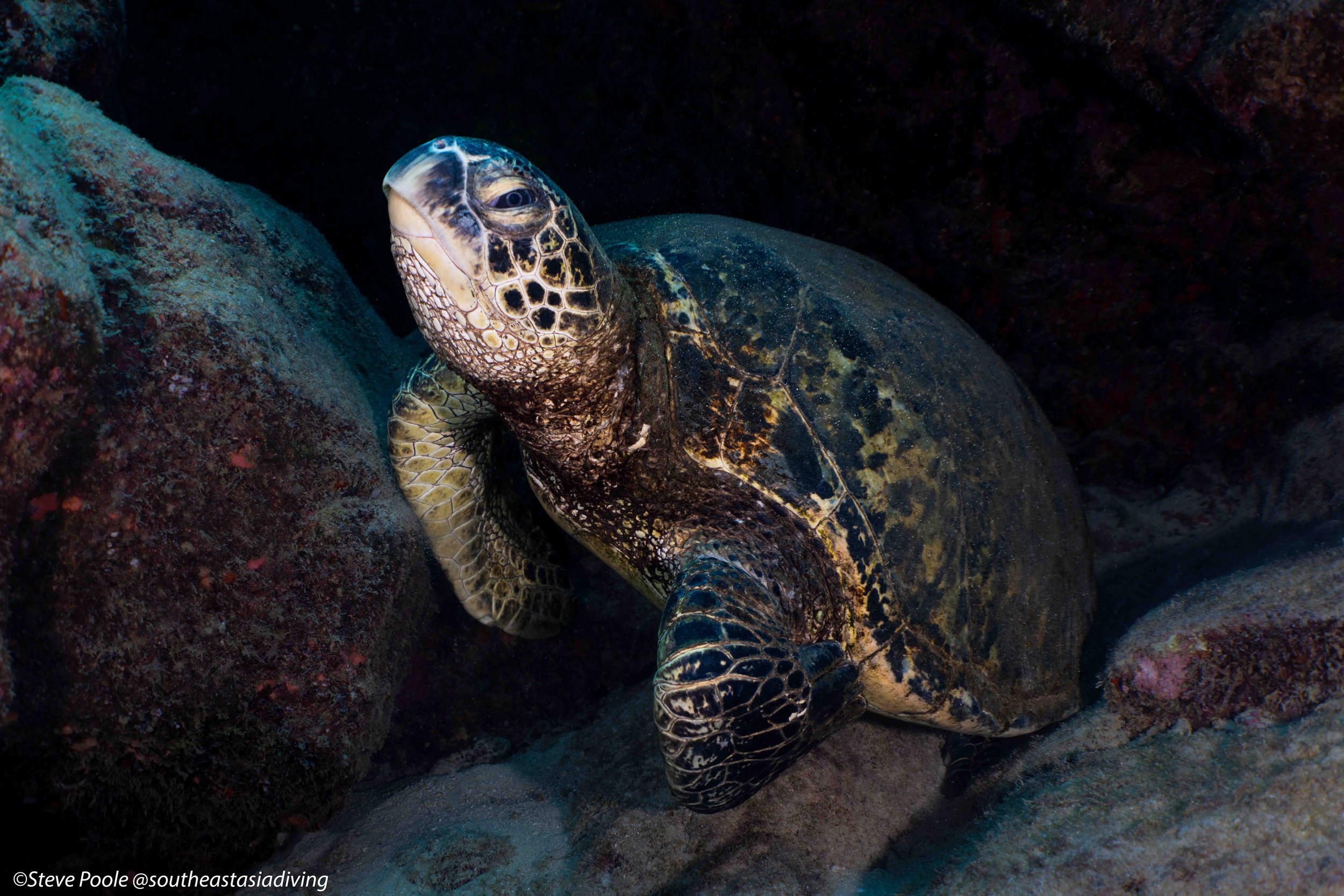
Green turtles were everywhere at Koloa Landing and also the south shore sites
At least the gear itself felt familiar. I'd brought my own kit rather than renting, and there's something reassuring about diving in equipment that already knows your body, even after such a long break. The one adjustment I hadn't accounted for was weight, my own, this time, rather than lead. A few pounds heavier than the last time I'd dived seriously, I needed a touch more weight on the belt than I was used to, which took a dive or two to dial in properly. The water was warm enough that a full wetsuit wasn't necessary, so I dived in a Sharkskin instead, a thin, close-fitting suit rather than neoprene, which always makes the buoyancy side of things easier to manage since there's so much less material to compensate for as you descend.
Well, the camera setup didn't quite go to plan.
I'd brought along my new Sony 100mm GM macro lens and spent time getting everything ready before the dive, but somewhere between assembling the housing and getting in the water, I'd knocked the focus ring into manual focus without realising it. For the entire first dive I couldn't understand why nothing would come sharp no matter what I tried, and it wasn't until we were back on the surface that I worked out what had happened. According to the dive computer, that first dive ran just over half an hour and stayed shallow, a gentle 9 metres at its deepest, which suited the situation perfectly: it turned into one of those dives where the photography genuinely didn't matter. Several Hawaiian green sea turtles cruised past along with plenty of reef fish, and it made for a properly enjoyable introduction to Kauai diving, even with virtually nothing usable to show for it afterwards.
The second dive, after a surface interval to fix the lens, was a different story. We spent closer to an hour in the water this time, working a little deeper along the reef to around 13 metres, and the extra care paid off. Turtles were still very much the theme of the day, but this time I actually managed to bring a few decent shots home. Two dives in, jet lag mostly shaken off, and I was properly excited for what the boat dives had in store.
First Day of Boat Diving – Damsel Land and Sheraton Caverns
Our boat diving got pushed back a day to 5 July, which turned out to work in our favour: the other group booked that morning had paid for a private dive guide, and since there was room on the boat, we got Julie, a wonderfully passionate and knowledgeable guide, completely free of charge.
The logistics couldn't have been easier. Fathom Five runs its boat dives out of Kukuiula Small Boat Harbour, which was only a short drive from the condo we were staying in, so there was none of the pre-dawn scrambling across the island that some Kauai dive sites demand. Once on board, the crew had our tanks and BCDs assembled and ready before we'd even finished our coffee, which felt like a small thing but genuinely wasn't. Having spent plenty of time diving around mainland America, where the culture tends to be far more self-sufficient, sort your own gear, carry your own cylinder, take responsibility for your own kit, it was a pleasant surprise to be looked after so thoroughly. It reminded us both far more of the boat operations we were used to across Southeast Asia than anything on the mainland.
The wind had other ideas about how relaxed the day would be. It picked up steadily through the morning, and by the time we surfaced from the first dive the swell had built enough to make the surface interval properly bumpy, nothing dangerous, but enough rocking and rolling on the boat that a couple of our fellow divers were looking a little green around the gills. Laura and I barely noticed it. Years of boat diving around Southeast Asia, where a lively swell between dive sites is more the rule than the exception, meant this felt entirely normal to us, even if it clearly wasn't to everyone on board.
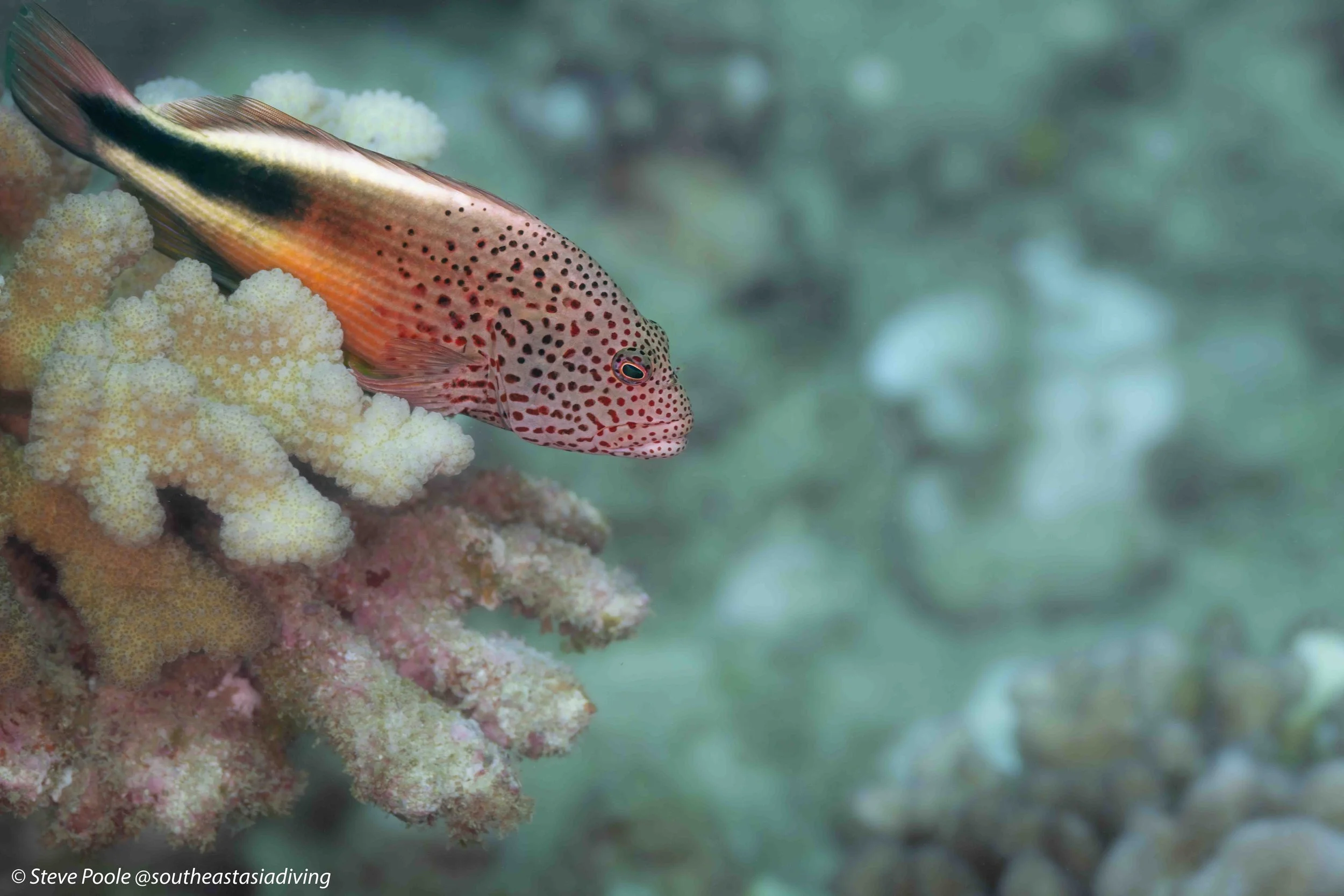
Endemic Hawkfish resting on coral
Damsel Land was the first site of the day, and while it was a pleasant enough dive, it didn't have quite the same drama as what followed. I'd set my camera up for wide-angle, expecting big scenery to be the theme of the day.
Sheraton Caverns had other ideas.
This is Fathom Five's signature boat dive and arguably the most photographed site on Kauai's south shore, and it's easy to see why. Three lava tubes run roughly 400 yards off the Sheraton Kauai hotel, riddled with archways, overhangs and swim-throughs that make the whole site feel more like a piece of underwater architecture than a natural reef. Turtles are so constant here that the local dive teams have half-joking nicknames for them, since after decades of the same boats visiting, the resident marine life barely reacts to divers at all. It's a density of turtles that reminded me of Sipadan, where after a few dives you stop reaching for the camera every time one swims past because another one is never far behind. We drifted through the tubes with sunlight filtering down through cracks in the lava overhead, turtles gliding past as though we weren't even there.
I'd packed for wide-angle, but once again the macro life stole the show. Tucked into the rock and coral we found a harlequin shrimp, several nudibranchs, an octopus, and a beautifully camouflaged frogfish, exactly the kind of small, patient discoveries that reward divers willing to slow down and look closely. Both dives that day ran a little over an hour, reaching a maximum depth of around 19 metres, comfortable, unhurried diving in water that stayed a steady 26°C throughout.
A few days later we headed out to Niʻihau, but that's a story for another post entirely.
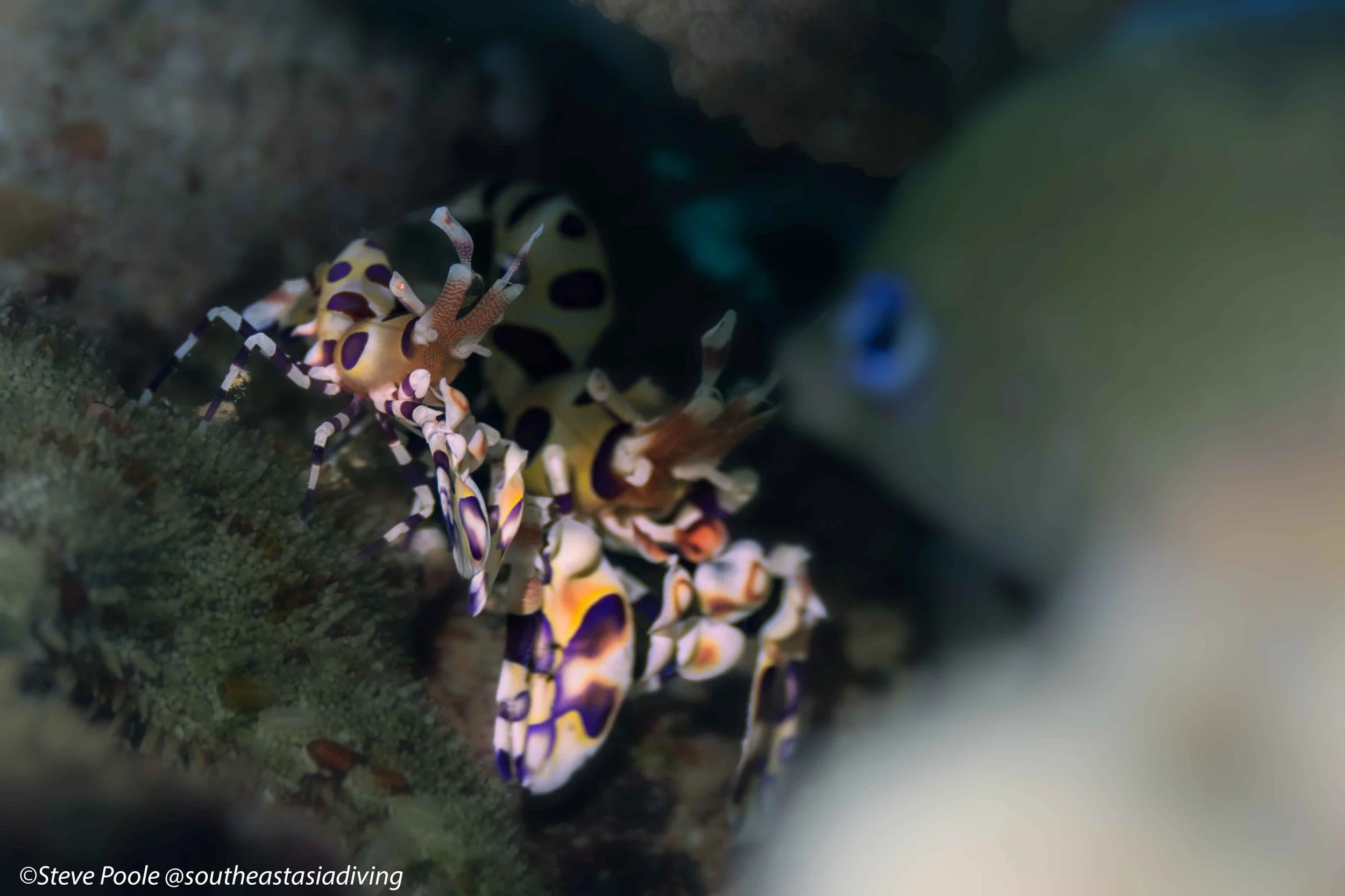
We saw Harlequin Shrimp on three dives
One Last Day – Three Fingers and Sheraton Caverns, Again
We'd enjoyed the south shore diving so much that we made a late decision to squeeze in one more day before flying home, heading back out with Fathom Five on 9 July. The wind that had picked up on the 5th hadn't really let up since, and if anything the swell rolling into Kukuiula was even choppier than before. It made for a properly rough ride out to the first site, and by the time we'd finished our two dives, several of the other divers on board had had enough of the conditions. Rather than push on for a third, the crew made the sensible call to head back to the harbour early. Laura and I would happily have stayed out longer, our years of diving Southeast Asia's channels and currents meant a bit of chop barely registered, but there's no arguing with a boat full of divers who've had enough, and it was the right call for the group as a whole.
Julie was our guide again, and our first site of the day was Three Fingers, a site I hadn't dived before. This time I'd deliberately set my camera up for macro, partly because the small stuff at Sheraton Caverns had been such a highlight, and it paid off immediately. We came across several moray eels, including a tiger moray, a species I'd never encountered before, along with another harlequin shrimp and a handful of nudibranchs tucked into the reef.
After a surface interval back at the harbour, giving the swell a chance to settle and everyone a chance to recover, we headed back out to Sheraton Caverns for one final dive. If anything, it might have been the best of the three visits. Frogfish, octopus, turtles, and yet another harlequin shrimp, our third sighting of the trip, made for a properly memorable way to end the diving on Kauai. Both dives that day ran close to an hour, with maximum depths around 17 to 19 metres and water temperatures still a comfortable 25 to 26°C.
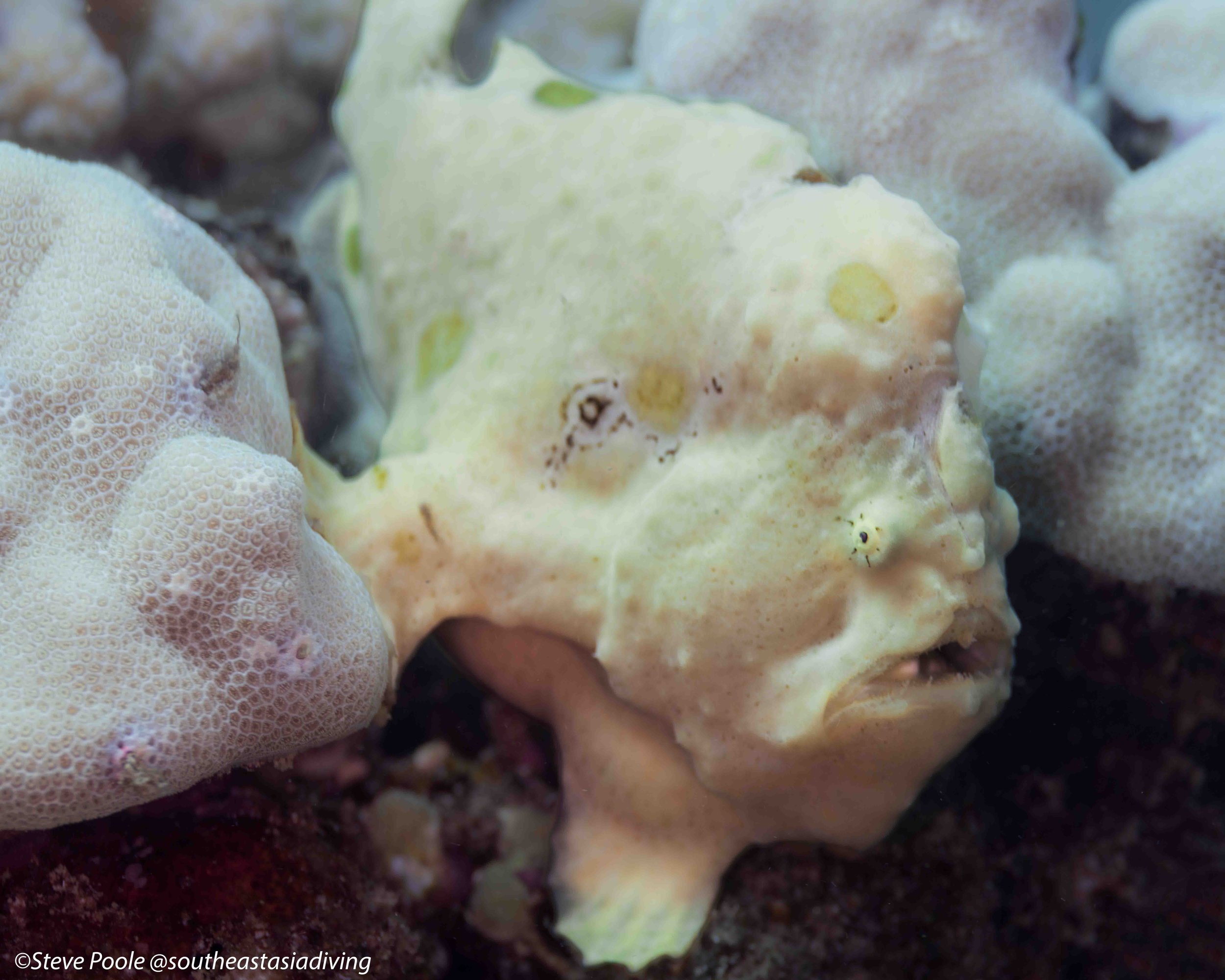
We also saw frogfish on a couple of dives
Final Thoughts
Three days, six dives, and a genuine surprise at just how much macro life was hiding among Kauai's volcanic scenery. I'd arrived expecting the south shore to be all about dramatic lava tubes and big animals, and while Sheraton Caverns delivered plenty of that, it was the harlequin shrimp, nudibranchs, frogfish and moray eels that ended up defining the trip for me, hunting through cracks in the lava in a way that reminded me more of muck and macro diving in Raja Ampat than anything I'd expected to find in Hawaii.
If I'm honest, the photography over these three days was okay rather than great, and by the end I found that mildly frustrating. Looking back, it isn't really surprising. Eighteen months away from a camera housing is a long time for muscle memory to fade, and one warm-up dive in Florida was never going to undo that on its own. What these six dives gave me instead was the process of slowly finding my feet again, or my fins, dive by dive: sorting out the manual focus mishap at Koloa Landing, switching between wide-angle and macro at Sheraton Caverns, and finally feeling genuinely comfortable again by the time we reached Three Fingers on the last day. That gradual rebuilding, more than any single photograph, is what I'll actually remember about this trip.
Just as much of the experience came down to the team at Fathom Five. Small, well-organised, and clearly full of people who genuinely love diving these waters, they made every dive easy and relaxed, from Rebecca's calm introduction at Koloa Landing to Julie's infectious enthusiasm out on the boat. It's the kind of operation that makes you want to come back, and I'm already looking forward to diving Kauai's south shore again.
FAQs: Diving Kauai's South Shore
Is Koloa Landing a good dive site for beginners or returning divers?
Yes. It's a sheltered, easy-entry shore dive with a shallow, forgiving reef, which makes it one of the best places on Kauai to warm up after time away from diving or to try scuba for the first time. Turtles and reef fish are reliably present, and conditions stay calm even when the weather elsewhere on the south shore doesn't cooperate.
What's the best boat dive site on Kauai's south shore?
Sheraton Caverns is the standout. Its three lava tubes, archways and swim-throughs make it Kauai's most photographed dive site, and the turtle density there rivals well-known Southeast Asia sites like Sipadan. Three Fingers is a strong second choice, particularly for macro life like moray eels, harlequin shrimp and nudibranchs.
Do you need your own dive gear in Kauai, or is rental enough?
Rental gear is widely available and perfectly serviceable, but diving in your own kit, especially your own wetsuit or Sharkskin, mask and fins, makes a real difference if you're getting back into diving after a break. Familiar gear removes one more variable while you're rebuilding buoyancy and confidence.
How windy or rough does boat diving get on Kauai's south shore?
It varies. Trade winds can build through the day, and a bumpy surface interval or choppier ride back to Kukuiula Harbour isn't unusual, particularly later in the day. Divers with experience in Southeast Asia's currents and channel crossings will likely find it manageable, but operators will sometimes cut a day short if conditions get uncomfortable for less experienced guests.
Is diving in Kauai similar to diving in Southeast Asia?
Not in terms of scenery, Kauai's volcanic swim-throughs and caverns look nothing like Southeast Asia's coral reefs, but the dive culture on Kauai's south shore, full-service boats where the crew handles your gear, felt far closer to Southeast Asia than to the more self-sufficient approach common on the US mainland.
How many dives do you need to properly explore Kauai's south shore?
Six dives across Koloa Landing, Sheraton Caverns (twice) and Three Fingers gave a solid first impression, but each site rewards repeat visits. Sheraton Caverns in particular is worth diving more than once, since the macro life on offer changes from visit to visit.