Diving Niihau: Sharks, Monk Seals, and Hawaii's Forbidden Island
Some dive trips start with a leisurely breakfast. This one started at Kukuiula Small Boat Harbour at 6am, in the dark, for what would turn into a twelve-hour day and, as it turned out, the best diving we did anywhere in Hawaii.
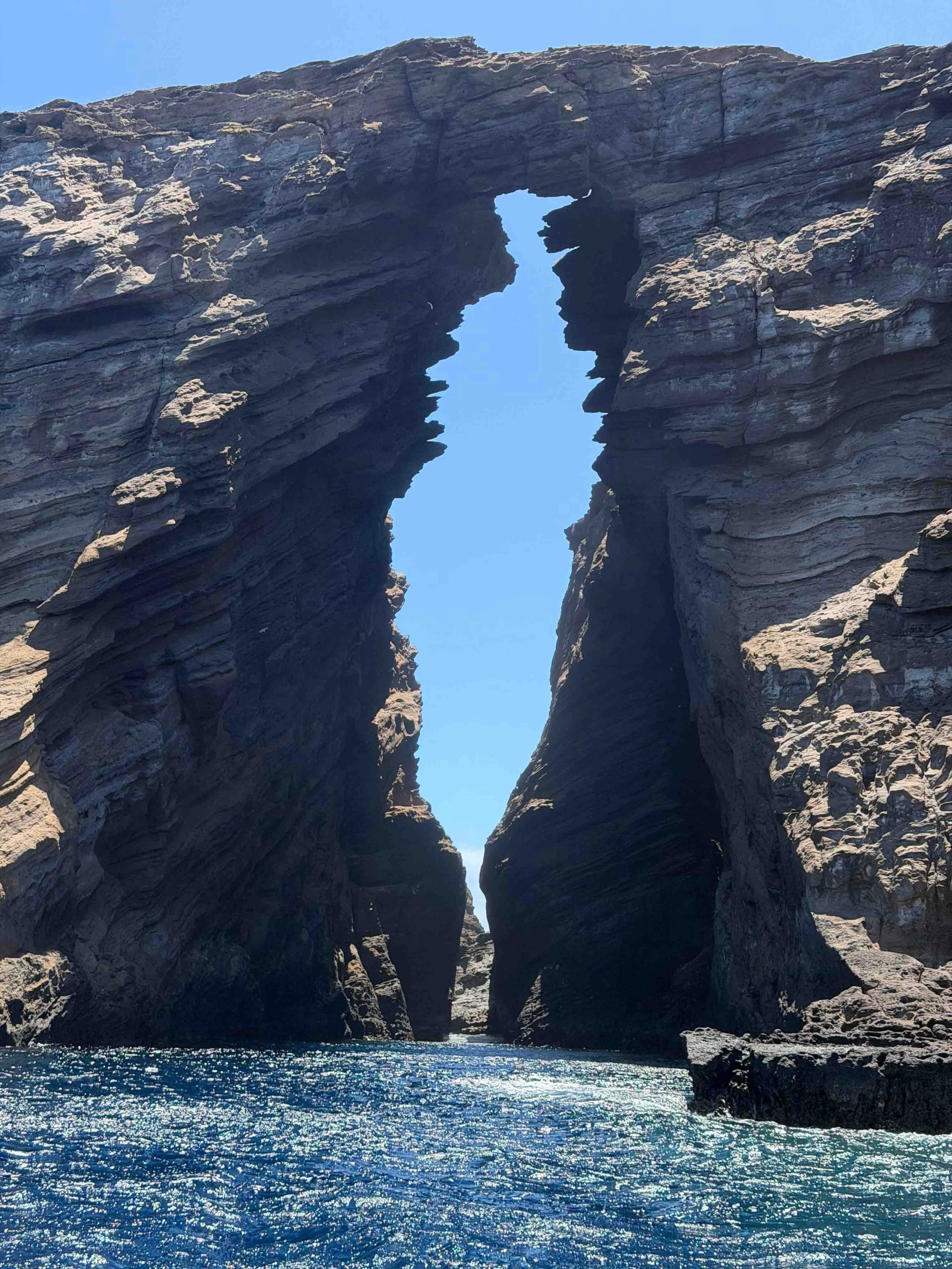
The Keyhole at the Lehua crater
The Forbidden Island
Niihau sits just 17 miles off Kauai's west coast, close enough to see on a clear day, and yet it might as well be a different century. The island has been owned by a single family, the Robinsons, since 1864, when their ancestor Elizabeth Sinclair bought it from King Kamehameha V for $10,000 in gold, and, depending on which account you believe, a grand piano thrown in to help seal the deal. Kamehameha reportedly asked one thing in return: that the family look after the Hawaiian people and their culture if the day ever came when they needed help. The Robinsons have spent more than a century and a half honouring that request, which is exactly why Niihau has earned its nickname of the Forbidden Island. There are no roads, no cars, no internet, and only around a hundred residents, all of whom still speak Hawaiian as their first language, the only place left in the state where that's true.
To be clear, we didn't set foot on Niihau itself. Almost nobody does. Outside visitors need an invitation from the Robinson family or government clearance, and the family has spent generations protecting the island's isolation rather than opening it up. What dive boats actually visit is the channel between Niihau and Lehua, a small crescent-shaped island just offshore, the exposed rim of an old volcanic crater and now a protected seabird sanctuary. It's close enough to Niihau to share its remoteness and its marine life without ever setting foot on the forbidden island itself, which somehow makes the whole day feel even more special rather than less.
How Niihau and Lehua Were Formed
The geology here is almost as interesting as the history. Niihau itself is the exposed remnant of a single shield volcano that erupted roughly five million years ago, part of the same hotspot that built the entire Hawaiian island chain as the Pacific plate slowly drifted over it. What's left today, Mount Paniau, once stood over 4,600 feet above sea level and has since eroded down to a little over 1,200 feet, though it still runs some 13,000 feet from the ocean floor to its current summit.
Lehua, the crescent-shaped islet where all the actual diving happens, is younger and formed very differently. It's a tuff cone, built not by lava simply flowing and cooling but by a series of violent submarine explosions, hot magma meeting cold seawater, flashing it instantly to steam, and throwing ash and rock skyward in the process. Layer after layer of that ash settled and cemented into tuff around the eruption vent, building the cone that later eroded into the crescent shape you see today, two long horns wrapping around a central basin. It's that same layered, explosively formed rock that gives Lehua's underwater walls their distinctive banded strata, the very same "geological storybook" look I found so striking on the Vertical Awareness wall.
The Crossing
Quick Facts: Diving Niihau
- Crossing time: ~2.5 hours each way from Kauai
- Dive sites: Vertical Awareness, Neon Cave, Niihau Arches
- Number of dives: 3, all on nitrox
- Depth range: 19–26 metres
- Water temperature: 25°C (77°F)
- Difficulty: Advanced / experienced divers recommended
- Total day length: ~12 hours, departing Kukuiula Small Boat Harbour at 6am
- Operator: Fathom Five Divers
We were on the water with Fathom Five Divers again, this time with two other divers joining Laura and me, our guide Shaun and boat captain Sergio, both immediately likeable and clearly very used to long days like this one. Lunch and snacks were already loaded onto the boat before we'd even had our coffee.
The crossing to Lehua takes around two and a half hours each way, and the crew had thought of everything, including marine bean bags scattered around the boat that made the ride far more comfortable than I expected. We set off just as the sun was rising over Kauai, the whole island lit up in soft gold and pink for a few minutes before the light flattened out into ordinary daylight, genuinely one of the most beautiful things I saw the entire trip, and a properly good reason to be awake and on the water at 6am. The winds hadn't picked up yet, so the crossing out was smooth for the most part, with only the last half hour or so turning properly bumpy as we got close to Niihau's waters.
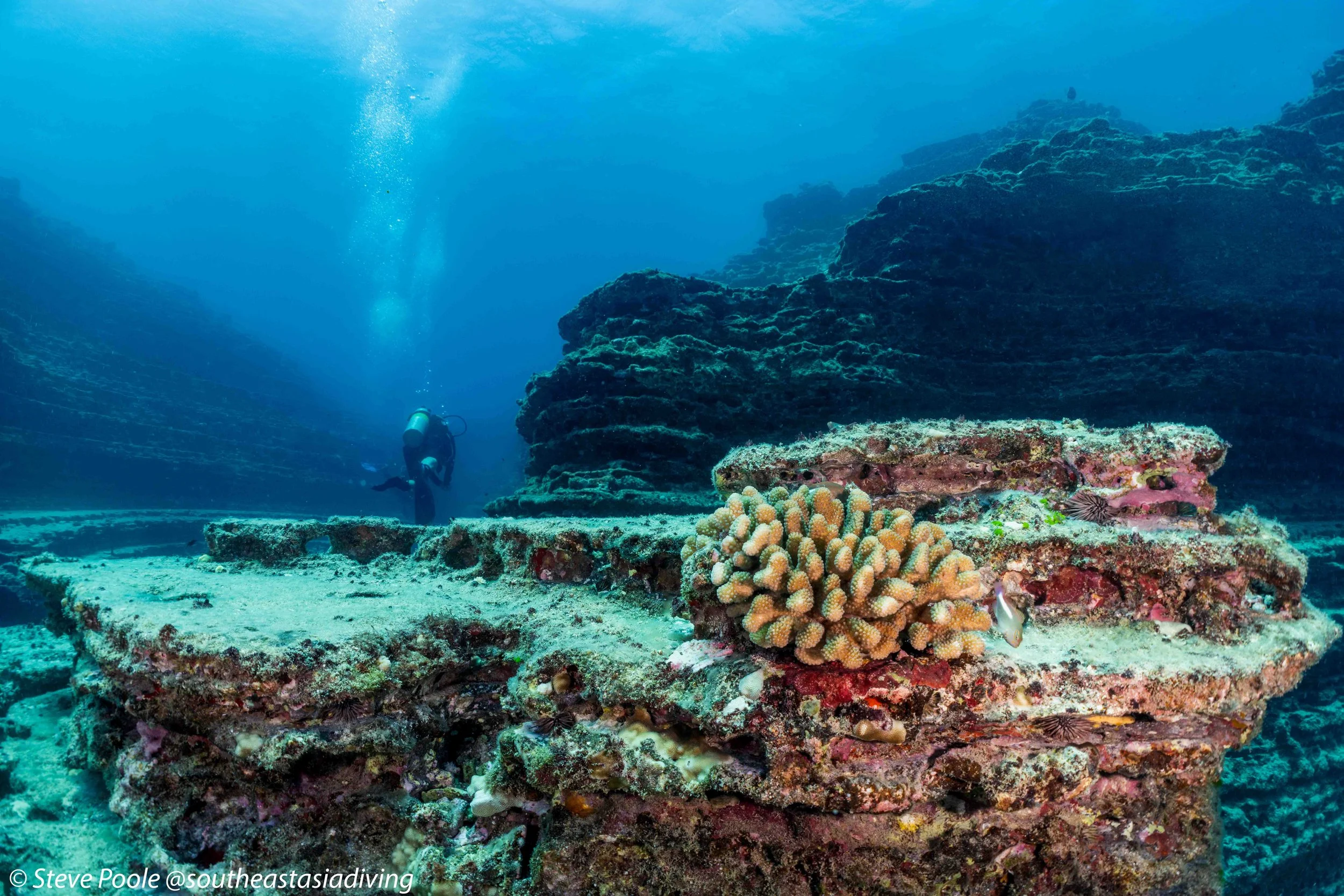
The impressive underwater topography of Ni’ihau
Dive One: Vertical Awareness
We backrolled in just after 9:40am to water that was warm, clear, and completely unlike anything I'd dived before. I'd settled on 8lbs of weight for the trip, and it showed: buoyancy felt noticeably more dialled in than it had just a few days earlier on the south shore, one less thing to think about on a dive where there was already plenty to take in. Vertical Awareness is Lehua's signature site for good reason: a wall that drops away into the depths in a way that makes you feel genuinely small, built from layer after layer of ancient lava flows stacked on top of each other over however many thousands of years.
We were greeted almost immediately by a Hawaiian monk seal, one of the rarest marine mammals on the planet, who was clearly curious about us but far too smart to let it show. Every time we turned to actually look at him, he'd vanish, which made him almost impossible to photograph and very easy to fall a little bit in love with.
Shaun filled us in on the background later, and it's a genuinely remarkable story. Hawaiian monk seals are among the most endangered marine mammals anywhere, with only around 1,600 left in total, and the vast majority of those live scattered across the remote Northwestern Hawaiian Islands, hundreds of miles from anywhere. For a long time, almost none lived in the main islands at all. Conservation efforts, including deliberate translocations to help the species recover, have gradually helped seals re-establish themselves closer to the populated islands, and Niihau and Kauai now hold the largest share of that small main-islands population, only a few hundred animals in total. The name itself comes from their solitary habits, seals that generally travel and rest alone rather than in colonies, and from the fold of skin around their neck that's said to resemble a monk's cowl. Having one shadow us for most of a dive, then vanish the instant we turned to look, felt like a small privilege given how few of them there are left.
Beyond the seal, the dive delivered a genuinely broad cross-section of what Niihau is known for: a sandbar shark cruising past, a spiny lobster tucked into the rock, a day octopus, a moray eel, and a nudibranch for good measure. According to the dive computer, we spent just under an hour in the water, reaching a maximum depth of 26 metres, deeper than any dive we'd done on Kauai's south shore, in a comfortable 25°C.
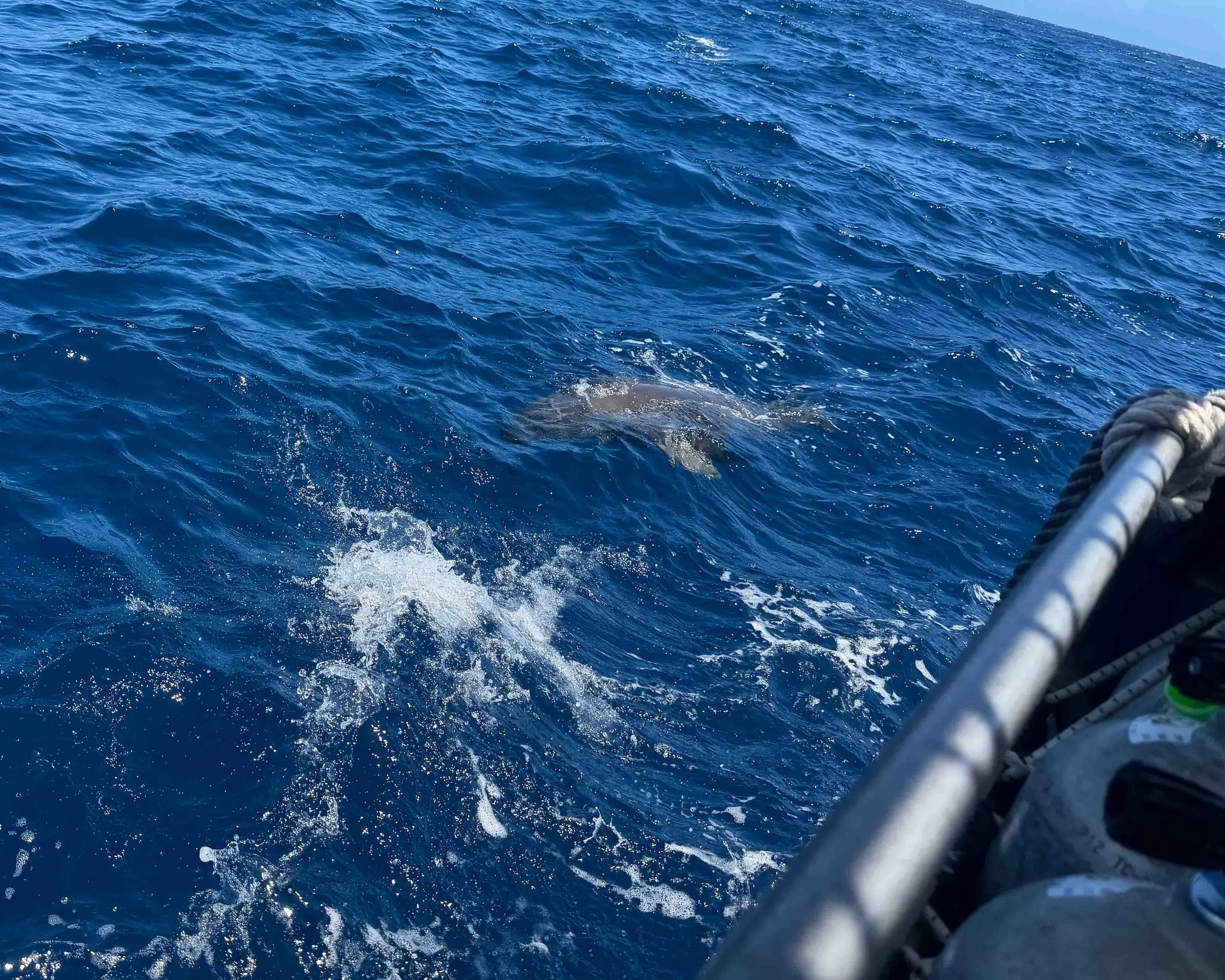
A monk seal plays at the surface
Between Dives: Lunch, Lehua, and a Very Good Storyteller
Between dives, Shaun turned out to be an excellent source of local history, filling the surface intervals with stories about Niihau and the Lehua Crater that made the whole day feel richer than just the diving itself. We had the entire site to ourselves, no other boats, no other divers, just Lehua's cliffs, its seabirds, and the occasional monk seal spotted resting on the rocks from the boat between dives. Lunch was simple and exactly what was needed: a turkey sandwich that tasted considerably better than it had any right to after a five-and-a-half-hour morning that already included one deep dive.
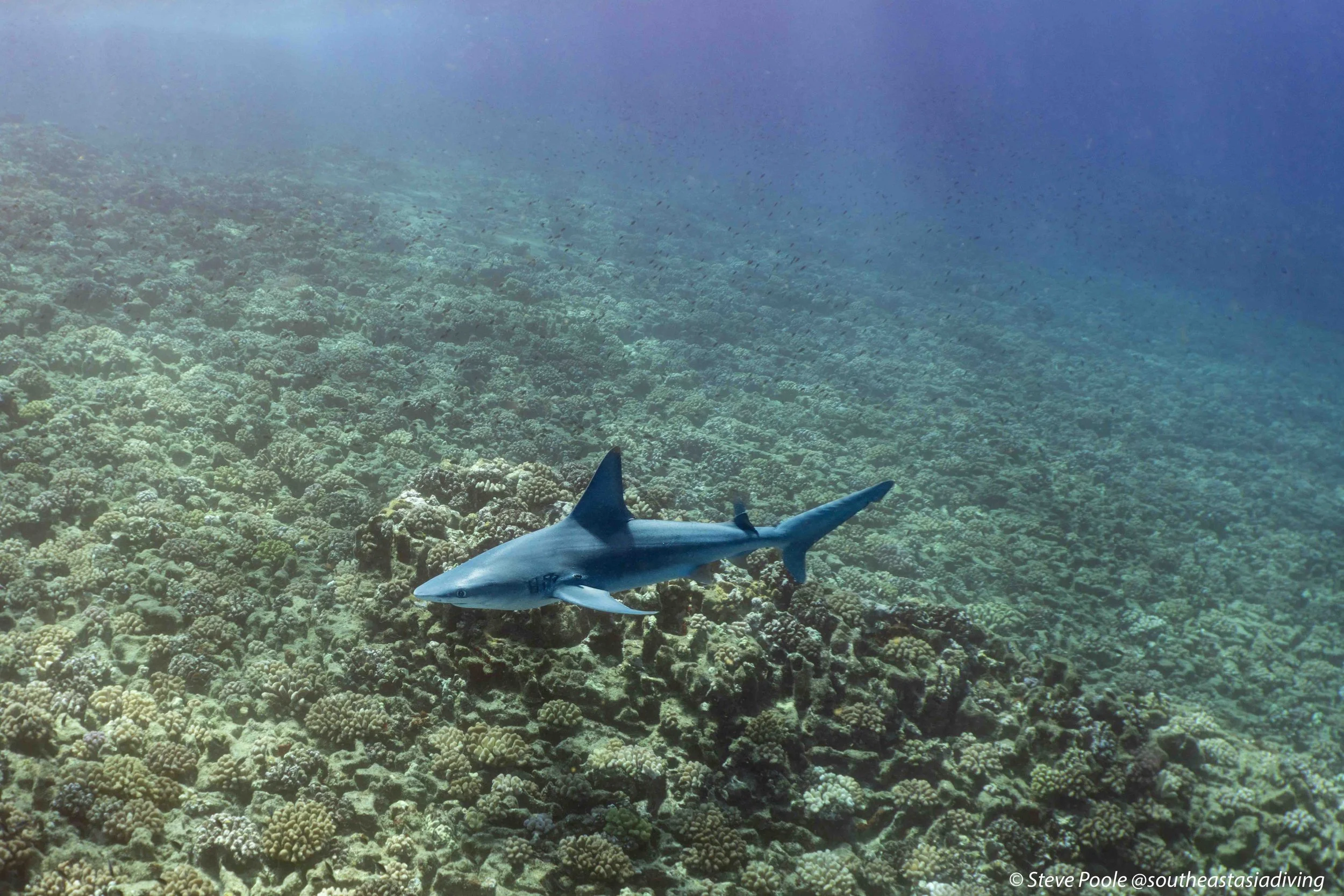
An exceptionally inquisitive Sandbar Shark follows us
Dive Two: Neon Cave
We entered the water again at 11:40am at a site called Neon Cave, and if the first dive had been about scale, this one was about encounters. A grey reef shark passed by, our camera-shy monk seal friend made a reappearance, and then, most memorably, a sandbar shark decided we were worth investigating properly, following us for almost the entire dive. There's something genuinely thrilling about a shark choosing to stick around out of curiosity rather than caution, circling back again and again rather than disappearing into the blue. The dive ran close to an hour, topping out at 24 metres in a steady 25°C, and by this point the nitrox we were diving on all three tanks was clearly paying off. No deco time stayed generous throughout, and we came up from each dive feeling far less drained than a day of repeated deep diving normally leaves you.
Dive Three: Niihau Arches
Our final dive of the day started at 1:30pm at Niihau Arches, and it might have been my favourite of the three. The topography here is genuinely hard to describe without sounding like you're exaggerating: enormous lava tubes and swim-throughs, some large enough to drive a truck through, arranged in a way that felt less like a natural reef and more like walking through a cathedral built by something ancient and very patient. Light streamed down through cracks and openings overhead, turning the whole site almost ethereal at points, quiet and eerie in the best possible way. Our monk seal, or one very like him, followed us again for most of the dive, still resolutely camera-shy no matter how slowly we moved. The dive ran a similar length to the other two, a shade over 57 minutes, with a maximum depth of 19 metres and an average of 11, in water that stayed just as warm at 25°C throughout, gentler than the two dives before it, which felt like exactly the right way to close out the day.
The Journey Home
Sergio warned us before we left that the ride back would be rough, and he wasn't exaggerating. The first thirty minutes were properly wild, the roughest crossing I've done since heading out to Atauro Island in Timor-Leste, though not quite as bumpy as that one. We got thoroughly soaked, which barely registered given we'd already spent the entire day wet anyway. At one point the ladders at the back of the boat, raised out of the water for the crossing, kept working themselves loose and had to be re-secured more than once. Gradually, though, the ride settled into more of a rhythm, and by the time Kauai came back into view the water had calmed enough for Sergio to properly open up the throttle. We got back to Kukuiula around 6pm, a full twelve hours after we'd left, exhausted in the particular way that only a proper day of diving can leave you.
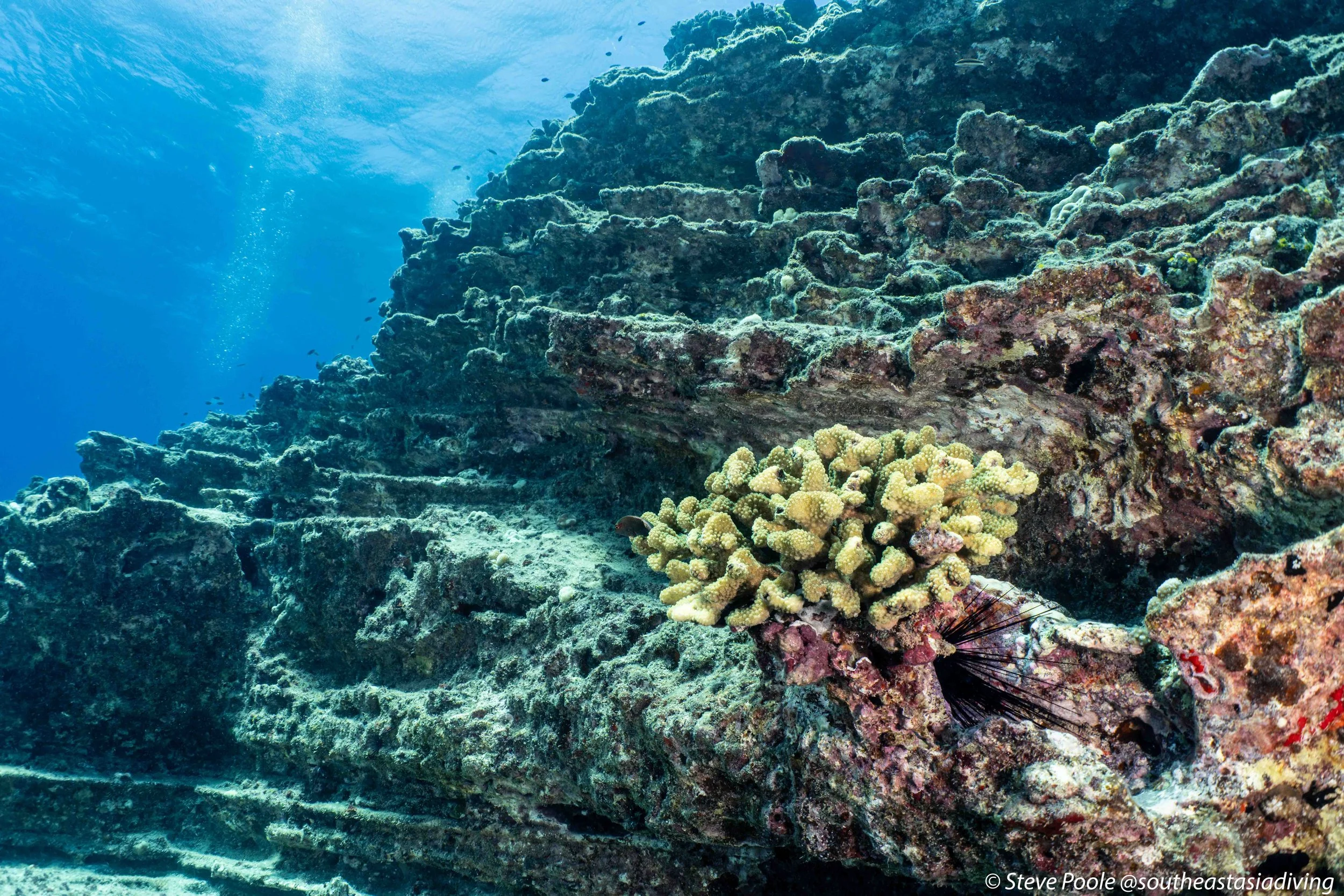
Ni’ihau underwater is almost otherworldly
Final Thoughts
Was it like anything I'd dived before? Not really. There's barely any coral here, nothing like the walls of hard and soft coral I've spent years photographing in Raja Ampat, and no sheer drop-offs thick with schooling barracuda and jacks the way Sipadan delivers them almost on demand. Niihau doesn't try to compete on that kind of abundance, and it doesn't need to. What it offers instead is walls, arches and lava tubes that sometimes look almost too deliberate to be natural, like something built rather than formed, closer in spirit to the volcanic drama of Komodo than the reef-heavy diving of the Philippines, but really its own thing entirely. Between the monk seals, the sandbar shark that wouldn't leave us alone, and topography unlike anything either of us had seen, this was, without question, the best diving we did anywhere in Hawaii, even before factoring in the history of the place we'd just spent the day circling. Niihau doesn't let many people in, but the water around it more than makes up for what the island itself keeps hidden.
FAQs: Diving Niihau and Lehua Crater
Can you actually visit Niihau?
Not in the way most people think. Niihau itself is privately owned by the Robinson family and closed to outside visitors without a direct invitation or government clearance. Dive and snorkel boats from Kauai visit the channel between Niihau and the neighbouring islet of Lehua, not the island itself, which is how divers get access to the area's marine life without ever setting foot on Niihau.
How do you dive Niihau from Kauai?
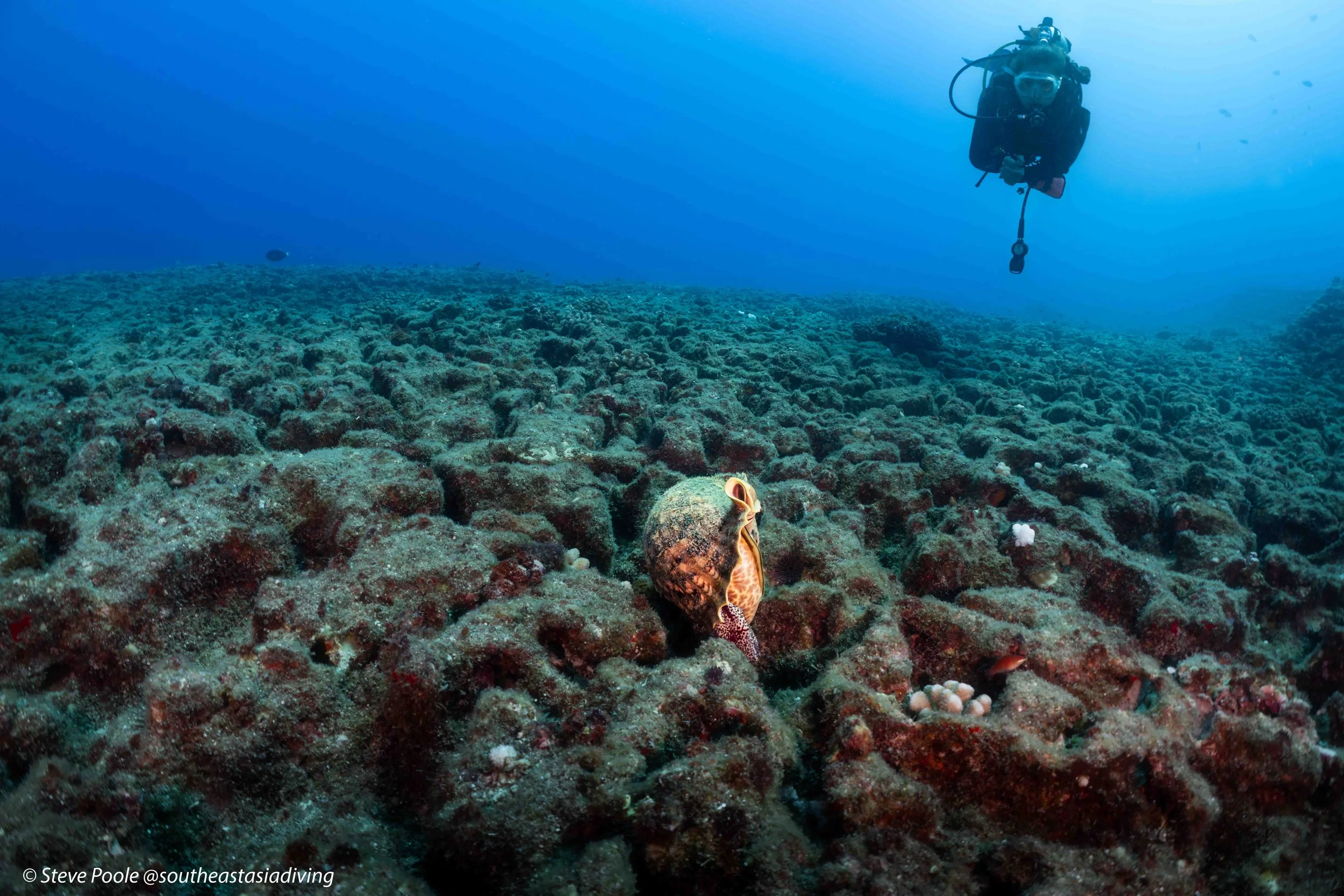
A triton snail on a lava bed
Several dive operators, including Fathom Five Divers, run full-day charters from Kauai's south shore, typically departing very early from a harbour like Kukuiula. It's roughly a two-and-a-half-hour crossing each way, with two or three dives at Lehua in between, making for a ten-to-twelve-hour day in total.
Is diving Niihau suitable for beginner divers?
Generally, no. The remoteness, potential for strong current, open-ocean crossing, and depths involved mean most operators recommend it for more experienced or advanced divers. Conditions can also be unpredictable, and trips are sometimes cancelled or rescheduled if the weather doesn't cooperate.
Why is the Hawaiian monk seal endangered?
Hawaiian monk seals are endemic to Hawaii and found nowhere else on Earth. Historic hunting reduced their numbers drastically, and today the population, estimated at around 1,600, continues to face threats from food limitation, shark predation, and human disturbance. Conservation efforts, including translocations, have helped a small population re-establish in the main Hawaiian Islands, with Niihau and Kauai now home to some of the highest concentrations outside the remote Northwestern Hawaiian Islands.
What's the best dive site at Lehua Crater?
Vertical Awareness is generally considered the signature site, a dramatic wall dropping away into deep water where sharks and monk seals are regularly encountered. Niihau Arches and Neon Cave are close contenders, known for their lava tube swim-throughs and cathedral-like topography.
Why is Niihau called the Forbidden Island?
The nickname dates back to 1864, when the Sinclair family, ancestors of today's Robinson family, purchased the island and began restricting outside access to protect the Hawaiian language and way of life still practised there today. It remains one of the last places in Hawaii where Hawaiian is spoken as the primary language.