🪸 What Divers Get Wrong About Reef-Safe Diving
(And What Actually Helps)
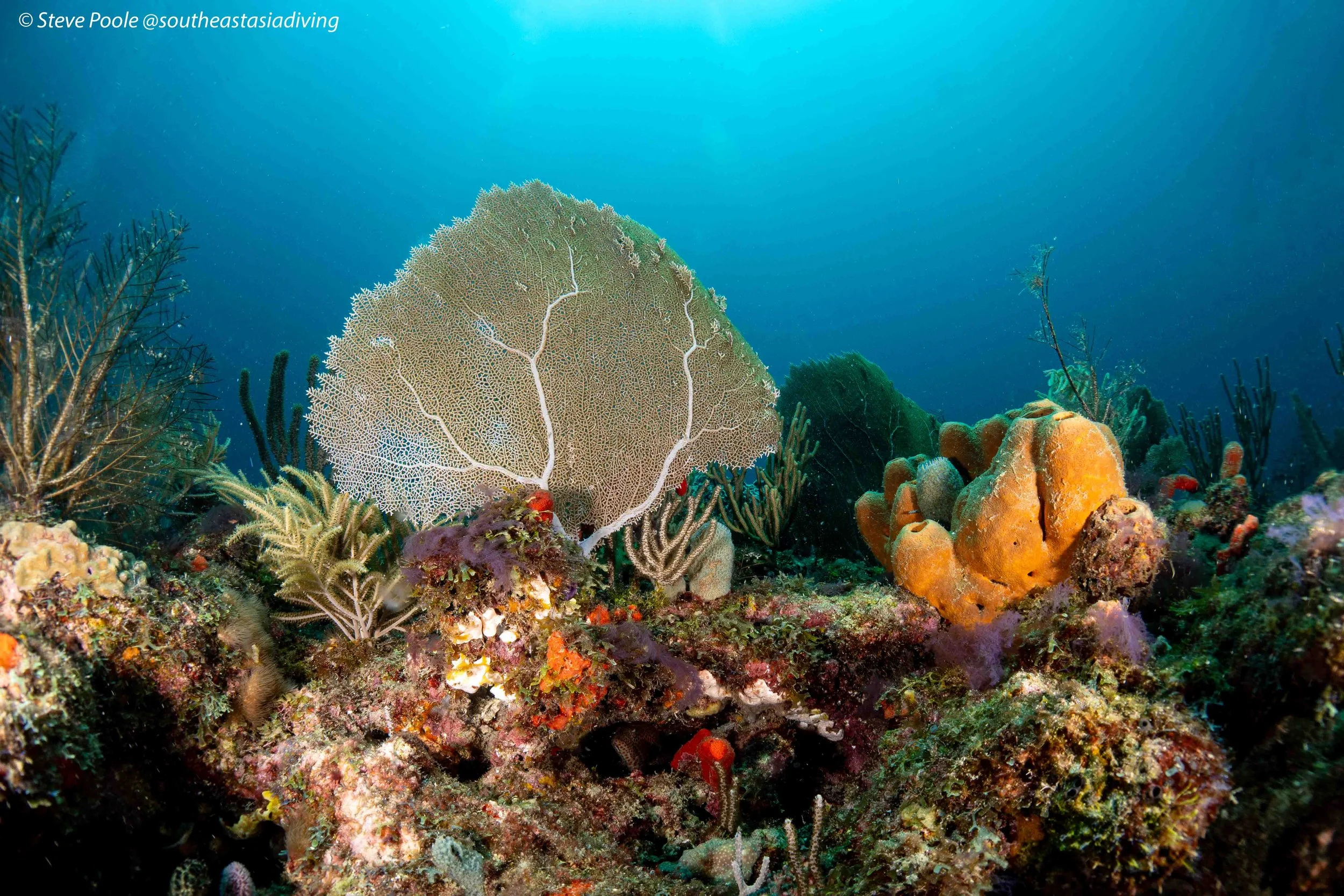
Healthy Corals
🧭 Introduction: Why “Reef-Safe” Needs a Reset
Reef-safe diving is talked about more than ever — and that’s a good thing. Most divers genuinely care about the places they visit. They want to protect reefs, reduce their impact, and make responsible choices underwater. Awareness has grown, conversations have improved, and reef protection is now part of mainstream dive culture rather than a niche concern.
But somewhere along the way, reef-safe has started to function more as a comforting label than a clearly defined practice. In many discussions, reef safety is reduced to a short checklist: use reef-safe sunscreen, don’t touch coral, dive only in marine parks. None of these ideas are wrong — they absolutely matter. The problem is that they’re often treated as sufficient, particularly in busy dive regions where reefs experience constant human pressure.
Across much of Southeast Asia, reef damage today is rarely driven by bad intentions or careless divers. It’s driven by scale. More divers, more boats, more courses, more cameras, and more social media exposure all funnel activity toward the same iconic sites, season after season. Even small, repeated impacts add up when they happen thousands of times a year.
In that context, the details begin to matter far more than slogans or product choices. Buoyancy control, situational awareness, how close divers hover without realizing it, how long groups remain in shallow zones, and how guides manage spacing and timing all play a larger role in reef health than most people expect. These factors rarely make it into marketing materials, but they quietly shape whether reefs recover or slowly degrade.
Reef-safe diving isn’t about doing more, and it isn’t about achieving perfection. It’s not about guilt, restriction, or avoiding famous dive sites altogether. It’s about doing the right things consistently, especially in places where reefs are already under pressure because they’re loved, not ignored.
This guide focuses on the behaviors that matter most underwater, rather than myths, marketing terms, or feel-good shortcuts. Because protecting reefs in Southeast Asia isn’t about staying away — it’s about learning how to dive them better.
🧠 How Reef-Safe Diving Is Often Simplified — and Why That’s a Problem
Modern reef-safe messaging tends to focus on what divers buy rather than how they dive. Sunscreens, certifications, marine park fees, and eco-labels are visible, marketable, and easy to communicate. They provide reassurance that the right choices have been made before anyone even enters the water. And to be clear — these things do matter. They are part of responsible diving.
The problem is that they’re often treated as the primary solution, rather than a baseline.
By focusing so heavily on products and credentials, reef-safe diving is unintentionally framed as something that can be achieved at the surface. Once the boxes are ticked — reef-safe sunscreen applied, permit paid, certification card shown — the more difficult conversation about underwater behavior quietly fades into the background.
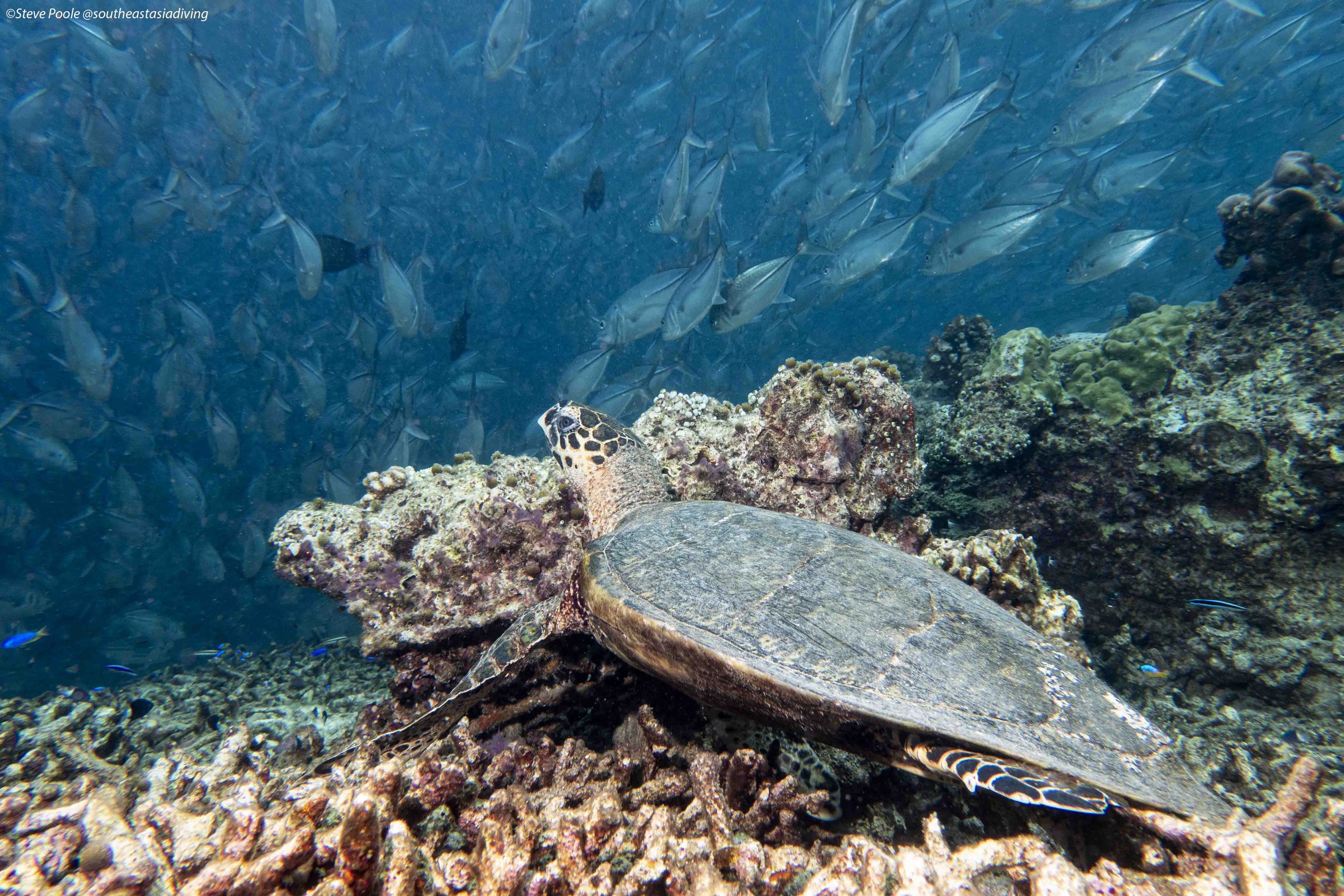
Coral damaged over time at South Point, Sipadan
But reef health isn’t determined at the shop counter or on a booking confirmation. It’s shaped underwater, dive after dive, by cumulative interactions that are rarely dramatic on their own. A fin tip brushing coral. A camera stabilised against rock. A group hovering too long in shallow water. None of these moments feel significant in isolation, yet repeated thousands of times, they become the dominant force behind reef wear in popular dive areas.
This is where many well-intentioned divers unknowingly focus on the wrong priorities. They’ve made responsible choices on land, but haven’t been given the tools — or the emphasis — to translate that responsibility into consistent behavior underwater. As a result, reef-safe diving becomes something people identify with, rather than something they actively practice.
If reef protection is the goal, the conversation has to move beyond labels and toward habits. Because reefs don’t respond to intentions — they respond to what happens around them, minute by minute, beneath the surface.
❌ Myth #1: Reef-Safe Sunscreen Is the Most Important Thing
Sunscreen has become the headline action of reef-safe diving. It’s visible, easy to understand, and heavily marketed. Choosing a product labeled “reef-safe” feels like a clear, responsible decision — and in some contexts, it is a sensible one.
The problem is that sunscreen is often treated as the most important reef-protection measure, when in reality it carries far more symbolic weight than practical impact on most dive sites.
Why This Myth Exists
Sunscreen fits neatly into consumer logic. It’s a tangible choice that can be made quickly, it feels proactive, and marketing often suggests an immediate environmental benefit. From a messaging standpoint, it’s far easier to promote a product than to teach skills like buoyancy, spatial awareness, or group control underwater.
There are also environments where sunscreen genuinely matters. In shallow lagoons, snorkel-heavy bays, and enclosed coastal areas with limited water exchange, certain chemical compounds can contribute to localized stress. In these settings, reducing chemical load does make sense and should be part of broader site management.
The issue isn’t sunscreen itself — it’s the overreliance on sunscreen as a proxy for reef safety.
What Causes More Damage in Reality
On most heavily dived reefs — particularly across Southeast Asia — physical disturbance causes far more cumulative damage than sunscreen exposure from scuba divers. Poor buoyancy control, uncontrolled fin kicks, sediment clouds, dangling equipment, and accidental contact happen hundreds of times a day on popular sites. Each incident may seem minor, but collectively they break coral tips, smother delicate polyps, and alter fish behavior over time.
In these conditions, reefs are shaped less by what divers apply to their skin and more by how they move through the water. Focusing primarily on sunscreen can unintentionally divert attention away from the behaviors that actually determine reef condition dive after dive.
A Better Approach
A more effective way to reduce chemical impact is often to reduce the need for sunscreen in the first place. Rash guards, leggings, hats during surface intervals, and shade on boats all limit exposure without adding chemical load to the water. When sunscreen is needed, thoughtful and limited application remains a reasonable choice.
Sunscreen still matters — but it works best as part of a wider, behavior-based approach rather than as a standalone solution.
Reef-safe diving doesn’t start with what you put on your skin. It starts with how you position your body, control your buoyancy, and move through the reef itself.
❌ Myth #2: Touching Coral Is the Biggest Problem
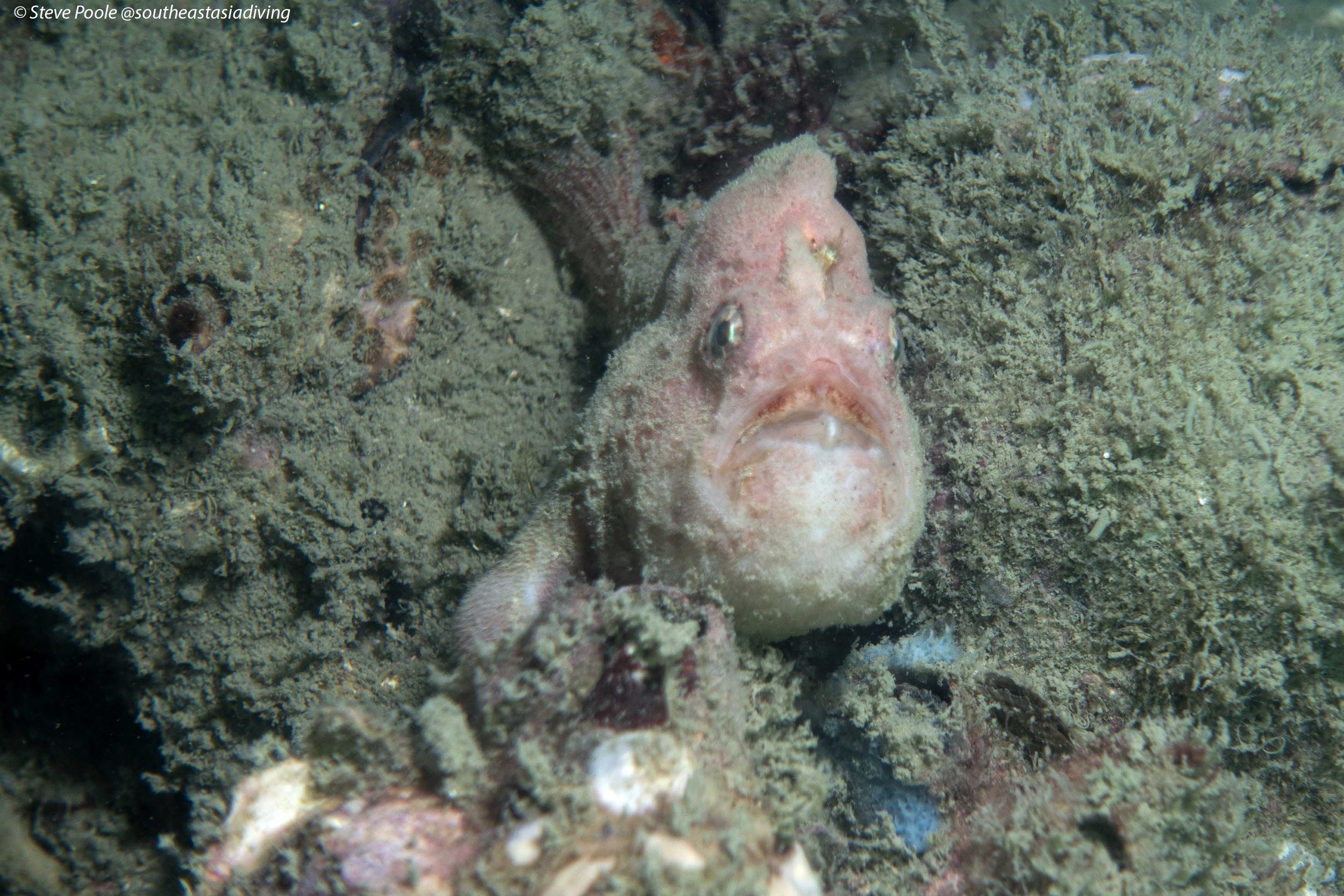
Damaged corals at Pulau Langkawi, Malaysia
“Don’t touch the coral” is one of the first rules divers learn — and for good reason. Coral is fragile, slow-growing, and easily damaged by direct contact. As a baseline message, it’s simple, memorable, and important.
The problem is that when reef-safe diving is reduced almost entirely to not touching coral with your hands, it obscures a much larger issue. On heavily dived reefs, most damage isn’t caused by intentional contact at all — and it rarely involves hands.
In busy dive environments, the most common sources of reef damage are accidental. Fin kicks close to the bottom, sculling to maintain position, sediment stirred up during descents, dangling gauges or camera rigs, and poor trim that causes divers to drift into coral all occur far more frequently than deliberate touching. These actions often happen without the diver even realizing it, yet their cumulative impact is significant.
Over time, repeated fin strikes break coral tips, clouds of sediment smother polyps, and constant disturbance alters fish behavior. None of this feels dramatic in the moment, which is precisely why it’s so damaging at scale. A diver may follow the “no touching” rule perfectly while still causing repeated harm through poor positioning and lack of awareness.
In many cases, a diver who briefly steadies themselves with a fingertip — in a controlled, unavoidable moment — may cause less overall damage than a diver who spends an entire dive hovering poorly and kicking coral without noticing. This isn’t an argument for touching reefs, but a reminder that impact is about patterns, not isolated actions.
Reef-safe diving depends less on rigid rules and more on control. Neutral buoyancy, stable trim, and full-body awareness prevent most reef contact before it happens. When those skills are solid, the need to think about touching coral largely disappears — because contact simply doesn’t occur.
Reefs aren’t damaged by hands alone. They’re damaged by a lack of control.
❌ Myth #3: Certification Automatically Equals Reef Awareness
Certification is essential. It makes diving possible, establishes safety standards, and provides the foundation every diver needs. But certification was never designed to guarantee reef awareness — and treating it as such creates a false sense of security.
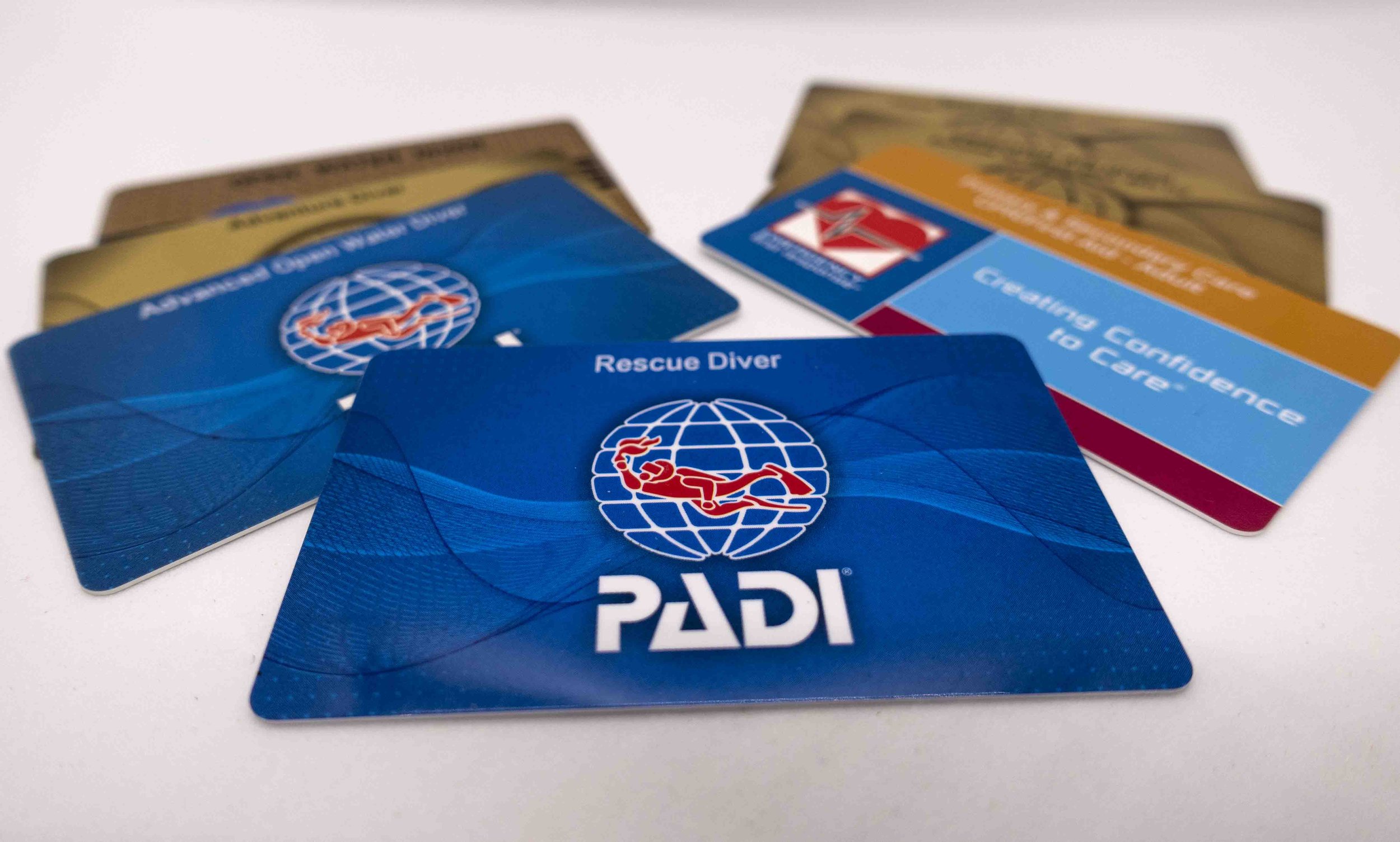
Certification doesn’t necessarily make you a reef safe diver
Most entry-level courses quite rightly prioritize survival skills: breathing, ascent control, emergency procedures, and basic buoyancy. Reef awareness is usually introduced conceptually, framed around respect and avoidance, but true mastery develops later. And that development is uneven. Some divers actively refine their skills with intention and feedback, while others simply repeat the same habits dive after dive.
This is where experience can become misleading. Logged dives don’t automatically translate into good buoyancy, spatial awareness, or refined trim. A diver can accumulate hundreds of dives while still kicking up sediment, drifting into coral, or struggling to hold position — especially in shallow, high-impact environments.
As task load increases, these gaps become more visible. Adding a camera, dealing with currents, navigating crowded sites, or diving in large groups demands greater control and awareness. In many cases, confidence grows faster than skill, and familiarity replaces attentiveness. The diver feels experienced, but their impact on the reef quietly increases.
Reef awareness isn’t something granted by a certification card, nor is it guaranteed by a dive count. It’s a skillset that develops through deliberate practice, honest self-assessment, and continued refinement. Divers who recognize this tend to improve steadily; those who don’t often plateau without realizing it.
Reef-safe diving, in the end, is not a credential. It’s a commitment to how you dive, not simply proof that you’re allowed to.
❌ Myth #4: Marine Parks Guarantee Healthy Reefs
Marine parks are valuable tools for conservation — but designation alone doesn’t equal protection. When well-managed, clearly regulated, and properly enforced, marine parks can significantly reduce pressure on reefs and allow ecosystems to recover. In those cases, they work.
The challenge is that not all marine parks function the same way. Some struggle with limited funding, inconsistent enforcement, unclear oversight, or visitor numbers that exceed what reefs can realistically absorb. In these situations, reefs inside marine park boundaries may experience many of the same stresses as unprotected sites, particularly in shallow, high-use areas.
A protected status doesn’t improve buoyancy, manage group behavior, or reduce crowding underwater. It doesn’t prevent sediment clouds from forming or stop repeated fin contact in popular zones. Those factors are shaped by how dives are conducted — by group size, guide practices, timing, and diver awareness — rather than by lines drawn on a map.
This is why diver behavior and operator standards continue to matter, even inside designated marine areas. Marine parks can create the conditions for protection, but they don’t deliver it automatically. Without responsible diving practices and realistic limits on use, protection exists mostly in name.
Marine parks help. They provide structure, funding pathways, and legal frameworks. But they don’t replace thoughtful, controlled diving — and they can’t compensate for it when pressure becomes too concentrated.
❌ Myth #5: Individual Divers Don’t Really Make a Difference
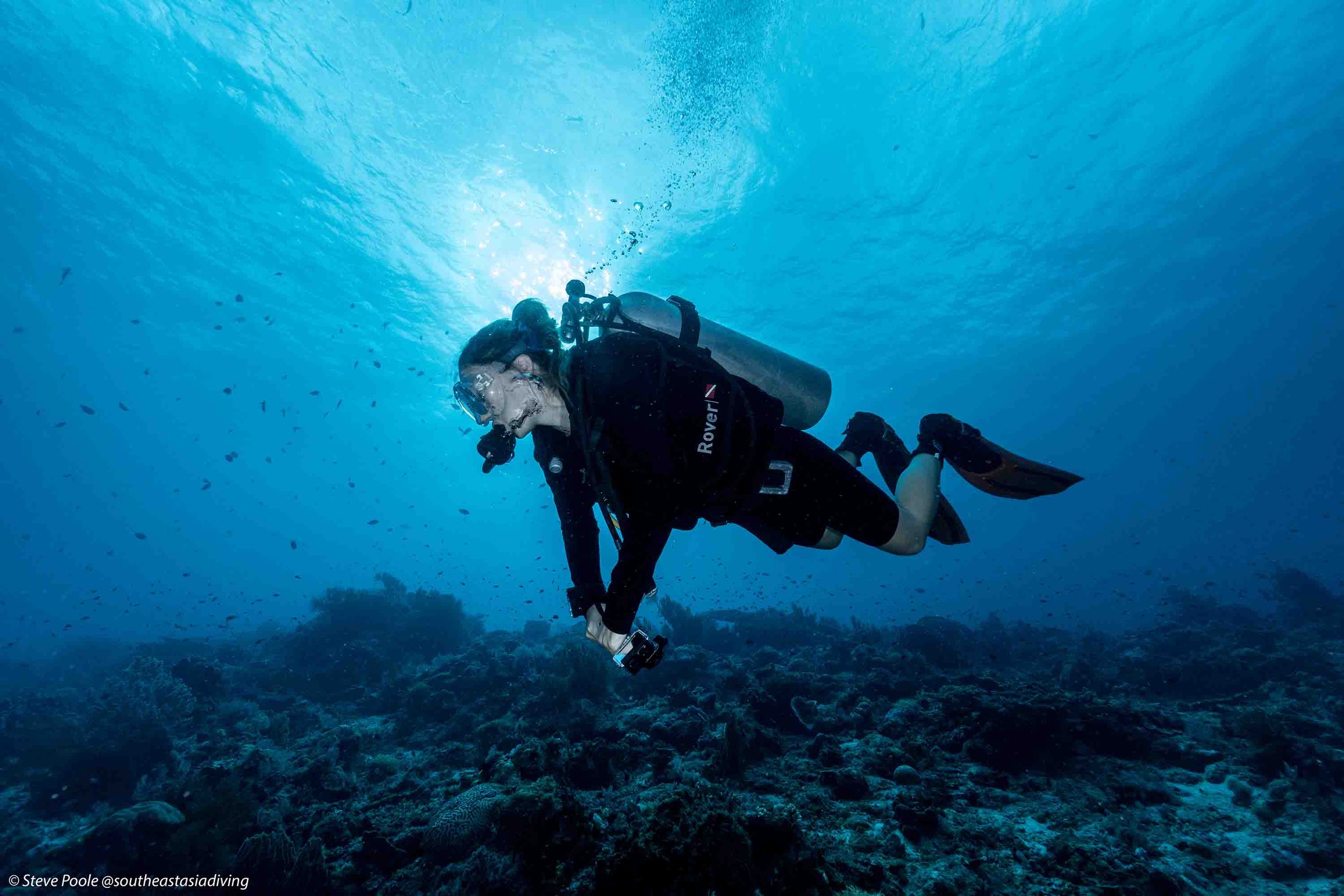
“It’s just one diver” feels reasonable — until you consider scale.
In popular dive regions, small behaviors are multiplied rapidly. A single diver with poor buoyancy, dragging fins or gear, or hovering carelessly near the reef may seem insignificant in isolation. But when that same behavior is repeated across hundreds of dives per week — day after day, season after season — it becomes a meaningful and measurable source of stress.
Reefs aren’t shaped by single dramatic events. They’re shaped by thousands of small interactions. A fin brushing coral here. A pressure gauge dragging across the bottom there. Camera rigs, alternate air sources, or loose accessories unintentionally sweeping over fragile structures. These habits are rarely malicious, but they are common — and they accumulate.
This is one reason equipment configuration matters more than many divers realize. Dangling gear increases the risk of contact even when the diver feels stable. Poorly secured hoses, consoles, or camera accessories can cause repeated damage without the diver ever noticing. Reef-safe diving includes how gear is set up, streamlined, and managed underwater — not just how it’s used.
Recognizing individual impact isn’t about guilt or blame. It’s about agency. Every diver contributes to the environment they’re moving through, whether intentionally or not. And that also means every diver has the ability to reduce their impact through awareness, control, and small adjustments that compound positively over time.
Reef-safe diving isn’t reserved for experts or professionals. It happens one diver, one dive, and one decision at a time.
✅ What Actually Helps Reefs (Consistently)
Once labels, shortcuts, and oversimplified rules are stripped away, reef-safe diving becomes much clearer. Reefs don’t respond to intentions or branding — they respond to repeated conditions underwater. When pressure is reduced and behavior improves consistently, many reefs show a real capacity to stabilize and recover, even in heavily visited regions.
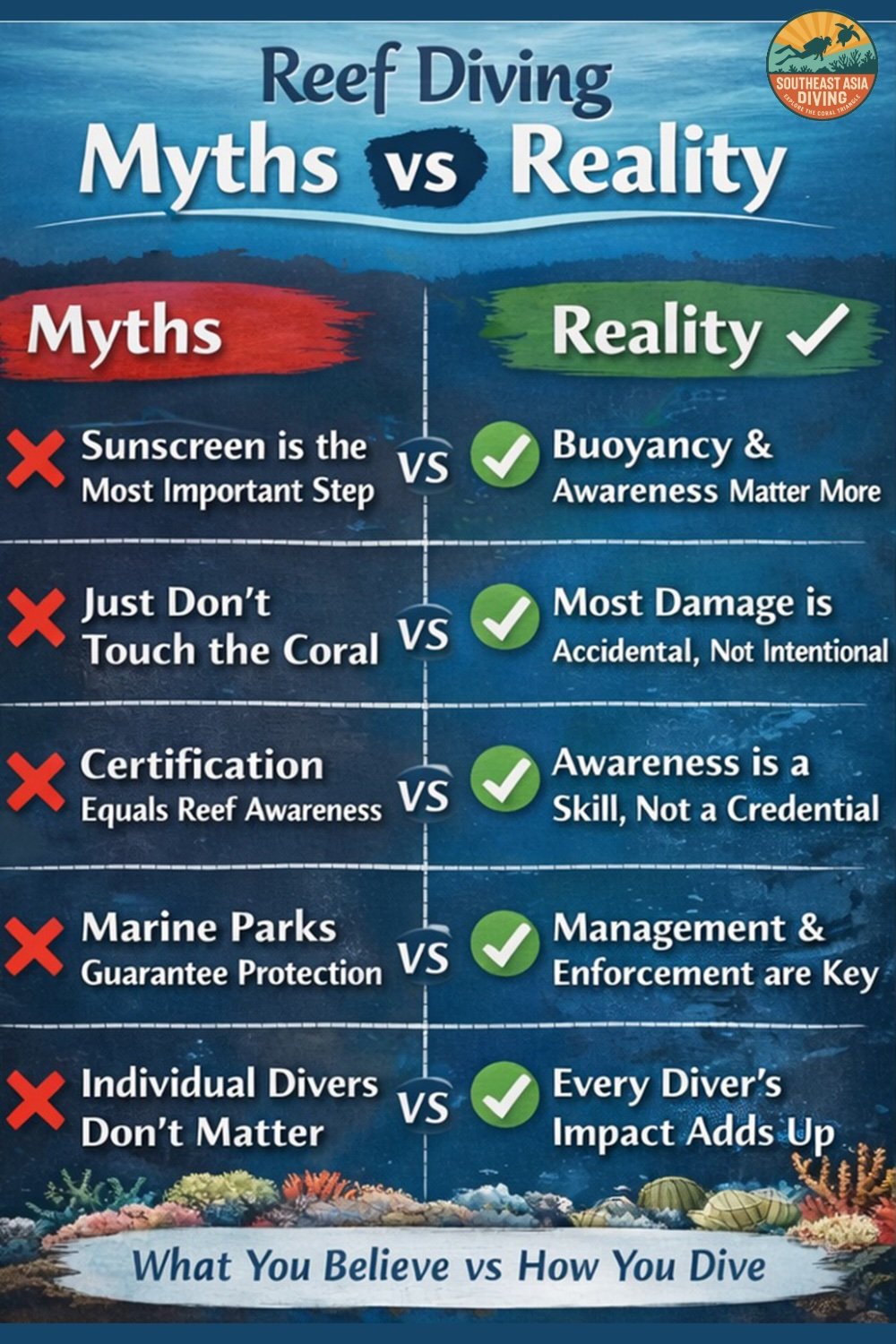
The single most effective factor is excellent buoyancy and situational awareness. Neutral buoyancy prevents fin contact, reduces sediment clouds, and minimizes accidental collisions before they happen. Awareness extends beyond hands to the entire diver profile — fins, hoses, gauges, camera rigs, and body position all matter. When control improves, physical contact drops dramatically, and reefs are given space to function without constant disturbance.
Thoughtful dive planning plays an equally important role. Avoiding peak pressure times, rotating sites, matching dive conditions to diver ability, and resisting the urge to force dives when conditions aren’t right all reduce cumulative stress. Reefs recover not because divers disappear entirely, but because pressure becomes intermittent rather than relentless.
Operator practices amplify or reduce this effect. Responsible operators who limit group sizes, enforce buoyancy standards, rotate sites, and conduct clear, honest briefings consistently reduce reef stress. Over time, these practices allow corals to regrow, sediment to clear, and fish behavior to normalize — outcomes that are observable on reefs where pressure is actively managed rather than simply permitted.
Reducing chemical load still matters, but it works best when approached thoughtfully. Physical sun protection such as rash guards, leggings, hats, and shade during surface intervals often eliminates the need for heavy sunscreen use. When sunscreen is necessary, limited and strategic application helps minimize impact without sacrificing comfort or safety.
Perhaps most importantly, slowing down changes everything. Smaller groups, better spacing, calmer movements, and fewer rushed dives lead to fewer collisions and more stable reef interactions. Marine life behaves more naturally, divers gain better control, and reefs experience longer recovery windows between disturbances.
Reef-safe diving isn’t about perfection or purity. It’s about consistency. When divers and operators repeatedly create the right conditions, reefs are remarkably resilient — and they respond.
🧾 Final Thoughts: Reef-Safe Is a Practice, Not a Product
Reef-safe diving was never meant to be something you buy, wear, or tick off a checklist. It’s a way of approaching the underwater world — with skill, awareness, and intention — dive after dive.
Most divers already care. The difference isn’t motivation; it’s focus. Too often, attention is directed toward products and labels, while the behaviors that matter most underwater receive far less emphasis.
In regions like Southeast Asia, where biodiversity is extraordinary and diving pressure is highly concentrated, reefs are shaped by cumulative actions. How divers move, hover, descend, manage their equipment, plan their dives, and choose operators matters far more than any single decision made on land.
The most reef-safe diver isn’t the one with the right products.
It’s the one who dives well — consistently.
❓ Frequently Asked Questions About Reef-Safe Diving
What does reef-safe diving actually mean?
Reef-safe diving means minimizing physical and environmental impact through good buoyancy, situational awareness, thoughtful dive planning, and responsible choices — not relying solely on products or labels.
Is reef-safe sunscreen enough?
No. Reef-safe sunscreen can help reduce chemical input, particularly in shallow or enclosed areas, but physical contact, sediment disturbance, and poor buoyancy cause far more cumulative damage on most dive sites.
What causes the most reef damage from divers?
The most common sources are fin kicks near the bottom, sediment stirred up during descents, poor buoyancy and trim, dangling equipment, crowding, and repeated accidental contact — often without the diver realizing it.
How can beginner divers protect reefs?
Dive conservatively, focus on buoyancy early, keep generous distance from the reef, avoid task overload, and choose operators who prioritize small groups and good in-water control.
Do dive operators really matter?
Yes. Operators influence group size, site rotation, dive timing, briefing quality, and underwater behavior. Their standards directly affect cumulative reef impact.
Is reef damage worse in Southeast Asia?
Not worse — but more concentrated. High diver numbers at iconic sites mean small improvements in behavior scale quickly, for better or worse.
What’s the single most important reef-safe habit?
Good buoyancy combined with full-body awareness. When those are solid, most reef contact never happens in the first place.