🌊 How to Dive Safely in Strong Currents (Komodo Diving Guide)

Some of the best dive sites in the world — from Komodo National Park, Raja Ampat, to the reefs of Indonesia and beyond — are defined by strong ocean currents.
These currents drive nutrient-rich water across the reef, attracting everything from reef fish to sharks, manta rays, and large pelagic species. In short, no current often means less life — while strong current usually means unforgettable diving.
But for many divers, currents come with a question:
Is it actually safe to dive in strong current?
If you’ve ever felt unsure about whether you’re “ready” for current diving — or worried about staying in control underwater — you’re not alone. It’s one of the most common concerns before diving destinations like Komodo.
The good news?
Current diving isn’t about strength — it’s about technique, awareness, and staying relaxed.
Once you understand how currents work — and how to position yourself in them — they become something you use, not something you fight.
In this guide, you’ll learn:
How to dive safely in strong currents
The key skills every diver needs Practical techniques used in places like Komodo
Common mistakes to avoid
So whether you’re planning your first trip to Komodo or simply want to feel more confident in moving water, this guide will help you dive smarter, safer, and with far less effort.
⚠️ Are Strong Currents Dangerous?
It’s one of the first questions divers ask when researching destinations like Komodo:
Are strong currents actually dangerous?
The short answer is no—currents themselves are not inherently dangerous. What creates risk is how divers respond to them.
In most situations, problems don’t come from the current itself, but from a combination of factors like poor buoyancy control, panic or overexertion, lack of awareness, or not following the dive plan. When divers try to fight the current, swim against it, or rush their movements, that’s when stress levels rise and mistakes happen.
Strong currents can feel intimidating at first—especially if you’re used to calm, sheltered dive sites. The sensation of movement, the speed of the water, and the idea of “losing control” can all trigger anxiety. But in reality, most current dives are controlled, predictable, and carefully managed.
At well-run dive destinations like Komodo, dive operators plan everything around the conditions. They monitor tides, understand how currents behave at specific sites, and choose entry and exit points accordingly. Briefings are detailed and practical, so you know exactly what to expect before you even enter the water.
You’re not being dropped into chaos—you’re being guided through a system that experienced dive professionals understand extremely well.
It’s also worth remembering that currents are the reason these dive sites are so special in the first place. They bring in nutrients, concentrate marine life, and create the kind of dynamic underwater environments that make places like Komodo world-class.
Once you shift your mindset—from seeing currents as something to fight, to something to work with—they become far less intimidating.
With the right techniques, a calm approach, and good guidance, current diving isn’t just safe—it’s often where the most rewarding diving happens.
🌪️ Understanding the Types of Currents
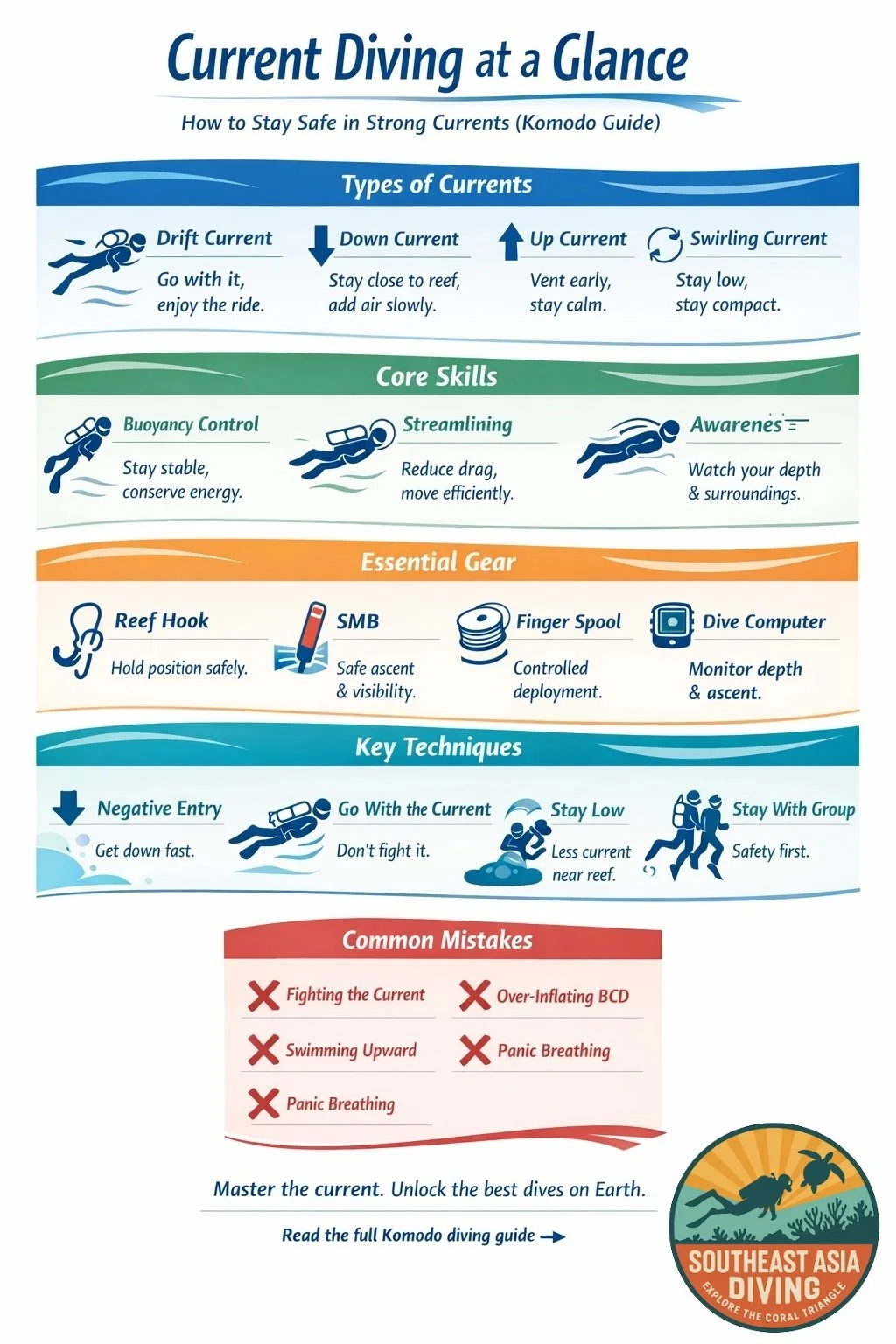
Not all currents feel the same underwater—and knowing what you’re dealing with can make a huge difference to how safe and comfortable you feel. In most dive destinations with moving water (like Komodo), you’ll encounter a mix of current types. Learning to recognize them—and how to respond—quickly builds confidence.
Here are the main types of currents divers experience—and the specific challenges each one can present:
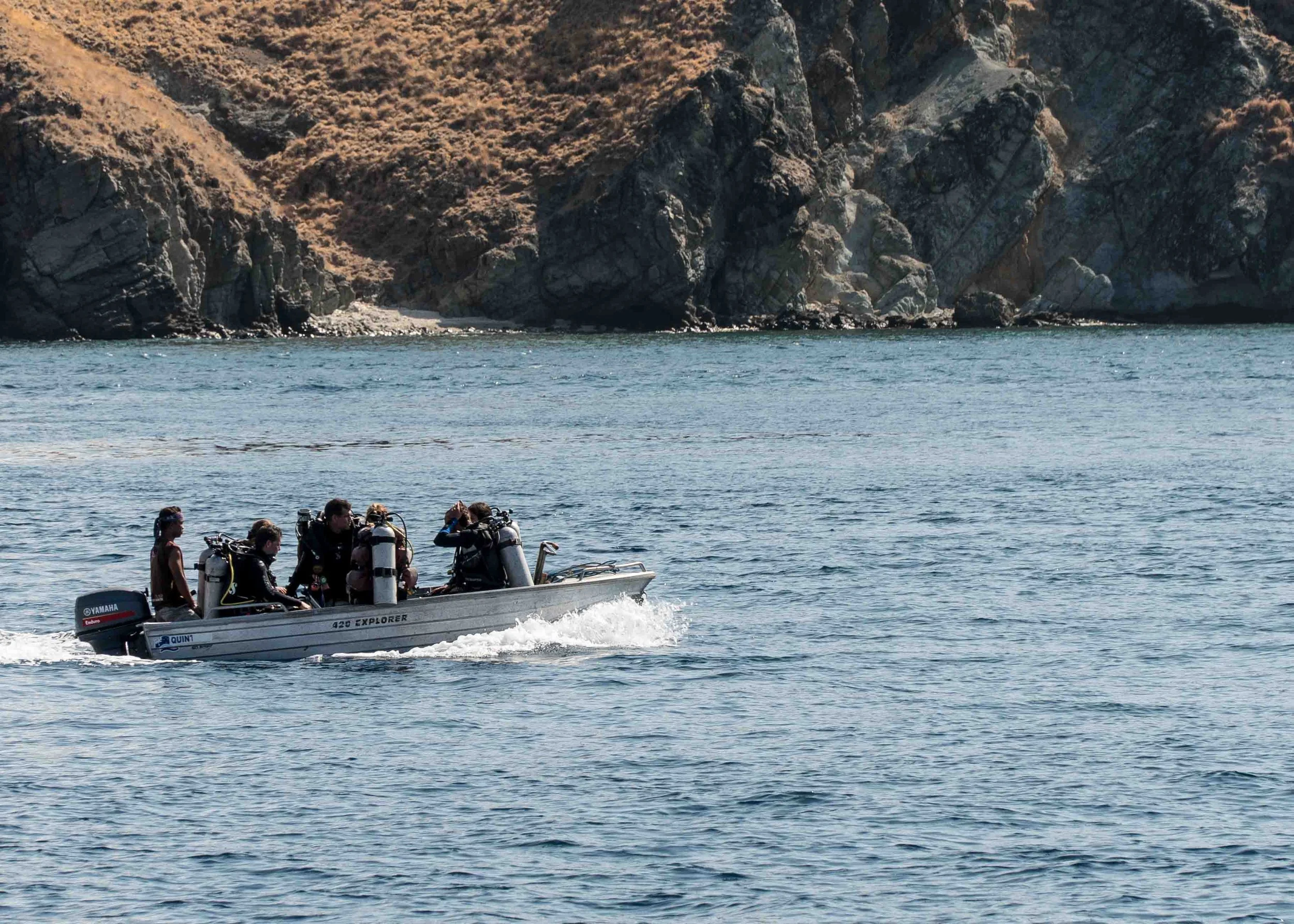
➤ Drift Currents
Drift currents are the most common—and often the most enjoyable. Instead of fighting the water, you move with it, allowing the current to carry you effortlessly along the reef.
Think of it as:
Flying underwater while the reef passes beneath you.
These dives are typically low effort and high reward, especially in places like Komodo where currents attract large schools of fish and pelagic life.
Potential risks:
Drifting away from your group if you’re not paying attention
Missing the planned exit point
Ascending in open water without proper signaling
What to focus on:
Stay close to your guide and group
Monitor your position regularly
Be ready to deploy an SMB if required
➤ Down Currents
Down currents push water downward, usually along walls, pinnacles, or steep reef slopes. They can feel more intense because they directly affect your depth—and can catch divers off guard if they’re not prepared.
Potential risks:
Being pulled deeper than planned
Rapid depth changes if you react too late
Increased air consumption from stress or overexertion
What to do:
Stay close to the reef where current is weaker
Add small, controlled bursts of air to your BCD
Swim away from the wall or slope if needed
👉 The key is to stay calm and act early—small adjustments make a big difference.
➤ Up Currents
Up currents are less common, but can lift you upward more quickly than expected. While they’re usually brief, they can create buoyancy challenges if you’re not paying attention.
Potential risks:
Uncontrolled or rapid ascent
Overexpansion of your BCD if not vented
Difficulty maintaining your planned depth
How to respond:
Stay calm
Vent air from your BCD early and gradually
Keep an eye on your depth and ascent rate
👉 Avoid sudden movements—controlled responses are far more effective.
➤ Swirling / “Washing Machine” Currents
These are the most unpredictable currents, where water changes direction rapidly. You might feel pushed sideways, up, and down in quick succession—hence the nickname “washing machine.”
The good news? They’re usually brief and localized.
Potential risks:
Disorientation
Separation from your group
Loss of buoyancy control if you react too aggressively
Best approach:
Stay low to reduce exposure
Keep your body compact and streamlined
Stay close to your guide and group
👉 Trying to fight these currents often makes things worse—stability and patience are key.
Understanding these current types—and the specific challenges they present—helps you stay one step ahead. Instead of reacting late, you’ll start anticipating how the water is moving and positioning yourself accordingly.
And that’s when current diving starts to feel controlled, not chaotic.
🤿 Essential Skills for Current Diving
You don’t need to be an advanced diver to handle strong currents—but you do need control. The difference between a stressful current dive and an effortless one usually comes down to a handful of core skills. Master these, and you’ll not only stay safe—you’ll enjoy the dive far more.
✔️ Buoyancy Control
If there’s one skill that matters more than anything else in current diving, it’s buoyancy. When your buoyancy is properly dialed in, everything becomes easier. You stay stable in the water column, avoid sudden depth changes, and conserve energy instead of constantly correcting your position. In stronger currents, even small buoyancy adjustments make a big difference. Over-inflating your BCD can cause you to rise too quickly, while being too heavy can make it harder to maneuver.
👉 The goal is neutral, controlled buoyancy—so you can respond to the current, not react to it.
✔️ Streamlining
Current exposes inefficiency very quickly. Any loose gear, dangling gauges, or poor body position creates drag—and drag means you’ll work harder than necessary. A streamlined diver moves with the water, not against it.
Keep your setup clean:
Gauges clipped in and secure
Hoses close to your body
A horizontal trim position
👉 The more streamlined you are, the less effort you’ll need to maintain control in moving water.
✔️ Positioning: Stay Close to the Reef
One of the simplest—and most effective—techniques in current diving is positioning. Currents are typically weaker closer to the reef or seabed, where natural features like rocks, bommies, and ridges break up the flow. By staying low (without touching the reef), you can dramatically reduce the force of the current and move more efficiently. Think of this as your “shelter zone”—a place where you can pause, regroup, and stay in control even when the water above you is moving faster.
✔️ Controlled Breathing
Your breathing has a direct impact on how you feel—and how you move—underwater. Fast, shallow breathing tends to increase stress, reduce control, and lead to overexertion. In currents, this can quickly escalate into fatigue. Slowing your breathing does the opposite. It helps you stay calm, improves buoyancy control, and reduces unnecessary movement.
Focus on a steady rhythm:
> Long, slow inhales followed by even longer exhales.
👉 The calmer your breathing, the more in control you’ll feel—no matter how strong the current is.
These four skills—buoyancy, streamlining, positioning, and breathing—form the foundation of safe current diving. Get them right, and everything else becomes significantly easier.
🪝 How to Use a Reef Hook (Komodo Essential)
In strong current destinations like Komodo, a reef hook can completely change your diving experience. Instead of constantly finning to stay in position, a reef hook allows you to hold steady in the current—giving you time to relax, conserve energy, and watch the action unfold in front of you. This is especially useful when observing sharks, manta rays, or large schools of fish gathering in current-swept areas.
Used correctly, it’s not just a convenience—it’s a safety and energy-saving tool.
🧭 When Should You Use a Reef Hook?
Reef hooks are typically used when:
The current is strong and consistent
You want to remain stationary at a specific point
Your guide signals it’s appropriate
👉 You won’t use one on every dive—but when conditions call for it, it makes a huge difference.
⚙️ How to Use a Reef Hook Properly
Using a reef hook is simple—but doing it correctly is essential for both safety and reef protection.
1. Find a solid attachment point
Look for dead rock, rubble, or bare substrate—never hook into live coral.
2. Secure the hook firmly
Make sure it’s stable before releasing tension.
3. Let the line extend fully
This creates space between you and the reef, reducing the risk of contact.
4. Position your body in the current
Allow yourself to drift back slightly, with your body aligned like a flag in the water.
✔️ What Good Positioning Looks Like
When set up correctly, you should be:
Floating horizontally in a stable position
Suspended off the reef (not touching it)
Relaxed, with minimal movement or effort
👉 Done right, you’re essentially hovering in place while the ocean moves around you.
⚠️ Common Mistakes to Avoid
Reef hooks are simple—but misusing them can cause damage or reduce their effectiveness.
❌ Hooking into live coral
❌ Positioning too close to the reef
❌ Holding tension instead of letting the line extend
❌ Using one when conditions don’t require it
👉 Always follow your guide’s instructions—they’ll know when and where it’s appropriate.
🌿 Responsible Use Matters
Reef hooks should always be used with care. The goal is to minimize impact, not create it. By choosing dead rock and maintaining good buoyancy, you can enjoy the benefits of a reef hook without disturbing the environment.
Once you get comfortable using a reef hook, it becomes one of the most enjoyable ways to experience current diving—effortless, stable, and perfectly positioned to take in some of the most exciting underwater encounters.
🎒 Essential Gear for Current Diving
If you’re planning to dive in strong current destinations like Komodo, having the right gear can make a significant difference—not just to your comfort, but to your safety and confidence underwater. Current diving tends to expose weaknesses in both technique and equipment. Small issues that might go unnoticed on calm dives—like a loose mask strap or poorly secured gear—can quickly become frustrating in moving water. The good news? You don’t need a huge amount of extra equipment. A few key items will dramatically improve your control and overall experience.
🪝 Reef Hook
A reef hook is one of the most useful tools for diving in strong, consistent currents. It allows you to hold position effortlessly, conserve energy, and stay perfectly placed to observe passing marine life—especially in areas where sharks and pelagics gather.
👉 In places like Komodo, this often turns a challenging dive into a relaxed, front-row experience.
🎈 Surface Marker Buoy (SMB)
An SMB is essential for safe ascents in current. When you surface away from the reef—or in open water—it makes you visible to the boat crew and helps ensure a smooth pickup. In stronger currents, this becomes even more important, as you may drift significantly during your ascent.
🧵 Finger Spool
A finger spool is typically used alongside your SMB and allows for controlled deployment from depth. It’s compact, reliable, and far easier to manage than larger reels—especially in current where simplicity matters.
👉 This is a small piece of gear that plays a big role in safe, controlled ascents.
⌚ Dive Computer
A dive computer becomes even more important in current diving, where depth changes can happen more quickly than expected. It helps you:
Monitor your depth and ascent rate
Track your no-decompression limits
Stay aware of your dive profile at all times
👉 In dynamic environments, having real-time information is key to staying in control.
If you’re planning a trip to Komodo or any strong current destination, these are the essential items I recommend bringing. Having the right gear makes a huge difference to your safety, comfort, and overall enjoyment in the water.
Affiliate Disclosure: This article may contain affiliate links. If you purchase through these links, we may earn a small commission at no additional cost to you.
| Gear | Best For | Why It Matters in Current Diving | |
|---|---|---|---|
| Reef Hook | Strong, consistent currents | Lets you hold position effortlessly while watching sharks, mantas, and schooling fish without constant finning. | View on Amazon |
| Surface Marker Buoy (SMB) | Drift dives & open water ascents | Keeps you visible to boats when surfacing away from the reef—especially important when currents carry you off site. | View on Amazon |
| Finger Spool | Controlled SMB deployment | Allows safe, simple SMB deployment from depth—critical for controlled ascents in moving water. | View on Amazon |
| Dive Computer | Dynamic dive conditions | Helps monitor depth, ascent rate, and no-decompression limits when currents cause frequent depth changes. | View on Amazon |
| Save-a-Dive Kit | Liveaboards & remote trips | Prevents small gear failures (like broken straps or missing O-rings) from ruining dives in remote locations. | View on Amazon |
🧰 Spares & Small Essentials
Currents have a way of exposing small gear issues fast. A broken mask strap, loose fin strap, or missing O-ring can quickly turn into a missed dive—especially on remote trips. At a minimum, it’s worth carrying:
Spare mask strap
Fin strap or bungee replacement
A few O-rings
Basic clips or zip ties
💡 Pro Tip: Build a Simple Save-a-Dive Kit
Packing a small “save-a-dive kit” is one of the easiest ways to avoid unnecessary stress on a dive trip. It doesn’t take much space, but it can save entire dives—particularly in destinations like Komodo or Raja Ampat where replacements aren’t always readily available.
👉 Think of it as a small investment that keeps your trip running smoothly.
With the right gear—and a bit of preparation—you’ll feel far more confident stepping into moving water. And once you’re comfortable, current diving becomes far less about managing risk… and far more about enjoying the ride.
🧠 Practical Techniques for Diving in Current
Once you understand how currents behave, the next step is knowing how to move with them. These are the techniques that experienced divers use to stay in control, conserve energy, and enjoy the dive—even in stronger conditions.
➤ Negative Entries
In current diving, how you enter the water matters. A negative entry—descending immediately with little or no air in your BCD—helps you get below the surface quickly, where currents are often weaker and more manageable. If you stay on the surface too long, you risk being pushed off the dive site before you’ve even started.
👉 The goal is simple: get down efficiently, regroup, and begin the dive in control.
➤ Don’t Fight the Current
This is the most important principle in current diving—and the one that takes the most adjustment. Your instinct might be to swim against the current, especially if you feel like you’re drifting too fast. But fighting the water almost always leads to rapid fatigue and increased air consumption.
Instead:
work with the current, not against it.
Let it carry you, adjust your position, and focus on control rather than resistance.
👉 In most cases, the easiest diver in the water is the one doing the least.
➤ Stay Behind Your Guide
Your dive guide isn’t just leading the group—they’re actively reading the current and choosing the safest, most efficient path through the dive site. They’ll use natural features like reefs, bommies, and contours to minimize exposure and keep the group together. Staying slightly behind and above your guide allows you to follow these lines without having to make constant adjustments yourself.
👉 Trust their positioning—it’s based on experience.
➤ Use the Reef as Shelter
Currents are rarely uniform. Even in strong flow, there are pockets of calmer water created by reef structures. By positioning yourself behind rocks, ridges, or coral formations (without touching them), you can significantly reduce the force of the current. This allows you to pause, regroup, or simply observe marine life without effort.
👉 Think of the reef as a series of natural windbreaks underwater.
➤ Stay with Your Group
The biggest real risk in current diving isn’t the current itself—it’s separation. In moving water, even small gaps between divers can widen quickly. Staying close to your group—and especially your guide—helps ensure that everyone follows the same path and surfaces safely together. Maintain regular visual contact, and avoid drifting too far ahead or behind.
👉 In current diving, awareness of your position relative to others is just as important as your position in the water.
🚫 Common Mistakes to Avoid
Even experienced divers get caught out by these—especially when conditions are stronger than expected. Most of them come down to instinctive reactions that don’t work well in moving water.
❌ Trying to swim against the current
❌ Over-inflating your BCD to compensate
❌ Swimming upward instead of moving sideways or down
❌ Panicking and increasing your breathing rate
❌ Ignoring or rushing through the dive brief
👉 The key is to stay calm, stay controlled, and make small, deliberate adjustments rather than sudden reactions.
Mastering these techniques doesn’t happen overnight—but even applying a few of them will make an immediate difference. And once they become second nature, current diving shifts from something you manage… to something you genuinely enjoy.
📍 Why Komodo Is the Perfect Place to Learn
Komodo has a reputation for strong currents—and it’s well deserved. But what many divers don’t realize is that it’s also one of the best places in the world to learn how to handle them. The key difference is how predictable and well-understood the conditions are. Dive sites in Komodo are explored daily, and experienced guides have an in-depth understanding of how currents behave across different tides, locations, and times of day. That means dives aren’t random or uncontrolled—they’re carefully planned to match both the conditions and the experience level of the group.
In practice, this gives you a natural progression. You might start on sites with mild, manageable current, focusing on buoyancy and positioning. As your confidence builds, you can gradually move into more dynamic sites where you’ll apply the same skills in stronger flow. This structured exposure is what makes Komodo such a powerful learning environment. You’re not just dealing with current—you’re learning how to read it, anticipate it, and move with it. And you’re doing it with:
Highly experienced dive guides
Well-established dive routes and entry points
A wide range of sites, from gentle drift dives to more advanced conditions
👉 In other words, you’re building real, transferable skills—not just getting through a single dive.
🌊 A Skill That Translates Everywhere
One of the biggest benefits of diving in Komodo is how quickly your confidence grows. Once you’re comfortable handling current here, you’ll find that many other destinations—whether it’s Raja Ampat, the Maldives, or beyond—feel far more manageable.=
👉 If you can dive confidently in Komodo, you can dive almost anywhere.
🛡️ Don’t Skip Dive Insurance
Strong currents, remote locations, and multi-dive days make dive insurance essential—especially in places like Komodo. A good policy gives you peace of mind so you can focus on the dive, not the “what ifs.”
Disclosure: This is an affiliate link. If you purchase through it, we may earn a small commission at no extra cost to you.
For a full breakdown of dive sites, conditions, and what to expect when planning a trip, check out our complete Komodo diving guide.
🌊 Final Thoughts
Currents aren’t something to fear—they’re something to understand. They’re the invisible force that shapes the ocean’s most extraordinary dive sites. Without them, reefs would be quieter, marine life less abundant, and those unforgettable moments—sharks cruising along drop-offs, mantas circling cleaning stations, entire schools of fish moving in synchrony—far less common.
Currents are what bring these environments to life.
And once you stop trying to fight them, everything changes.
You move more efficiently. You feel more in control. And instead of working against the ocean, you start moving with it—effortlessly, almost instinctively. That’s when current diving stops feeling challenging… and starts feeling like one of the most rewarding experiences in scuba diving.
There’s no better place to learn that shift than Komodo.
With the right guidance, the right techniques, and a calm approach, what once felt intimidating quickly becomes something you look forward to on every dive.
👉 Ready to experience it for yourself?
Explore our full Komodo diving guide to plan your trip and discover the best sites, conditions, and seasons to dive.
❓ FAQ: Current Diving
❓Is current diving safe for beginners?
Yes—current diving can absolutely be safe for beginners, provided it’s done with the right guidance. Many dive destinations, including Komodo, offer sites with mild to moderate current that are ideal for building confidence. With a proper briefing, a calm approach, and close attention to your guide, most divers adapt quickly.
👉 The key is to start in manageable conditions and progress gradually.
❓Do I need a reef hook?
Not always—but in strong current destinations like Komodo, a reef hook is highly recommended. It allows you to hold position safely, conserve energy, and enjoy the dive without constant finning. While not required on every dive, it becomes extremely useful when currents are strong and consistent.
👉 Always follow your guide’s advice on when and where to use one.
❓What should I do if I get caught in a down current?
The most important thing is to stay calm and avoid sudden reactions. Add small, controlled amounts of air to your BCD and move away from the wall or slope, where the downward flow is usually strongest. Staying close to the reef initially can also help reduce the effect.
👉 Acting early and staying controlled is far more effective than trying to fight it.
❓Can I dive Komodo without current experience?
Yes—many divers visit Komodo without prior current diving experience. Dive operators typically start with easier sites and gradually introduce stronger conditions as your confidence improves. With experienced guides and proper planning, Komodo is not just a place to handle current—it’s one of the best places to learn.
👉 You don’t need to be an expert—you just need to be prepared to learn.