🐔 Chicken Reef, Raja Ampat: The Reef That Doesn’t Shout
🌊 Intro
Some dive sites demand attention from the moment you enter the water.
You roll backward off the boat and within minutes there are barracuda spirals tightening in current, reef walls dropping into cobalt blue, or sharks cutting decisive lines across your field of vision. The pulse quickens. Cameras rise instinctively. The dive feels like an event.
Chicken Reef in Raja Ampat is not that dive.
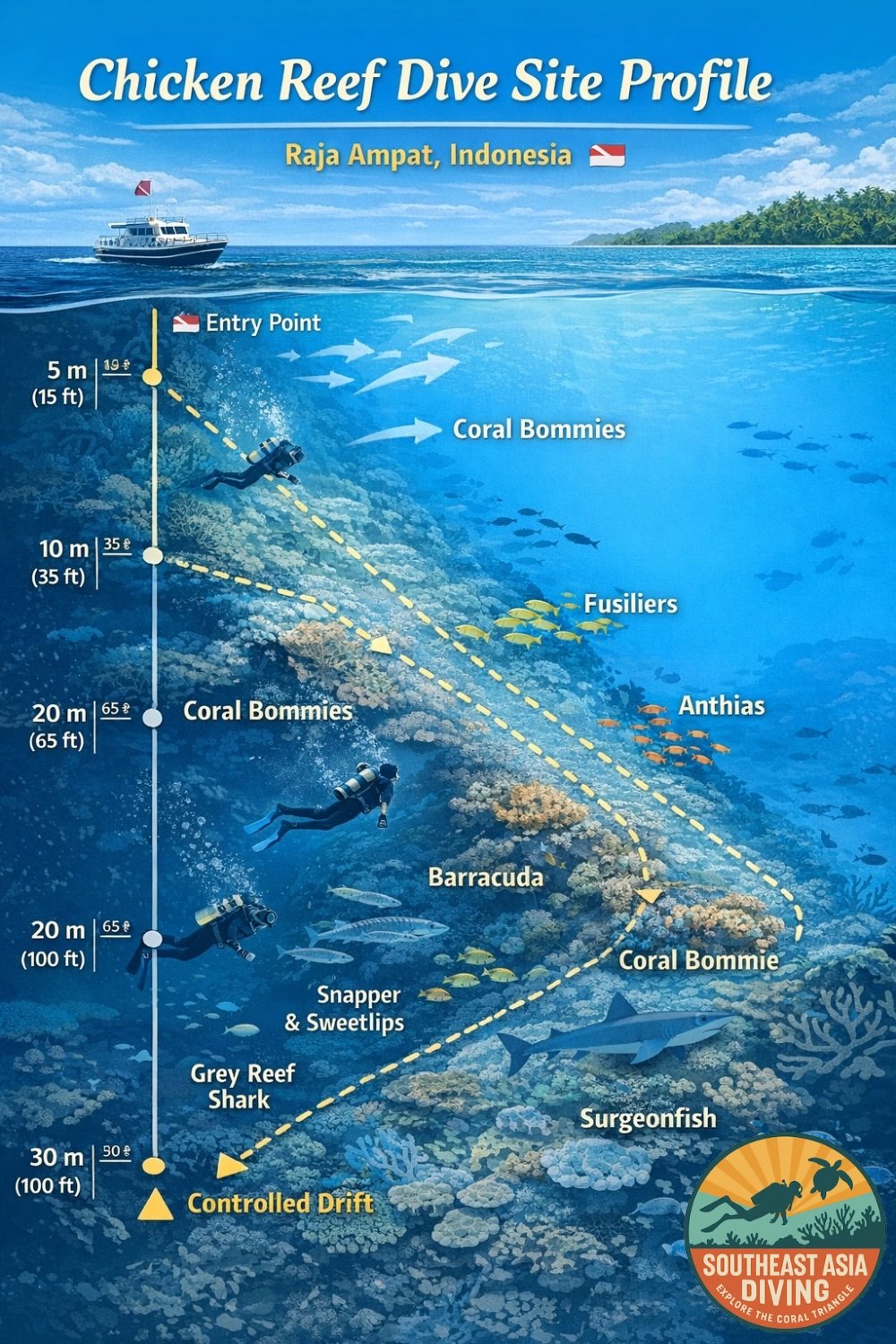
The descent is unhurried. Clear water gives way to a gently sloping coral reef rather than a dramatic wall or pinnacle. There is no singular “drop-away” moment. Instead, life reveals itself gradually. Anthias hover in dense orange clouds above hard coral heads. Schools of fusiliers move steadily across the slope, shifting direction with the tide. A grey reef shark appears from the blue, glides past without urgency, and fades again into open water.
There is no feeding frenzy. No sudden spectacle. No single moment that demands applause.
And that is precisely why Chicken Reef matters.
In a region of Indonesia known for record-breaking biodiversity and headline dive sites, Chicken Reef represents something rarer — a reef ecosystem functioning at full strength without needing to perform. It doesn’t overwhelm you with drama. It surrounds you with stability.
For underwater photographers, it’s the kind of environment where composition develops slowly and awareness matters more than reaction — the sort of diving that rewards thoughtful preparation and dependable underwater photography gear.
The reef does not shout.
It simply exists — layered, balanced, alive — and in today’s ocean, that quiet confidence may be the most extraordinary thing of all.
Planning a remote destination like Raja Ampat?
For destinations such as Raja Ampat, where dive sites are far from major hospitals and evacuation logistics can be complex, comprehensive travel insurance is strongly advisable.
For remote dive trips, we personally don’t travel without dedicated coverage. On previous trips to remote Southeast Asia, we’ve used World Nomads , as their policies are designed with adventure travel and diving in mind.
Disclosure: The link above is an affiliate link, meaning we may earn a small commission if you choose to purchase — at no additional cost to you. We only recommend services we have personally used or researched carefully.
Always review policy details carefully to ensure appropriate coverage for scuba diving activities.
📍 Where Is Chicken Reef?
Chicken Reef is located in central Raja Ampat, Indonesia, within the nutrient-rich waters of the Dampier Strait — the channel that separates Waigeo and Batanta islands. This strait is widely regarded as one of the most productive dive regions in Raja Ampat, where tidal exchanges concentrate marine life and sustain extraordinary reef health.
Most divers experience Chicken Reef via liveaboards operating out of Sorong, which typically build Dampier Strait into multi-day itineraries. It is also accessible from select land-based resorts positioned strategically along the strait. Because of its central location, it often appears alongside other iconic Raja Ampat dive sites such as Cape Kri, Blue Magic, and Sardine Reef.
What distinguishes Chicken Reef geographically is not remoteness, but positioning. It sits in a corridor where tidal flow funnels nutrients across sloping reef systems rather than steep drop-offs. That flow sustains the consistent biomass the site is known for — schools of fusiliers, cruising reef sharks, and dense anthias clouds.
Within the broader Raja Ampat map, Chicken Reef may not carry the same global name recognition as its neighbours, but it occupies prime ecological real estate. It benefits from the same currents, the same Coral Triangle biodiversity, and the same marine protected area framework.
For divers planning a Raja Ampat itinerary, that combination makes it a dependable highlight — a site that reliably delivers healthy reef structure and balanced marine life without relying on spectacle.
🤿 What It Feels Like to Dive Chicken Reef
Diving Chicken Reef is not about adrenaline. It’s about control and observation.
The site unfolds as a sloping reef system rather than a dramatic wall or isolated pinnacle. As you descend, the coral rises gradually to meet you — layered hard coral plates, dense bommies, and subtle spur-and-groove formations that guide both current and life across the reef face.
There is no immediate drop-off into blue. No singular feature demanding your attention.
Instead, you hover.
The current — often mild to moderate — presses gently against you, just enough to remind you that this is a living, tidal system. Position yourself slightly off the reef and you feel the flow strengthen. Move behind a bommie and it softens. Depth becomes a tool, not just a number on your computer.
Rather than chasing wildlife, you settle into place and allow the reef to reorganise around you.
Anthias reform their orange clouds above coral heads once your bubbles fade. Sweetlips hold steady in loose formations beneath overhangs. Surgeonfish resume grazing patterns across the slope as if you were never there. A grey reef shark appears at the edge of visibility, cruising parallel to the reef before dissolving back into open water.
Nothing surges.
Nothing explodes into motion.
The life here moves with rhythm rather than urgency.
It feels balanced. Stable. Mature.
There is no single headline moment to recount on the surface. No dramatic crescendo in the final minutes of the dive.
There is only continuity — the quiet assurance that every layer of the ecosystem is present and functioning.
And when you ascend, that steadiness lingers longer than spectacle ever does.
🐟 Marine Life Highlights
Chicken Reef diving is not defined by a single “signature” animal. It is defined by structure — by how species layer across the reef slope and interact with current.
The first impression is density.
As you descend, anthias dominate the foreground. Thousands hover above hard coral heads, shifting colour with light — orange in direct sun, almost translucent in shadow. When current increases, they tighten formation, facing into the flow in synchronised orientation.
Just beyond them, schools of fusiliers move in coordinated waves across the slope. They rarely form tight tornadoes here. Instead, they travel in long, fluid bands — silver and blue bodies reflecting sunlight as they pivot in response to subtle current changes. Their movement draws predators.
Grey reef sharks are regular presences at Chicken Reef. They tend to patrol slightly off the reef edge rather than charging through the centre of the site. Often you’ll first notice a silhouette at the limit of visibility — a clean shape against blue water. They cruise parallel to the slope, assessing the reef before turning back into open water.
Blacktip reef sharks occasionally appear in shallower sections, particularly near reef plateaus.
Barracuda are present as well, though not typically in massive cyclonic formations. At Chicken Reef, they often gather in looser, mid-water aggregations, hovering just beyond the reef face.
Under ledges and around bommies, sweetlips cluster in tight groups, stacked almost symmetrically. Snapper and batfish occupy the mid-water column, drifting through schools of fusiliers.
On the reef itself, the grazing layer is constant. Surgeonfish, parrotfish, and triggerfish maintain the reef’s balance, keeping algae in check and reinforcing the ecosystem’s health. Titan triggerfish are occasionally seen during breeding season — a reminder to maintain awareness and distance.
Macro life exists, but it is not the primary draw. Nudibranchs, small crustaceans, and reef invertebrates are present within coral folds and rubble patches, though Chicken Reef is overwhelmingly a wide-angle site.
What makes the marine life here remarkable is not rarity — it is proportion.
Predators are present but not dominant. Grazers are abundant but not overwhelming. Schooling fish move continuously but do not blot out the reef.
Everything feels in balance.
In many dive destinations, the absence of apex predators is noticeable. At Chicken Reef, their presence feels normal. That subtle distinction is what elevates the dive.
It is not a site built around spectacle encounters. It is a site built around ecosystem integrity.
And for divers who understand reef systems, that may be the most compelling highlight of all.
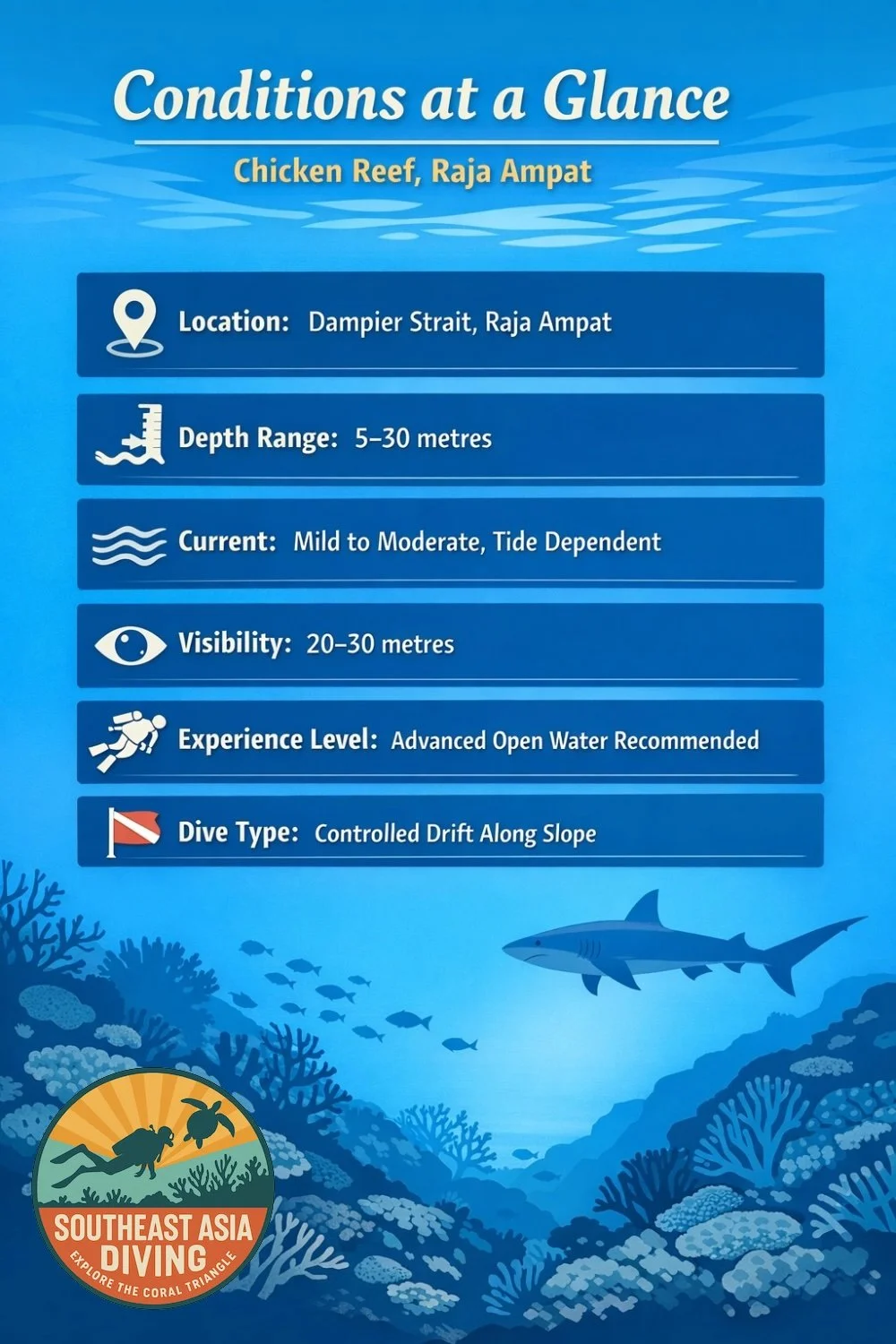
📊 Conditions at a Glance
Location: Central Raja Ampat, Dampier Strait
Depth Range: 5–30 metres
Current: Mild to moderate, tide dependent
Visibility: 20–30 metres typical
Experience Level: Advanced Open Water recommended
Dive Type: Drift along sloping reef
The slope allows divers to adjust depth to manage current strength. Shallow sections often provide shelter, while deeper areas may hold increased pelagic activity.
Strong buoyancy control is important.
🗓 Best Time to Dive Chicken Reef
One of the strengths of diving Raja Ampat is that it is accessible year-round — but conditions do shift depending on season and tidal movement.
Chicken Reef, located within the Dampier Strait, benefits from consistent nutrient flow driven by strong tidal exchanges between the Pacific and Indonesian seas. That means marine life density remains high across the calendar.
That said, conditions are typically at their most stable between October and April.
During these months, seas are generally calmer, rainfall patterns are more predictable, and visibility often ranges between 20–30 metres. Surface conditions tend to be smoother, making liveaboard crossings and daily transfers more comfortable.
From May to September, Raja Ampat can experience increased wind exposure in certain areas. However, the Dampier Strait region — where Chicken Reef sits — is relatively protected compared to more exposed southern sites. Diving remains very good, though visibility can fluctuate slightly depending on plankton concentration and tidal strength.
Importantly, at Chicken Reef, tide matters more than month.
Because the site is slope-based rather than a sheer wall or exposed pinnacle, current direction and strength influence the experience more than season. Incoming tides often bring clearer water and increased fish movement along the reef face. Outgoing tides can intensify flow but also concentrate schooling species.
Experienced dive guides plan entries carefully based on tidal timing, which is often the biggest factor in how the dive unfolds.
For underwater photographers, periods of moderate current with stable visibility provide the best balance — enough movement to animate schools of fusiliers and anthias, but not so much flow that positioning becomes difficult.
In short:
Best overall conditions: October–April
Year-round marine life: Yes
Most important variable: Tidal timing
🌊 Planning a Dive Trip to Chicken Reef?
Chicken Reef is typically accessed via liveaboards operating in the Dampier Strait region of Raja Ampat. If it’s high on your list, it’s worth checking itineraries carefully — not every route includes it on every departure.
Reviewing operator schedules, seasonal timing, and route maps in advance helps ensure Chicken Reef is part of your trip rather than assumed.
Disclosure: I may earn a small commission from affiliated booking platforms mentioned on this site, at no additional cost to you. I only reference services relevant to Southeast Asia diving.
Chicken Reef does not rely on seasonal migrations or single-species events. Its strength lies in ecological consistency — and that consistency holds across the year.
🚤 Logistics and What to Expect
Diving Chicken Reef is straightforward in principle, but like most sites in Raja Ampat, it rewards preparation and realistic expectations.
Getting There
Chicken Reef is most commonly accessed via:
Liveaboards departing from Sorong, which typically include Dampier Strait in 7–10 night itineraries
Select land-based dive resorts positioned along the Dampier Strait corridor
Sorong (SOQ) is the main gateway to Raja Ampat, reached via domestic flights from Jakarta or Makassar. From there, transfers are handled by your operator — either directly to a liveaboard or onward by boat to a resort.
Because Chicken Reef sits centrally within Dampier Strait, it is often dived early in an itinerary while divers are still acclimating to Raja Ampat’s currents.
Dive Planning & Briefings
Expect detailed dive briefings focused on:
Current direction and anticipated strength
Entry point and drift line
Maximum depth and slope contour
Surfacing procedure and pickup strategy
Unlike exposed pinnacles where reef hooks are standard, Chicken Reef typically does not require one. The sloping reef allows divers to adjust depth to manage flow — shallower sections often provide natural shelter.
Buoyancy control is essential. The coral cover is dense and healthy, and careful positioning prevents contact damage.
Most operators plan Chicken Reef as:
A morning dive when light is strongest
A controlled drift along the slope
A 60-minute profile depending on current and air consumption
Skill Level & Experience
While technically accessible, Chicken Reef is best suited for:
Advanced Open Water divers
Divers comfortable in mild to moderate current
Those with confident buoyancy control
It is not an aggressive current site, but neither is it a static reef dive. Awareness of positioning, spacing, and reef structure enhances the experience significantly.
Divers new to Raja Ampat often find this site an ideal introduction to Dampier Strait diving — dynamic enough to feel alive, but controlled enough to avoid overwhelm.
What Surprises People Most
What surprises many divers is not the scale — it’s the steadiness.
There is no dramatic crescendo in the final minutes of the dive. No staged moment of peak intensity. Instead, life remains consistent from descent to ascent.
The reef doesn’t build toward something.
It sustains.
And when you surface, the conversation isn’t about a single encounter — it’s about the overall density, the layering of fish, the sense that nothing felt missing.
For a region famous for spectacle, Chicken Reef delivers something subtler: reliability.
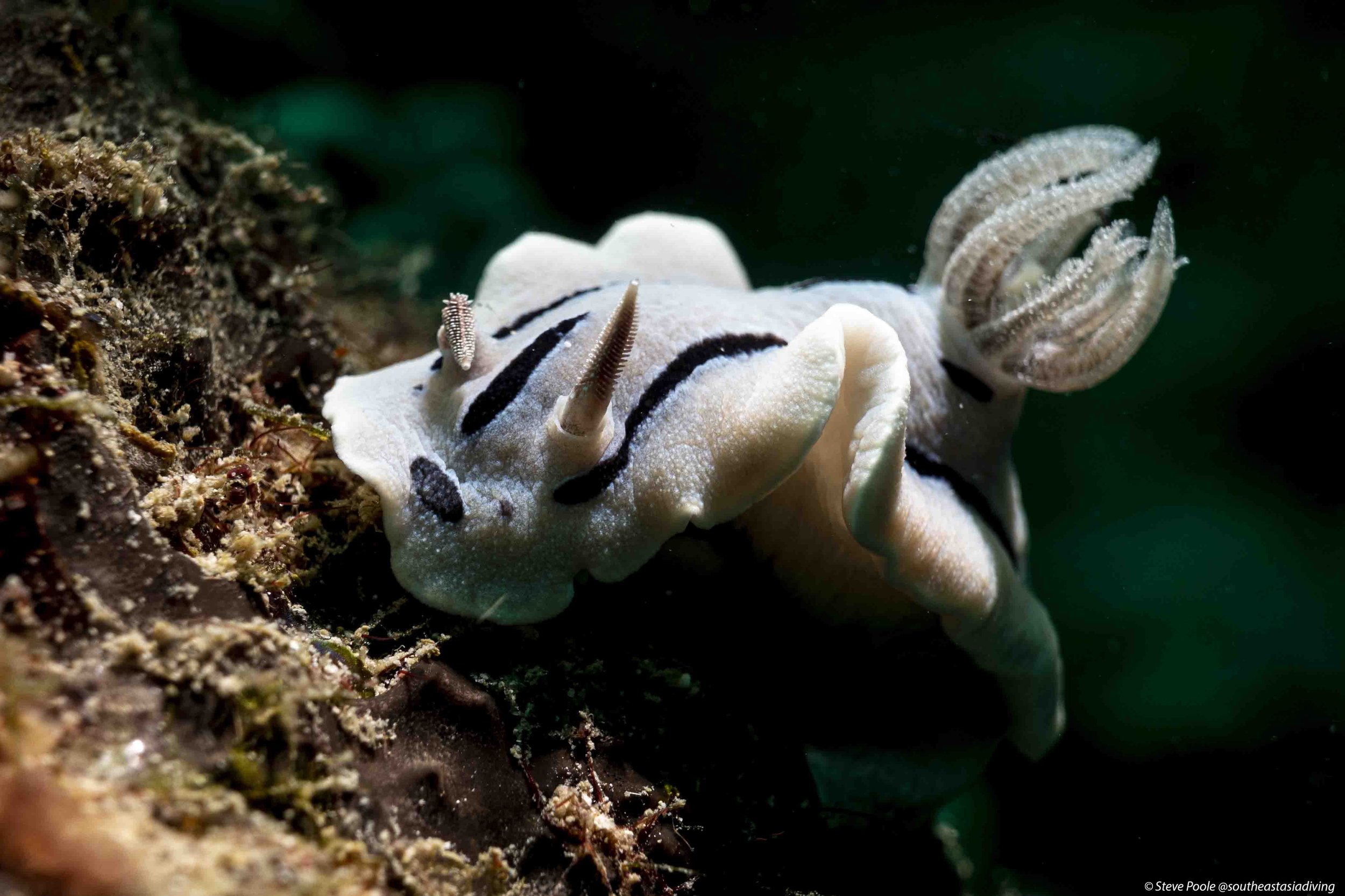
Nudibranchs are common at Chicken Reef
📸 Underwater Photography at Chicken Reef
Chicken Reef is, first and foremost, a wide-angle dive site.
The scale of the reef, the density of schooling fish, and the consistent presence of reef sharks all favour a lens that captures context rather than isolation. A 16–35mm range (or similar ultra-wide setup) is ideal for framing coral structure in the foreground, anthias in mid-water, and blue water negative space beyond.
This is a site built for layering.
Position yourself slightly below a coral bommie and shoot upward to combine:
Hard coral texture in the foreground
Anthias clouds suspended in current
Fusiliers moving across the slope
A shark silhouette cutting through blue
Because Chicken Reef is a slope rather than a vertical wall, you can control composition more easily. Adjust depth to manage current strength and light angle. In moderate flow, fish face into the current, which often creates stronger, more predictable framing opportunities.
Patience matters more than speed.
Rather than chasing sharks or barracuda, settle into position and wait. At Chicken Reef, life tends to pass through the frame if you allow it to.
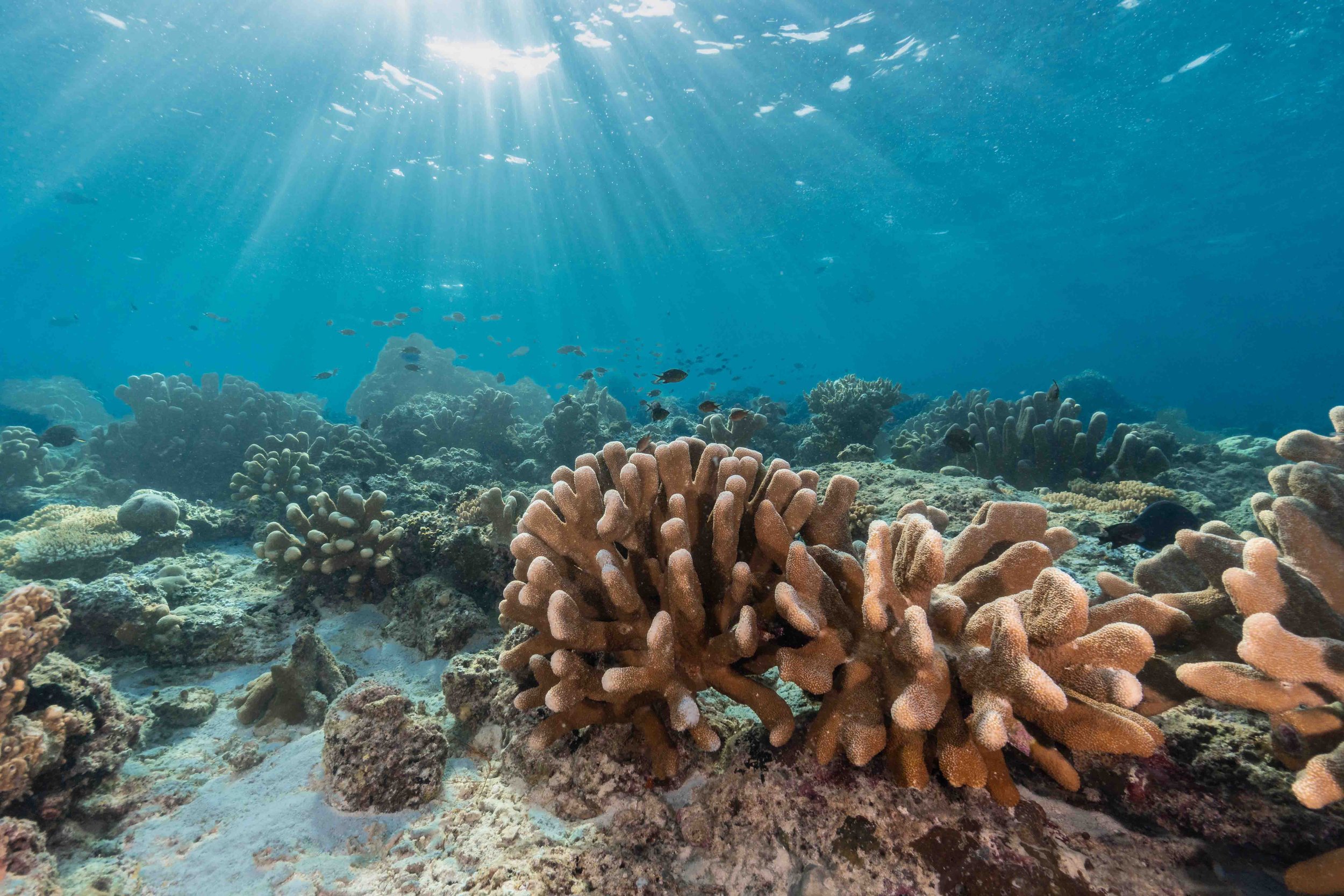
Reefscape are the key to wide angle photography at Chicken Reef
Sunbursts work particularly well in shallower sections (5–15m), especially during morning dives when light penetrates cleanly through Dampier Strait waters.
Wide Angle Strategy
Best results typically come from:
Shooting slightly upward for depth layering
Using bommies as natural frames
Allowing anthias to reform after disturbance
Waiting for predators to intersect existing composition
Strobe positioning should be angled outward to avoid lighting backscatter in plankton-rich water, particularly during stronger tidal exchanges.
This is not a “single hero subject” site.
It’s an ecosystem frame site.
What About Macro?
While Chicken Reef is overwhelmingly wide-angle focused, macro opportunities do exist — they simply require a different mindset.
Within coral folds and rubble pockets you may find:
Nudibranchs
Small reef shrimp
Blennies and gobies
Juvenile reef fish tucked into coral heads
However, this is not Lembeh or Anilao. The macro life here is part of the ecosystem rather than the primary draw.
Switching to a dedicated macro lens for Chicken Reef is generally not recommended unless your itinerary includes multiple dives at the site. Most photographers benefit from committing to wide-angle and embracing scale.
If your Raja Ampat itinerary includes macro-heavy sites elsewhere, Chicken Reef serves as the wide-angle counterbalance — the place where you step back and show reef health in context.
What Makes It Special for Photographers
What distinguishes Chicken Reef for underwater photographers is consistency.
You don’t need a rare migration window or a seasonal aggregation. The reef structure and biomass provide reliable compositional opportunities year-round.
Predators are present but not chaotic. Schools move predictably with the tide. Coral density gives every frame texture.
It’s a site that rewards compositional discipline over reactive shooting.
And in a region famous for dramatic encounters, that compositional stability is quietly powerful.
🌱 Conservation Status & Reef Health
Chicken Reef lies within the Raja Ampat Marine Protected Area (MPA) network — one of the most widely recognised community-led conservation models in Southeast Asia.
Raja Ampat’s protection framework combines:
Locally enforced no-take zones
Patrol monitoring against illegal fishing
Marine park entry fees funding conservation
Community involvement in reef management
This structure has helped preserve what divers experience at Chicken Reef: high coral cover, stable predator presence, and consistent fish biomass.
That does not mean the reef is untouched.
Raja Ampat still faces pressures — climate change, warming seas, and increasing tourism all present long-term risks. Coral bleaching events have occurred across parts of Indonesia in recent years.
But what distinguishes Chicken Reef is resilience.
The coral structure remains dense and layered. Apex predators are part of the ecosystem, not an exception. Fish populations show natural behaviour rather than avoidance or depletion patterns common in heavily fished regions.
In global terms, this matters.
Many dive destinations now rely on isolated marine life encounters surrounded by otherwise diminished reefs. At Chicken Reef, the ecosystem still feels intact — not because it is perfect, but because it remains proportionate.
Predators, grazers, schooling fish, coral cover — all present.
That balance is not accidental. It is the result of sustained protection and geographic advantage within the Coral Triangle.
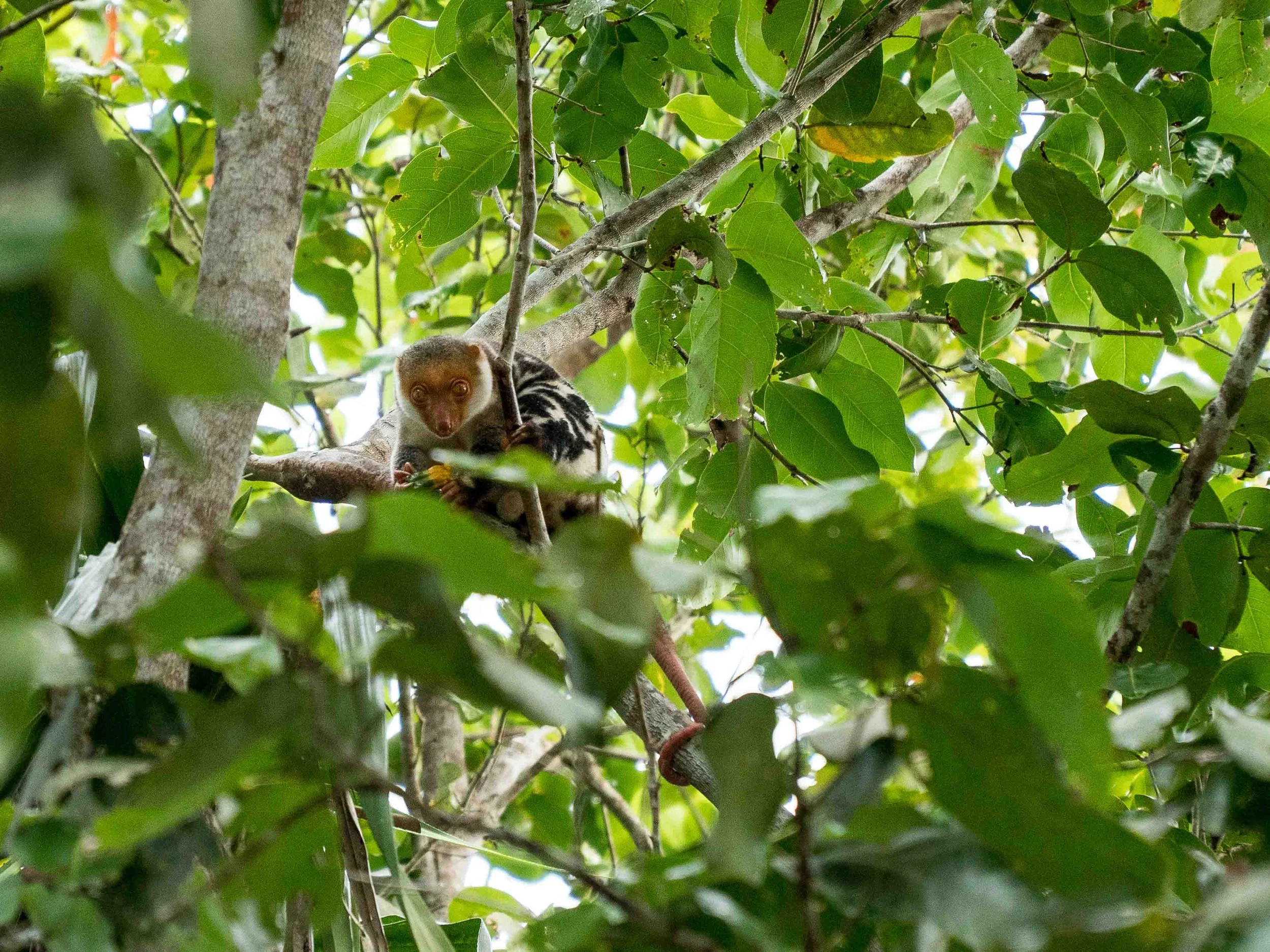
Raja Ampat also has lots of topside animal life too
For divers, experiencing Chicken Reef is not just a recreational event. It is a glimpse of what Indo-Pacific reefs can look like when management works.
🧭 Final Thoughts
Some dive sites rely on spectacle.
Some rely on records.
Some rely on reputation built on a single extraordinary encounter.
Chicken Reef relies on stability.
It does not overwhelm with theatrics. It does not build toward a single defining moment. There is no dramatic crescendo at the safety stop.
Instead, there is continuity.
From the first metre of descent to the final ascent, life remains present, layered, and balanced. Sharks cruise without urgency. Fusiliers move with tidal rhythm. Anthias hover in disciplined formation above coral that shows little sign of stress.
The reef does not shout because it does not need to.
In Raja Ampat — a region famous for biodiversity headlines — Chicken Reef offers something arguably more important: ecological confidence.
You surface without a story about a single animal.
You surface with the feeling that nothing was missing.
And in today’s ocean, that quiet completeness may be the most extraordinary experience of all.
❓ FAQ: Chicken Reef, Raja Ampat
Is Chicken Reef suitable for beginner divers?
Chicken Reef is best suited to Advanced Open Water divers or those comfortable in mild to moderate current. While it is not an extreme current site, good buoyancy control and awareness are important due to the sloping reef structure and tidal flow.
What marine life can you see at Chicken Reef?
Divers regularly encounter grey reef sharks, barracuda, large schools of fusiliers, sweetlips, batfish, surgeonfish, and dense anthias clouds. While macro life exists, Chicken Reef is primarily known for reef-scale biodiversity and ecosystem balance rather than rare critters.
Is Chicken Reef better than Cape Kri?
They offer different experiences. Cape Kri is famous for record-breaking biodiversity counts and dramatic wall structure. Chicken Reef is more about sustained reef health, layered marine life, and balanced ecosystem function.
Is Chicken Reef a drift dive?
Yes. Most dives at Chicken Reef follow a controlled drift along the sloping reef. Current strength varies depending on tide, and dive guides plan entries carefully around tidal timing.
What is the best time of year to dive Chicken Reef?
Raja Ampat is diveable year-round. The most stable surface conditions typically occur between October and April, though marine life density remains strong throughout the year. Tidal timing often influences the dive more than season.
Is Chicken Reef good for underwater photography?
Yes — particularly for wide-angle photography. The sloping coral reef, schooling fish, and shark silhouettes provide excellent compositional opportunities. It is not primarily a macro site, though small reef life can be found.