Deep Dive Series: Mabul Island — Malaysia’s Macro Diving Paradise
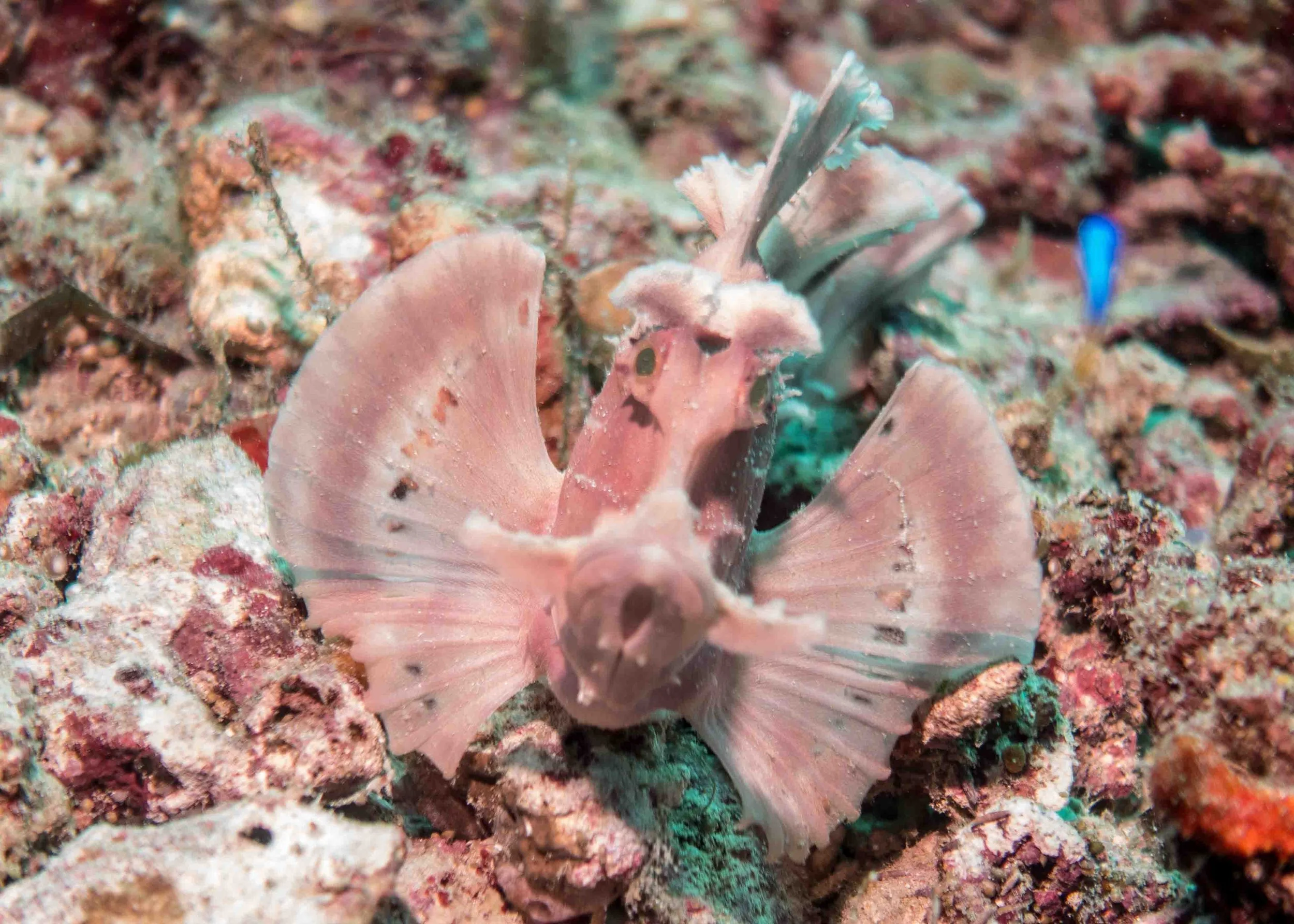
A Rare Rhinopias in Mabul, Malaysia
Not every great dive is about sharks, mantas, or fast-moving current.
Some dive destinations change the way you experience the ocean entirely, shifting the focus away from big pelagic encounters and toward the smaller details hidden within the reef itself. Instead of scanning the blue for large silhouettes in the distance, divers begin searching the sand for movement, texture, and tiny signs of life that would normally go unnoticed.
That is exactly what diving in Mabul Island feels like.
Located just a short boat ride from the legendary walls of Sipadan Island, Mabul offers a completely different style of diving. Sipadan overwhelms divers with spectacle — barracuda tornadoes, reef sharks, turtles, and schooling fish moving through blue water — while Mabul rewards patience, observation, and curiosity.
It is also one of the best known macro diving and muck diving destinations in Southeast Asia, attracting underwater photographers and critter hunters from around the world. Unlike dramatic coral walls or current-swept reefs, many of Mabul’s dive sites initially appear surprisingly understated, with sandy slopes, scattered rubble, artificial structures, and patches of seagrass that do not immediately suggest world-class diving.
Yet hidden within those seemingly ordinary environments is an extraordinary concentration of marine life. Frogfish disguise themselves as algae-covered sponges, blue-ring octopuses emerge cautiously from the sand, and flamboyant cuttlefish pulse with color as they move across the seabed. Nudibranchs, ghost pipefish, pygmy squid, and tiny shrimp hide among coral fragments and discarded debris, rewarding divers who slow down and begin paying attention to the smaller details of the reef.
Over time, even an empty-looking patch of sand starts to feel full of possibility, because every piece of rubble or subtle movement in the sediment could conceal something remarkable. For underwater photographers in particular, that transformation becomes addictive, as Mabul is not simply a place to dive, but a destination that teaches divers to see differently underwater.
🌴 What Makes Mabul Different?
Why Muck Diving Reveals a Hidden Side of the Reef
Unlike many of Southeast Asia’s most famous dive destinations, Mabul Island has built its reputation less on dramatic coral walls, strong current, or large pelagic encounters and more on what divers refer to as muck diving — a style of diving focused on finding rare and unusual marine life hidden within sandy, silty, or seemingly barren underwater environments.
🌍 Travel Insurance for Diving in Mabul & Sipadan
Remote dive destinations like Mabul and Sipadan are unforgettable, but they also require careful planning. Good travel insurance can help provide coverage for dive-related incidents, trip delays, lost baggage, and emergency medical evacuation while traveling in Southeast Asia.
This post may contain affiliate links. As a World Nomads affiliate partner, we may earn a commission if you purchase through these links at no extra cost to you.
Around Mabul, much of the diving takes place over shallow sand slopes, rubble patches, seagrass beds, and artificial structures that create ideal habitats for small critters and highly camouflaged species. Compared to the steep walls and open blue water surrounding nearby Sipadan Island, these environments can initially appear understated, particularly to divers expecting colorful coral reefs or constant large-animal action.
But that contrast is exactly what makes Mabul so fascinating.
Muck diving rewards patience and observation rather than spectacle. Instead of immediately seeing the beauty of the reef, divers learn to search for it carefully, paying attention to subtle textures, movement, and detail. A patch of broken coral suddenly reveals a perfectly camouflaged frogfish. What appears to be drifting seaweed transforms into a ghost pipefish. A faint ripple in the sand becomes a mimic octopus emerging cautiously from its burrow.
The experience feels less like traditional sightseeing and more like underwater exploration, where every dive becomes a slow search for creatures that are often invisible until pointed out by an experienced guide.
Because conditions are usually calmer and shallower than Sipadan’s exposed walls, divers also have more time to observe marine life behavior in detail. Underwater photographers can experiment with composition, lighting, and macro techniques without constantly managing strong current or fast-moving subjects, while guides carefully point out species that would be almost impossible to notice without a trained eye.
This slower pace gives Mabul a completely different rhythm from many other dive destinations in Southeast Asia. Instead of chasing adrenaline or pelagic encounters, divers begin to appreciate patience, buoyancy control, and the excitement of discovering marine life hidden within environments that at first glance may appear almost empty.
And for many divers, that shift in perspective becomes one of the most rewarding parts of diving in Mabul.
🦑 The Magic of Muck Diving
Why Some of the Best Diving Happens Over Bare Sand
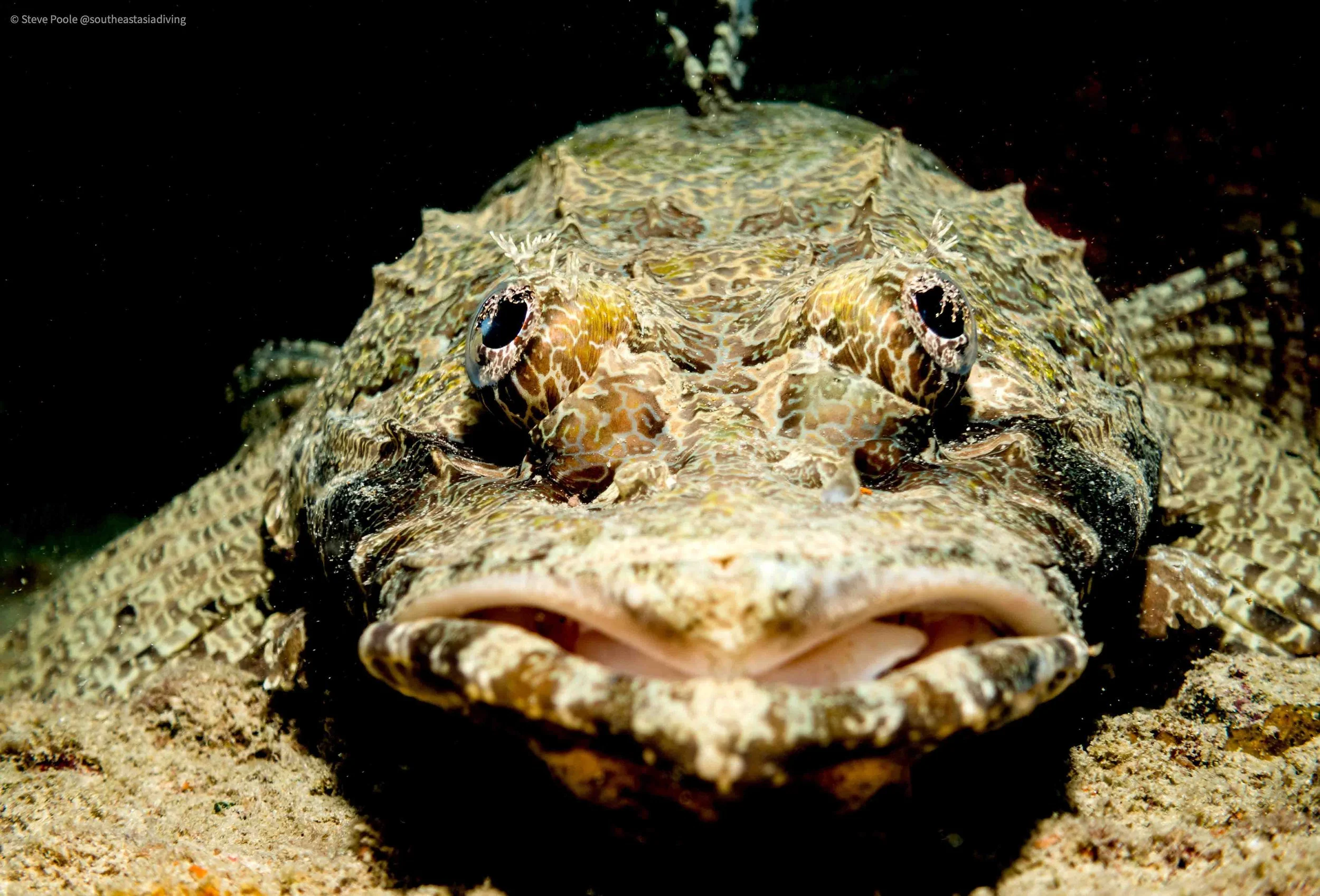
A crocodiulefish
To non-divers, the phrase “muck diving” probably does not sound especially appealing.
Unlike colorful coral reefs or dramatic wall dives, muck diving often takes place over sandy slopes, volcanic silt, rubble patches, seagrass beds, and artificial structures that can initially appear barren or lifeless. But among underwater photographers, macro enthusiasts, and experienced critter hunters, muck diving has become almost legendary precisely because of what hides within those seemingly ordinary environments.
At destinations like Mabul Island, muck diving transforms the entire way divers interact with the reef. Instead of focusing on wide-angle scenery or large marine life encounters, the excitement comes from discovery — spotting creatures so perfectly camouflaged that they remain invisible until suddenly they move.
A discarded bottle may shelter a tiny octopus. What appears to be drifting algae reveals itself as an ornate ghost pipefish. Bare sand suddenly comes alive with shrimp, gobies, jawfish, and juvenile cuttlefish once divers begin slowing down and paying closer attention to the details around them.
That process of searching is part of what makes muck diving so addictive.
Unlike many forms of diving where the highlights are obvious immediately, muck diving rewards patience, buoyancy control, and observation. Divers spend more time hovering motionless above the seabed, studying textures and movement carefully while guides search for subtle signs of hidden marine life.
Over time, even the most unremarkable-looking dive sites begin to feel full of possibility.
A patch of rubble that initially seemed empty may contain several different species within only a few square meters. Tiny behavioral interactions become fascinating, whether it is a shrimp cleaning its host, a frogfish yawning, or a flamboyant cuttlefish shifting color as it moves across the sand.
For underwater photographers, muck diving also creates opportunities that are difficult to replicate elsewhere. Calm conditions, shallow depths, and cooperative macro subjects allow photographers to experiment with snoots, wet diopters, super-macro setups, and creative lighting techniques in ways that are often impossible in stronger current environments.
But perhaps the most rewarding part of muck diving is the way it changes how divers see underwater environments altogether.
🐙 The Critters That Make Mabul Legendary
Rare Marine Life Hidden Within the Sand and Rubble
Part of what makes diving in Mabul Island so addictive is the sheer variety of unusual marine life hidden within its sandy slopes, rubble patches, seagrass beds, and artificial structures. No two dives ever feel exactly the same, because almost every descent brings the possibility of finding something rare, unexpected, or so perfectly camouflaged that it seems invisible until suddenly it moves.
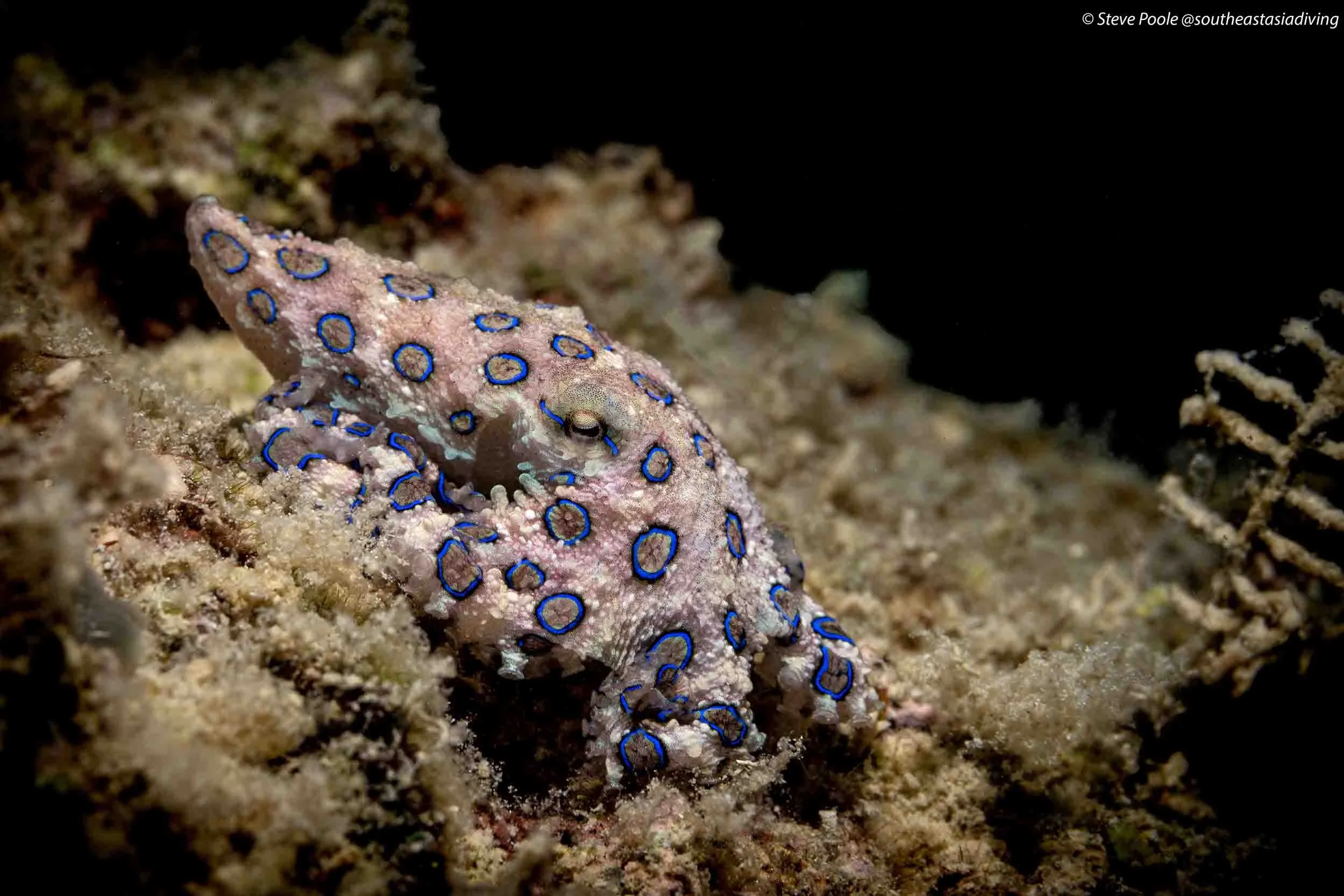
The deadly Blue Ringed octopus can be seen in Mabul
For macro photographers and critter hunters, that unpredictability is part of the appeal.
Among the most sought-after sightings are pygmy seahorses, tiny masters of camouflage that cling almost invisibly to soft corals and sea fans. Barely larger than a fingernail, these miniature seahorses reward divers with excellent buoyancy control and patient observation, particularly photographers willing to slow down and spend time searching carefully through the reef.
Mabul is also known for occasional sightings of the extraordinarily rare rhinopias scorpionfish, one of the most prized subjects in underwater photography. Covered in elaborate textures and appendages that resemble drifting algae or sponge growth, rhinopias rely almost entirely on camouflage rather than movement, remaining motionless for long periods while waiting to ambush prey. Finding one feels less like spotting a fish and more like uncovering a hidden part of the reef itself.
Elsewhere across Mabul’s dive sites, mimic octopuses emerge cautiously from sandy burrows, reshaping their bodies to imitate venomous sea snakes, lionfish, and other marine creatures in an extraordinary display of defensive behavior. Nearby, blue-ring octopuses flash electric blue warning rings as they move between rubble and discarded debris, while flamboyant cuttlefish pulse with constantly shifting patterns and vivid colors as they walk across the seabed in search of prey.
Frogfish remain one of Mabul’s signature sightings, disguising themselves so effectively among sponges, algae, and coral rubble that they can sit unnoticed only inches from divers. Ghost pipefish drift delicately among crinoids and soft coral, garden eels sway cautiously from sandy burrows, and crocodile fish lie motionless against the seabed with near-perfect camouflage.
Smaller subjects are everywhere for divers willing to look carefully enough. Hairy shrimp cling almost invisibly to hydroids, pygmy squid hover among seagrass blades, and bobtail squid bury themselves in the sand during daylight hours before emerging at night. Nudibranchs of every imaginable color crawl across coral rubble, while gobies, juvenile fish, crabs, and tiny shrimp occupy almost every available space beneath jetties and artificial structures.
What makes these encounters so memorable is not simply the rarity of the animals themselves, but the way divers experience them. Unlike large pelagic encounters that appear dramatically out of the blue, macro subjects in Mabul reveal themselves slowly. Divers learn to hover motionless, study the reef carefully, and appreciate the incredible detail and behavior of creatures that many people would otherwise swim straight past.
Over time, the excitement shifts away from chasing large marine life and toward discovering hidden worlds in the smallest corners of the reef. And for many divers, that is exactly when Mabul becomes truly unforgettable.
Of course, divers should not expect to see all of these creatures on a single dive — or even during a single trip. Part of what makes diving in Mabul Island so rewarding is that many of its most sought-after subjects are rare, seasonal, highly camouflaged, or simply difficult to spot without experience. Finding them often depends on a combination of patience, luck, conditions, and, perhaps most importantly, the skill of a knowledgeable local guide who understands exactly where to look.
Many of the species mentioned here are creatures that I have personally encountered across multiple visits to Mabul over the years, which is part of what keeps drawing me back. Even after several trips, the island continues to surprise me, with familiar dive sites revealing new critters, unusual behavior, or species I had somehow missed before. That constant sense of discovery is one of the reasons Mabul remains such a special destination for underwater photographers and macro enthusiasts alike.
🌙 Night Diving Around Mabul
From Mandarin Fish to Blackwater Encounters
As impressive as Mabul’s macro diving can be during the day, the island takes on an entirely different character after sunset.
Night diving around Mabul Island reveals marine life and behavior that many divers never see during daylight hours. Familiar dive sites suddenly feel transformed as nocturnal species emerge from the sand, predators become more active, and small critters hidden throughout the day begin moving openly across the reef.
For macro photographers in particular, night dives around Mabul can be some of the most rewarding dives in Southeast Asia.
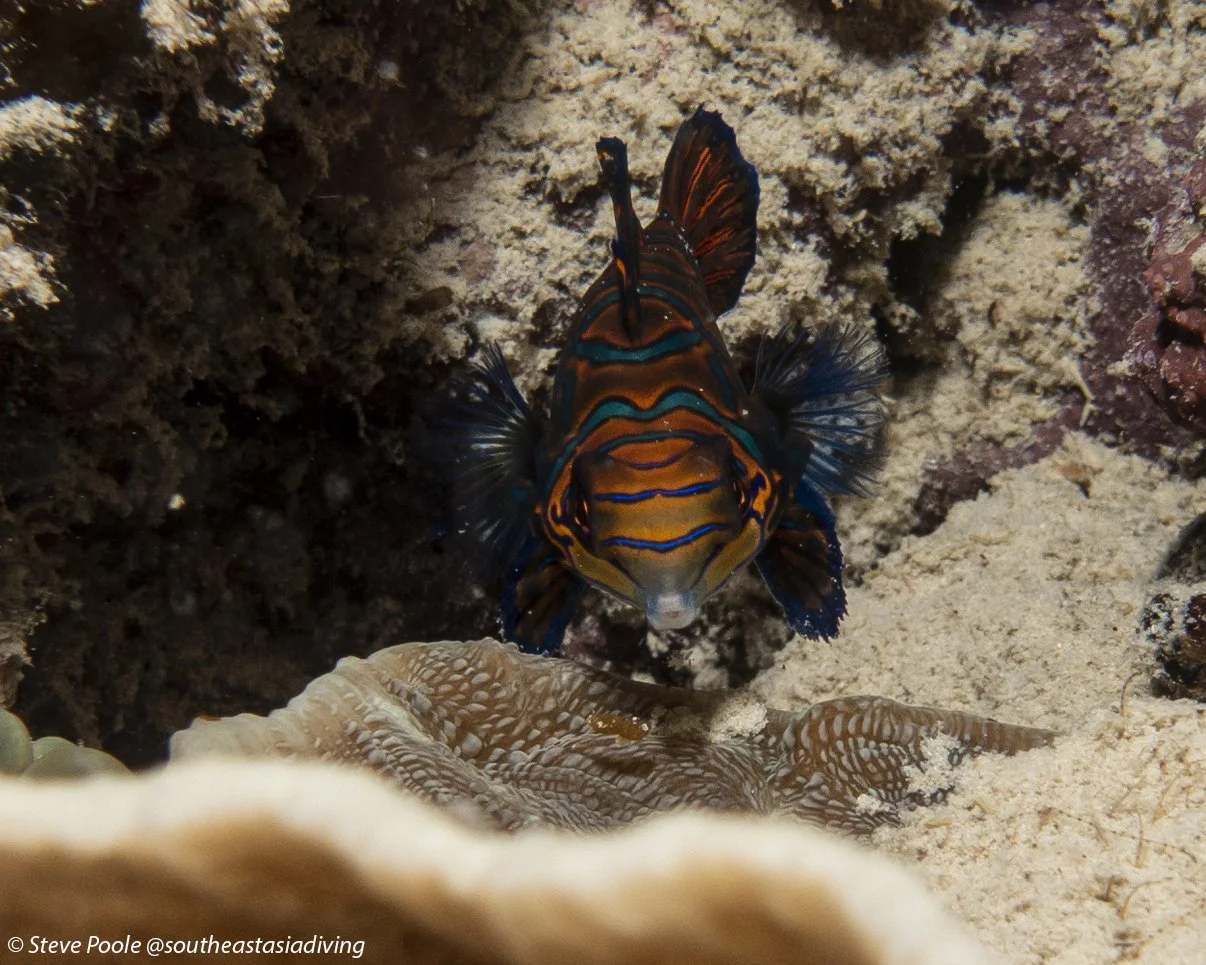
If you are lucky you could spot a Mandarinffish on a dive at dusk
Bobtail squid emerge cautiously from the sand, hunting beneath torchlight while tiny shrimp and crabs scatter across rubble patches and seagrass beds. Frogfish become more active, octopuses move between hiding places, and cuttlefish pulse with shifting colors against the dark seabed. Juvenile fish and unusual larval species also appear far more frequently at night, creating photographic opportunities that feel completely different from daytime dives.
One of the highlights for many divers is the chance to observe mandarin fish behavior at dusk, when these normally shy fish emerge briefly from coral rubble to court and spawn in the fading light. Watching their rapid displays of color and movement requires patience and precise timing, but it is one of the most iconic macro experiences in the region.
Night diving also changes the atmosphere underwater entirely. Without the distraction of wide reef scenes or blue-water visibility, divers become more focused on small details illuminated within the narrow beam of a torch. The experience feels quieter, slower, and more immersive, encouraging divers to pay even closer attention to behavior and movement on the reef.
For photographers, this environment creates opportunities for highly creative lighting and macro techniques. Snoots, focus lights, backlighting, and black backgrounds become particularly effective at night, allowing subjects to stand out dramatically against the darkness.
In recent years, blackwater diving has also become increasingly popular in parts of Malaysia, including around Sipadan and nearby waters when conditions allow. Unlike traditional night diving, blackwater dives take place in open water over deep ocean, where divers descend along a suspended line and wait for larval marine life to rise toward the surface under cover of darkness.
The experience feels surreal.
Tiny jellyfish pulse through the water column, transparent larval fish drift past in alien-looking forms, and delicate pelagic creatures appear briefly in torchlight before disappearing back into the darkness again. Many of these animals are rarely seen by divers at any other stage of their life cycle, making blackwater diving one of the most unique forms of underwater photography anywhere in the world.
📸 Recommended Gear for Macro Diving in Mabul
From focus lights and snoots to compact camera systems and travel-friendly dive gear, having the right setup can make a huge difference when photographing Mabul’s tiny critters and elusive macro subjects.
This post may contain affiliate links. As an affiliate partner, we may earn a commission from qualifying purchases at no extra cost to you.
Whether exploring a shallow muck site at night or drifting above deep water during a blackwater dive, darkness reveals an entirely different side of Mabul — one that often feels even stranger, more delicate, and more fascinating than the reef during daylight hours.
📸 A Paradise for Underwater Photographers
Why Mabul Rewards Patience, Observation, and Creativity
For underwater photographers, Mabul Island is one of the most rewarding macro diving destinations in Southeast Asia.
Unlike current-heavy dive destinations that favor dramatic wide-angle reef scenes and fast-moving pelagic encounters, Mabul is all about patience, precision, and detail. Divers spend less time chasing action in the blue and more time hovering carefully over sand slopes, rubble patches, and seagrass beds, searching for tiny subjects hidden within environments that at first glance can appear almost empty.
That slower style of diving is exactly what makes Mabul so compelling for photography.
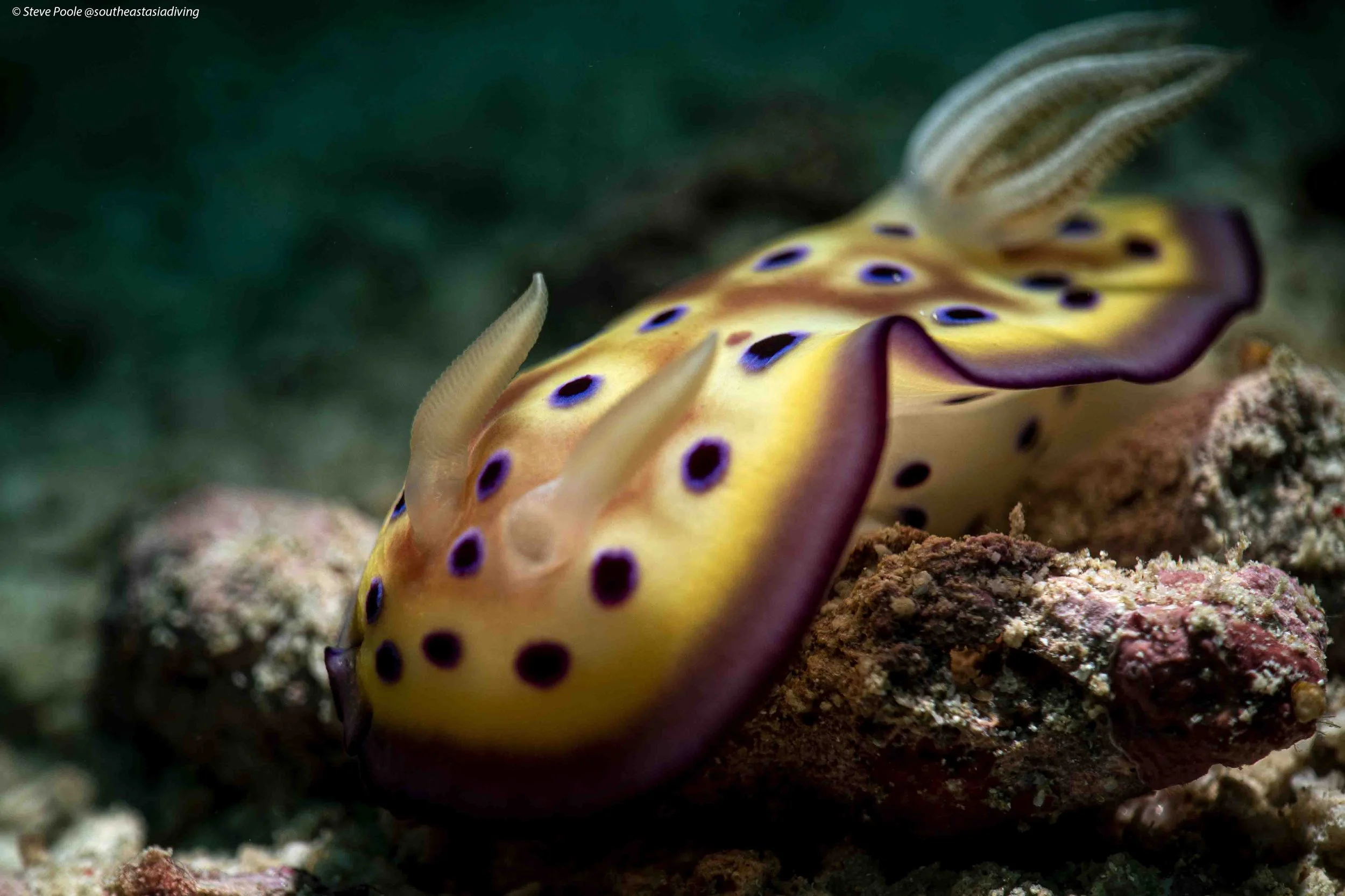
Nudibranchs are common around Mabul
Nudibranchs, frogfish, flamboyant cuttlefish, blue-ring octopuses, mimic octopuses, ghost pipefish, pygmy squid, and countless species of shrimp and crabs can all be found here, often within the same dive. For photographers, every descent feels like a treasure hunt where almost any patch of reef, discarded debris, or movement in the sand could reveal something extraordinary.
Even after multiple visits to Mabul, the island continues to surprise me. New critters appear unexpectedly, familiar dive sites reveal species I had somehow missed before, and subtle changes in behavior or lighting conditions can make the same location feel completely different from one trip to the next. That constant sense of discovery is part of what makes Mabul so addictive for underwater photographers.
It is also an ideal place to experiment with specialized macro photography techniques and equipment. Wet diopters, snoots, focus lights, and super-macro setups all become incredibly useful in these conditions, particularly when paired with patient local guides who know exactly where elusive subjects like rhinopias scorpionfish, pygmy seahorses, or hairy shrimp are likely to be hiding.
Compact camera systems and mirrorless setups are especially popular around Mabul because they allow photographers to remain streamlined while still achieving exceptional macro detail. Smaller systems also make it easier to maintain precise buoyancy and composition while shooting tiny subjects close to the sand.
Wide-angle photography still has a place around Mabul, particularly beneath the island’s jetties where schools of fish gather beneath beams of sunlight filtering through the structure. But unlike nearby Sipadan Island, where wide-angle scenes and blue-water encounters often dominate, Mabul rewards photographers who enjoy slowing down, refining technique, and focusing on marine life behavior rather than spectacle alone.
For many underwater photographers, Mabul becomes more than just another dive destination. It becomes the place where they truly learn how to see underwater — not by searching for the biggest subjects on the reef, but by discovering how much life exists in the smallest corners of it.
Once divers learn to notice the hidden life within sand, rubble, and seagrass, reefs no longer feel defined only by coral walls or large marine life encounters. The ocean begins to reveal an entirely different layer of detail — one that many divers swim past without ever realizing it exists.
🌊 The Best Dive Sites Around Mabul
From Artificial Reefs to World-Class Muck Diving
One of the reasons diving in Mabul Island remains so rewarding is the sheer variety of dive sites surrounding the island. Some are famous for rare macro critters and muck diving, while others combine artificial structures, schooling fish, and surprisingly healthy coral growth.
Although no two dives are ever completely predictable, several sites around Mabul have become classics for underwater photographers and critter hunters alike.
🪸 Paradise 1 & Paradise 2
Paradise is often considered one of Mabul’s signature macro dive sites and perfectly captures what makes the island so special.
The site consists primarily of sandy slopes, coral rubble, and scattered reef patches that initially appear fairly unassuming. But once divers slow down and begin searching carefully, the amount of hidden marine life becomes extraordinary.
Frogfish, ghost pipefish, nudibranchs, shrimp, gobies, crocodile fish, and juvenile reef species are all commonly found here, while lucky divers may also encounter mimic octopus, flamboyant cuttlefish, or blue-ring octopus moving cautiously across the sand.
For underwater photographers, Paradise is an ideal site for macro and super-macro work because the conditions are usually calm and relatively shallow, allowing long bottom times and patient observation.
🏗 Sea Venture Dive Rig
Few dive sites in Southeast Asia feel as unusual as the legendary Seaventures Dive Rig.
Originally an offshore oil platform, the structure was converted into a dive resort and now sits permanently above one of the most fascinating artificial reef systems in the region. Beneath the rig, enormous support beams descend into the water column, attracting schools of fish, batfish, barracuda, jacks, and reef species that shelter among the metal framework.
The atmosphere underwater feels completely different from Mabul’s surrounding muck sites.
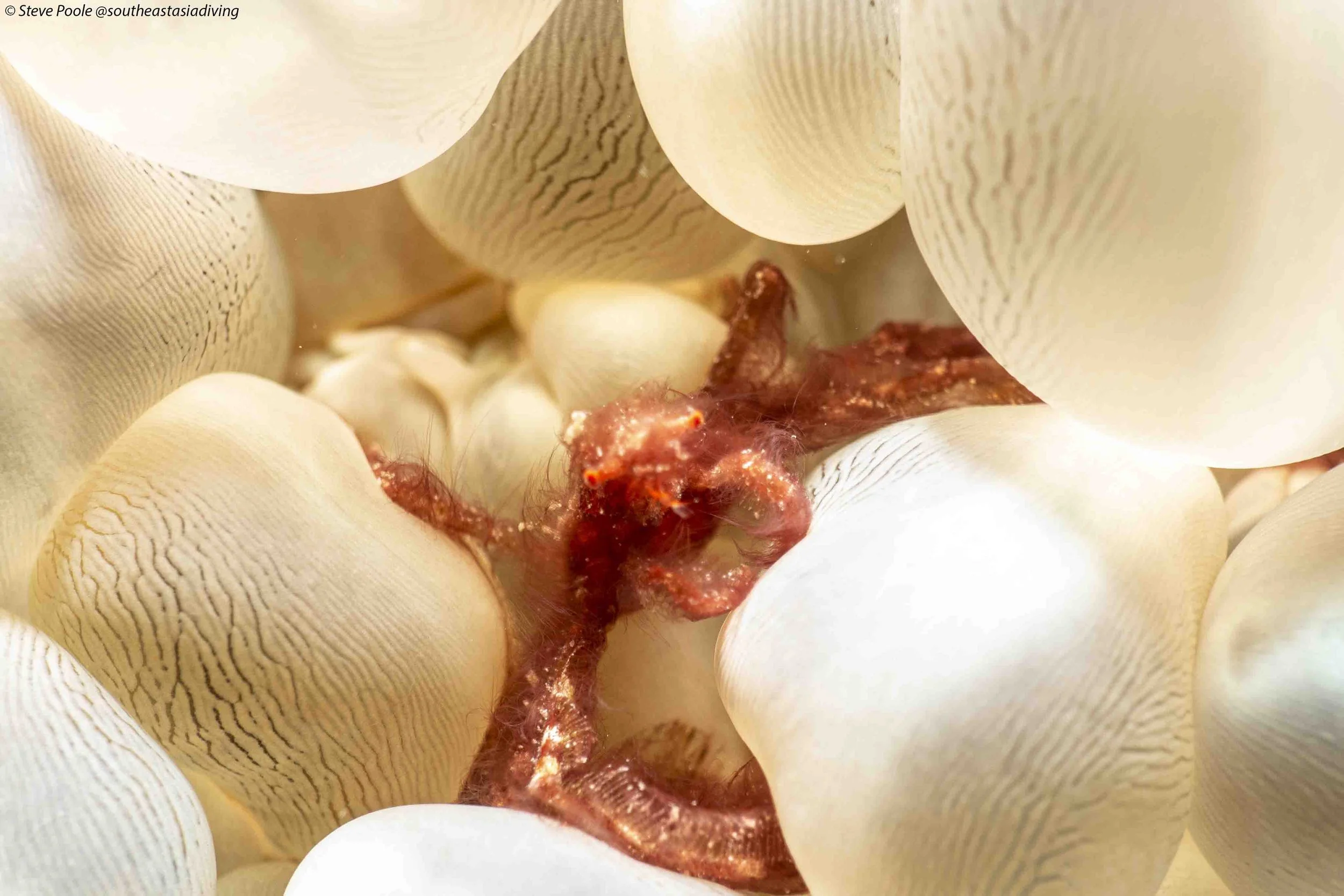
An Orangutan Crab spotted in Mabul
Sunlight filters dramatically through the rig’s structure while clouds of fish circle the beams and ladders below. Macro subjects still thrive around the base of the platform, but the site also creates unique wide-angle opportunities that contrast beautifully with Mabul’s more traditional macro diving.
For photographers, Sea Venture is one of the island’s most versatile sites because it combines artificial structure, schooling fish, macro subjects, and dramatic light rays all within a single dive.
And above the surface, sleeping on a converted oil rig in the middle of the Celebes Sea is an experience in itself.
🐙 Froggy Lair
As the name suggests, Froggy Lair is famous for frogfish, although the site regularly produces a wide range of other critters as well.
The dive site’s sandy rubble habitat provides excellent camouflage for anglerfish, scorpionfish, shrimp, and juvenile reef species, making it particularly rewarding for patient macro divers and photographers.
Because many subjects remain motionless for long periods, Froggy Lair is an excellent location for experimenting with macro composition, snoots, and super-macro setups.
🌿 Eel Garden
Unlike the coral-heavy reefs found elsewhere in Southeast Asia, Eel Garden is defined by open sandy seabed covered with colonies of garden eels swaying gently in the current.
Approaching them requires patience and slow movements, as the eels retreat instantly into their burrows if divers get too close too quickly. Around the edges of the site, divers may also encounter gobies, shrimp, pipefish, and juvenile fish hidden among the sand and rubble.
The simplicity of the environment is part of what makes the site so photogenic, particularly for minimalist macro photography.
🐟 Lobster Wall
Lobster Wall offers a slightly different feel from many of Mabul’s flatter muck sites, with a sloping reef structure that supports both macro life and larger schooling fish.
As the name suggests, lobsters are common here, often hiding deep within crevices and overhangs, while reef fish and nudibranchs occupy the surrounding coral growth. The site also produces occasional turtle encounters and larger reef species moving between Mabul and nearby Sipadan.
🌅 Mandarin Valley
Mandarin Valley becomes especially popular during late afternoon and dusk dives, when divers gather in the hope of witnessing mandarin fish courtship behavior.
These brilliantly colored fish emerge briefly from coral rubble around sunset, performing rapid mating displays before disappearing back into cover. Timing and patience are essential, but seeing the behavior unfold is one of the most memorable macro experiences around Mabul.
For photographers, low-light conditions and fast movement make this site deceptively challenging despite the small subjects involved.
🌴 A Different Kind of Diving Experience
Unlike destinations where dive sites are defined by dramatic walls or constant current, Mabul’s best sites are often built around subtlety, patience, and observation. Some dives may focus entirely on finding a single rare subject, while others reveal dozens of unusual species hidden within only a few square meters of sand and rubble.
That unpredictability is exactly what keeps divers — and especially underwater photographers — returning to Mabul year after year.
🌊 Final Thoughts: Why Mabul Changes the Way You Dive
Some dive destinations overwhelm you immediately with dramatic walls, strong current, sharks moving through the blue, or enormous schools of fish circling above the reef.
Mabul Island leaves a very different impression.
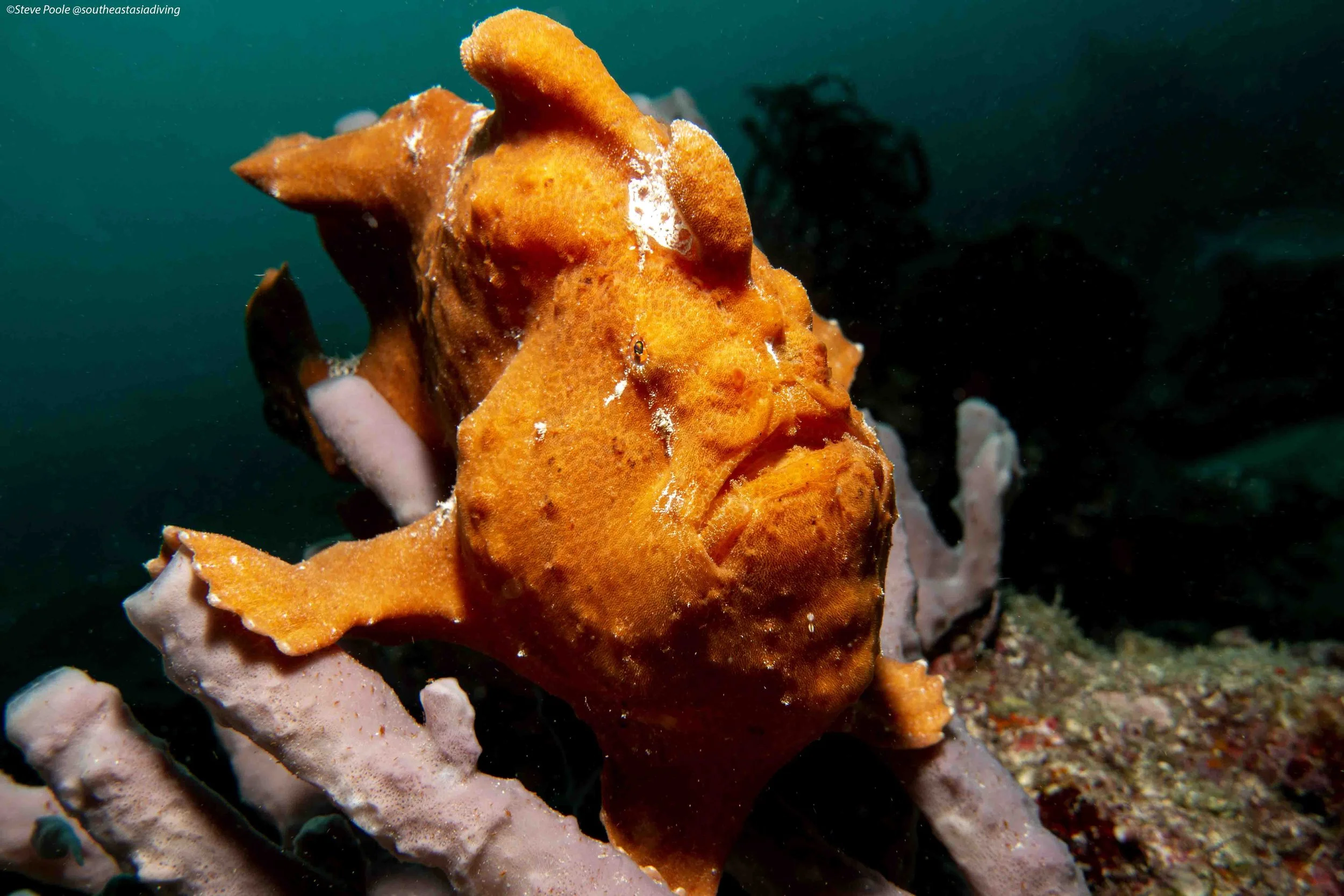
Frogfish can be found at Mabul too
At first, its sandy slopes, rubble patches, and artificial structures can seem understated compared to the current-swept reefs of Sipadan Island or the dramatic coral landscapes of Komodo National Park and Raja Ampat. But over time, Mabul changes the way divers experience underwater environments entirely, shifting the focus away from spectacle and toward observation, patience, and discovery.
You begin noticing movement where others see only sand. Tiny details become fascinating, and every patch of rubble starts to feel full of possibility. Divers slow down naturally, spending more time hovering motionless above the seabed, studying behavior, textures, and subtle changes in the environment that would have gone unnoticed before.
For underwater photographers, Mabul often becomes far more than simply another dive destination. It becomes a place to refine buoyancy control, improve macro techniques, experiment with lighting and composition, and develop a deeper appreciation for marine life behavior. Even after multiple visits, familiar dive sites continue to reveal new critters, unusual interactions, and species that somehow escaped attention on previous dives.
And even for divers who normally chase sharks, mantas, and large pelagic encounters, there is something strangely addictive about spending an entire dive searching carefully for creatures no larger than a fingernail.
Because Mabul proves that some of the most extraordinary underwater experiences are not always the loudest, largest, or most dramatic.
Sometimes, they are simply the ones that teach you to slow down and look closer.
❓ Frequently Asked Questions About Diving in Mabul
Is Mabul good for diving?
Yes — Mabul Island is widely considered one of the best macro diving and muck diving destinations in Southeast Asia. While nearby Sipadan Island is famous for sharks, turtles, and schooling fish, Mabul is known for rare critters, underwater photography, and calm, shallow dive sites filled with unusual marine life.
What is Mabul Island famous for?
Mabul is best known for macro diving and muck diving. Divers visit the island to search for species such as mimic octopus, blue-ring octopus, flamboyant cuttlefish, frogfish, ghost pipefish, pygmy seahorses, nudibranchs, and other rare critters hidden within sandy slopes and rubble patches.
The island is also popular with underwater photographers because of its calm conditions and exceptional variety of macro subjects.
Is Mabul better than Sipadan?
Mabul Island and Sipadan Island offer completely different diving experiences.
Sipadan is famous for wall diving, schooling barracuda, turtles, reef sharks, and strong current, while Mabul focuses on muck diving, macro photography, and rare critters. Most divers visit both destinations together because they complement each other so well.
What marine life can you see in Mabul?
Marine life around Mabul includes:
Mimic octopus
Blue-ring octopus
Flamboyant cuttlefish
Frogfish
Ghost pipefish
Pygmy seahorses
Rhinopias scorpionfish
Hairy shrimp
Nudibranchs
Bobtail squid
Garden eels
Crocodile fish
The island is especially famous for rare macro species and unusual critter behavior.
Is Mabul good for underwater photography?
Yes — Mabul is one of the best underwater photography destinations in Malaysia, particularly for macro photography.
The island’s calm, shallow dive sites allow photographers to spend long periods observing and photographing small marine life. Macro lenses, wet diopters, snoots, and compact mirrorless camera systems are all especially useful here.
What is muck diving?
Muck diving is a style of diving focused on finding rare and unusual marine life in sandy, silty, or rubble-filled environments rather than on coral reefs.
Although the environments can initially appear barren, muck diving destinations like Mabul Island are often filled with hidden critters and highly camouflaged marine life.
Do you need to be an advanced diver to dive in Mabul?
No — most dive sites around Mabul are relatively calm and shallow compared to nearby Sipadan, making them suitable for newer divers with good buoyancy control.
However, because many marine creatures are fragile and highly camouflaged, maintaining careful buoyancy and avoiding contact with the seabed is extremely important.
When is the best time to dive in Mabul?
Diving is possible year-round around Mabul Island, although conditions are generally considered best between April and December when visibility is often calmer and more consistent.
Different critters may appear seasonally throughout the year, which is one reason many underwater photographers return multiple times.
Is night diving good in Mabul?
Yes — night diving around Mabul is excellent and offers completely different marine life behavior compared to daytime dives.
Divers may encounter bobtail squid, octopus, cuttlefish, crustaceans, juvenile fish, and other nocturnal species that remain hidden during the day. Blackwater diving opportunities may also be available in nearby waters depending on conditions and operators.
What camera setup is best for diving in Mabul?
Macro and super-macro setups are generally best for diving in Mabul.
Mirrorless cameras, compact systems with wet diopters, snoots, and focus lights are all popular choices because they allow photographers to capture tiny critters and marine life behavior in detail. Wide-angle photography is still possible beneath jetties and artificial structures, but macro photography is the main focus for most divers visiting the island.