Drift Diving Explained: The World’s Most Exciting Current-Fueled Dives
Some divers spend their entire lives trying to avoid strong current, seeking out calm, easy conditions where the reef feels predictable and controlled. Others, however, cross oceans specifically to find it, drawn to the energy and movement that turn drift diving into one of the most exciting experiences in the ocean.
Because while still water may make diving comfortable, it is current that truly brings a reef to life. Known more broadly as current diving or drift diving, these conditions allow water to carry nutrients across vast distances, feeding entire ecosystems and creating the perfect environment for schooling fish, hunting predators, and large pelagic encounters. In the right conditions, reefs don’t just sit quietly beneath you — they move, pulse, and react to the rhythm of the ocean itself.
In places like Komodo National Park, Raja Ampat, Sipadan Island, and the Galápagos Islands, water movement shapes everything. Strong tidal currents surge through narrow channels and around volcanic pinnacles, feeding coral ecosystems that explode with life. Mantas hover effortlessly above cleaning stations, barracuda gather into dense, spiraling formations, and hammerheads emerge from the blue as divers hold position and watch the ocean move around them.
For many experienced divers, current is no longer something to fear, but something to understand, respect, and ultimately embrace. It changes not only what you see underwater, but how you experience the dive itself — shifting the focus from control to adaptation, from observation to immersion.
And it is no coincidence that some of the best drift dives in the world happen exactly where the water moves fastest.
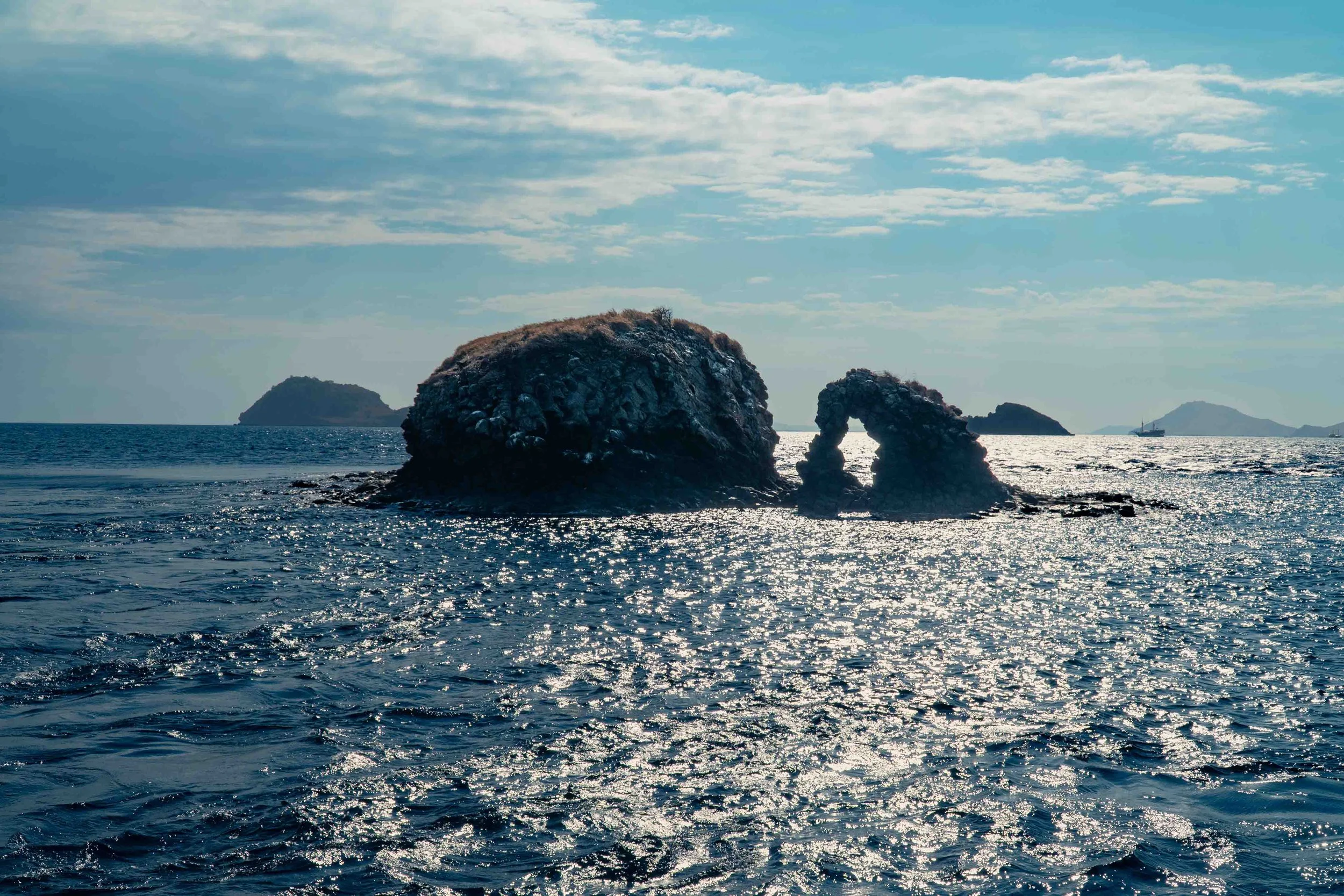
Batu Bolong - A classic drift dive in Southeast Asia
🌊 Why Current Creates Incredible Diving
Strong current is one of the defining ingredients behind the world’s healthiest and most biodiverse marine ecosystems, and a key reason why drift diving is often considered some of the best diving on Earth.
As water moves through reefs, channels, and seamounts, it transports nutrients and plankton across enormous distances. This constant flow fuels coral growth, attracts baitfish, and creates ideal hunting conditions for larger predators. The result is an underwater environment that feels dramatically more alive than calmer reefs nearby, with energy and movement visible in every direction.
It is no coincidence that many of the world’s most iconic current diving destinations are shaped by this same process. In Komodo National Park, tidal flow between islands creates nutrient-rich upwellings that draw in sharks, giant trevally, tuna, and mantas. In Raja Ampat, powerful water movement supports the highest marine biodiversity recorded anywhere on Earth. And in the Galápagos Islands, cold, nutrient-rich currents rising from the deep ocean fuel encounters with hammerheads, whale sharks, and vast schools of pelagic fish.
Current doesn’t just influence what you see — it changes how the reef behaves. Soft corals open fully into the flow to feed, reef fish orient themselves naturally into the current, and cleaning stations become active hubs where larger marine life gathers to be serviced by cleaner wrasse and shrimp. Everything becomes more dynamic, more purposeful, and more connected to the movement of the ocean.
For underwater photographers, this transformation is just as noticeable. Fish behave more predictably in moving water, often facing into the current, while soft coral landscapes gain texture and motion. Scenes that might feel static in still conditions suddenly take on depth, energy, and a sense of life that is difficult to replicate elsewhere.
This is why experienced divers often associate current with “good diving.”
Not because the conditions are easier — but because current almost always means life.
⚠️ Understanding the Different Types of Current
Not all current feels the same underwater. Some drift gently along a reef, creating relaxed drift diving conditions, while others shift unpredictably or move vertically through the water column, requiring far more awareness and control.
Learning to recognize different types of current is one of the most important steps in becoming a confident diver in advanced conditions. It not only improves safety, but also helps you anticipate how a dive will unfold — from entry and positioning to marine life encounters.
🌊 Tidal Current
Tidal current is the most common type encountered in world-class current diving destinations such as Komodo National Park and Raja Ampat. As tides rise and fall, vast volumes of water are forced through narrow channels between islands, often accelerating dramatically as they pass over reefs and around pinnacles.
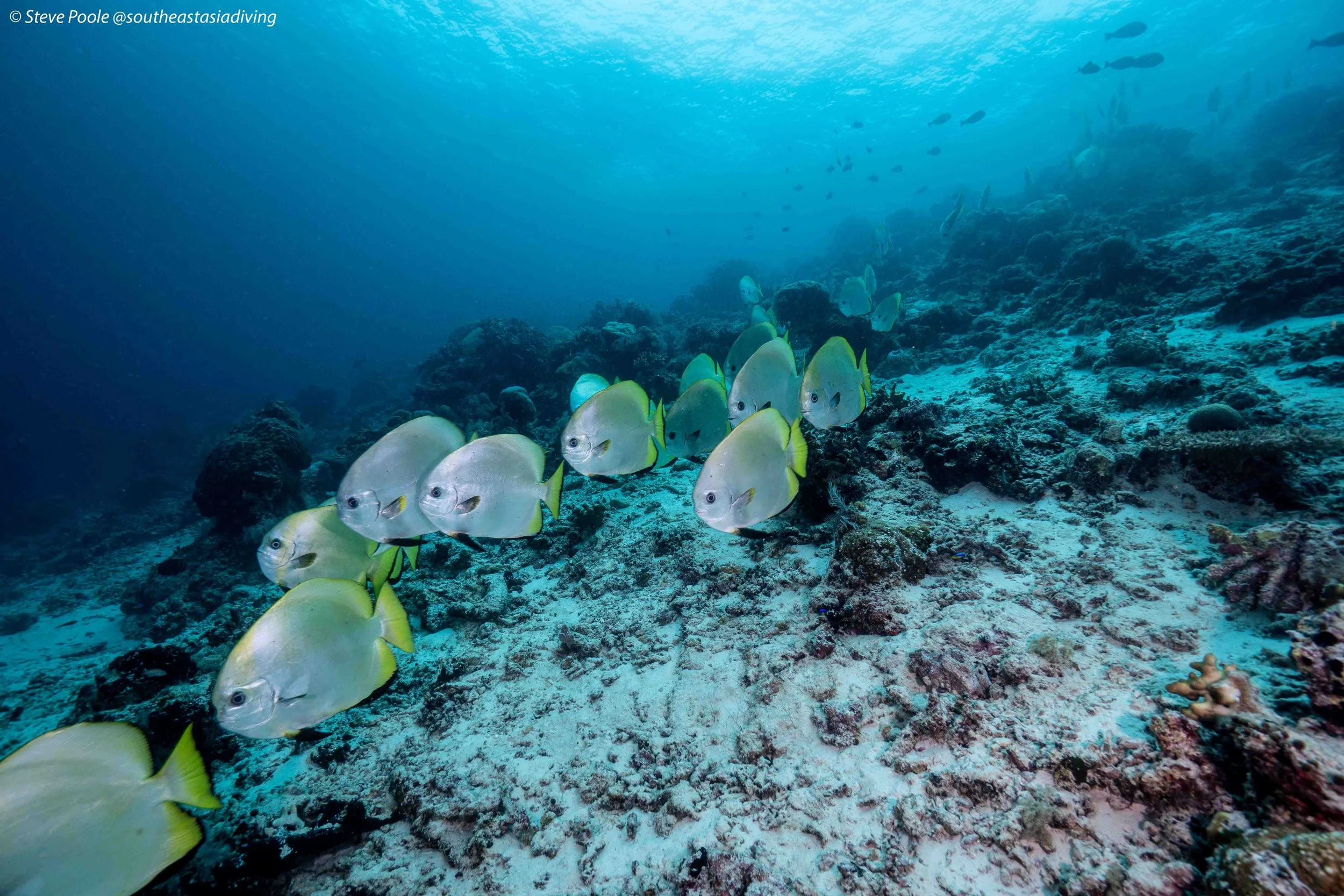
Batfish are a common sight in drift dives such as at Barracuda Point, Sipadan
These currents are usually predictable, which is why timing is everything. Entering a site at the right stage of the tide can mean the difference between a smooth, controlled drift dive and a far more challenging experience.
⬇️ Down Currents
Down currents occur when water is pushed downward along walls, slopes, or reef structures. They can feel intimidating because they may pull divers deeper unexpectedly, particularly near corners or pinnacles where current collides with underwater topography.
In most cases, the safest response is not to fight upward directly, but to move away from the structure and out of the descending flow. Understanding how these currents form helps reduce panic and allows divers to react calmly and effectively.
⬆️ Upwellings
Upwellings bring colder, nutrient-rich water from deeper layers of the ocean toward the surface. Divers often notice these as sudden drops in temperature, sometimes accompanied by reduced visibility.
While they can feel uncomfortable, upwellings are often a positive sign. They indicate the presence of nutrient flow that supports plankton, attracts baitfish, and ultimately brings in larger pelagic species.
🌪 Washing Machine Current
At some exposed sites, particularly around seamounts and pinnacles, current can become highly variable, shifting direction rapidly and creating swirling, multidirectional flow. Divers often describe this sensation as being inside a “washing machine.”
These conditions can make buoyancy control and positioning more challenging, especially for less experienced divers, but they are also often associated with high-energy environments and dense marine life.
🌊 Surge
Surge is different from tidal or directional current, as it is caused by wave energy rather than large-scale water movement. It creates a back-and-forth motion, most noticeable in shallow water, where divers are pushed toward and away from the reef in a rhythmic pattern.
Even sites that feel calm at depth can experience strong surge near the surface or along reef tops, making careful positioning and awareness essential.
Understanding how different currents behave is one thing — experiencing them in the world’s most iconic dive destinations is something else entirely. In places where powerful tidal flow shapes the reef, current diving becomes less about theory and more about immersion, as each site reveals its own rhythm, intensity, and reward.
🐉 Komodo: Riding the Conveyor Belt
Few places showcase the power of current quite like Komodo National Park.
🐉 Komodo Drift Diving: Conditions at a Glance
- Current level: Moderate to very strong
- Best for: Experienced divers, drift diving, sharks, mantas, schooling fish
- Typical dive style: Negative entries, fast descents, reef shelter, controlled drifting
- Key sites: Batu Bolong, Castle Rock, Crystal Rock, The Cauldron
- Photography: Wide-angle scenes, schooling fish, reef action, fast-moving subjects
- Safety focus: Listen to briefings, stay streamlined, follow guides, carry an SMB
Here, the meeting of the Indian and Pacific Oceans drives powerful tidal exchange between volcanic islands, creating conditions that are both exhilarating and incredibly productive. Water accelerates through narrow channels, sweeping over reefs and pinnacles, and feeding ecosystems that are among the most vibrant in Southeast Asia.
It’s this constant movement that has made sites like Batu Bolong, Castle Rock, Crystal Rock, and The Cauldron legendary. At Batu Bolong, anthias blanket the reef in every direction while giant trevally patrol the blue just beyond the slope. At Castle Rock, divers descend into fast-moving water surrounded by sharks, tuna, and dense schools of fusiliers holding effortlessly in the current.
From the moment you enter the water, the energy is unmistakable. Negative entries are often required, descents are quick, and divers stay streamlined and close to the reef while guides track subtle changes in current direction and intensity. Rather than fighting the flow, the experience becomes about working with it — finding shelter where needed, then drifting as the reef opens up around you.
This is exactly what makes Komodo so unforgettable. The reef doesn’t feel static; it feels alive, shaped by movement, with marine life constantly reacting to the flow of water around it.
For underwater photographers, Komodo offers some of the best wide-angle opportunities in the region. Current concentrates fish life around reef structures, creating scenes filled with motion, color, and scale. But these same conditions demand discipline — streamlined setups, strong buoyancy control, and the awareness to put the camera aside when the dive itself requires full attention.
🪸 Raja Ampat: Controlled Chaos
Raja Ampat may not always feel as aggressive as Komodo, but current remains at the heart of what makes the region so extraordinary.
Across iconic sites like Cape Kri, Blue Magic, Sardine Reef, and Manta Sandy, tidal flow drives the biodiversity that has made Raja Ampat famous. Water moves steadily across reef slopes and pinnacles, carrying nutrients that support an almost overwhelming density of marine life.
🪸 Raja Ampat Drift Diving: Conditions at a Glance
- Current level: Mild to strong (often tidal and variable)
- Best for: Biodiversity, reef life, schooling fish, manta encounters
- Typical dive style: Gentle to moderate drift dives, reef edges, current positioning
- Key sites: Cape Kri, Blue Magic, Sardine Reef, Manta Sandy
- Photography: Wide-angle reef scenes, dense fish life, soft corals in motion
- Safety focus: Watch current changes, maintain buoyancy, stay close to reef contours
At Cape Kri, current funnels along the reef as vast schools of fish move through the blue. Sweetlips, barracuda, giant trevally, surgeonfish, and snapper often appear layered together in astonishing numbers, creating scenes that feel almost impossible at first glance. Even experienced divers often surface feeling slightly overwhelmed by just how much life surrounds them.
Unlike the explosive, high-energy feel of Komodo, current in Raja Ampat is often more rhythmic and controlled. Dives tend to unfold as gentle drift dives along reef edges, where soft corals sway in the flow and reef fish orient themselves naturally into the current. Instead of reacting to sudden bursts of movement, divers become part of a slower, more continuous flow.
It’s this balance of movement and biodiversity that gives Raja Ampat its unique character. The reef feels constantly alive, not because of intensity, but because of sheer abundance.
For underwater photographers, these conditions are ideal. Fish are more active and predictable in moving water, while soft coral landscapes gain texture and depth as they open fully into the current. Many of the best wide-angle opportunities come from positioning carefully against the flow and allowing the reef — and everything moving through it — to come to you.
🦈 Sipadan: Hanging on the Edge
For generations of divers, Barracuda Point has defined what a classic current dive should feel like.
Rising abruptly from deep water off the coast of Malaysian Borneo, Sipadan Island sits directly in the path of nutrient-rich currents that sweep along its steep walls and exposed corners. This constant flow attracts vast schools of pelagic fish, creating encounters that feel both concentrated and intensely atmospheric.
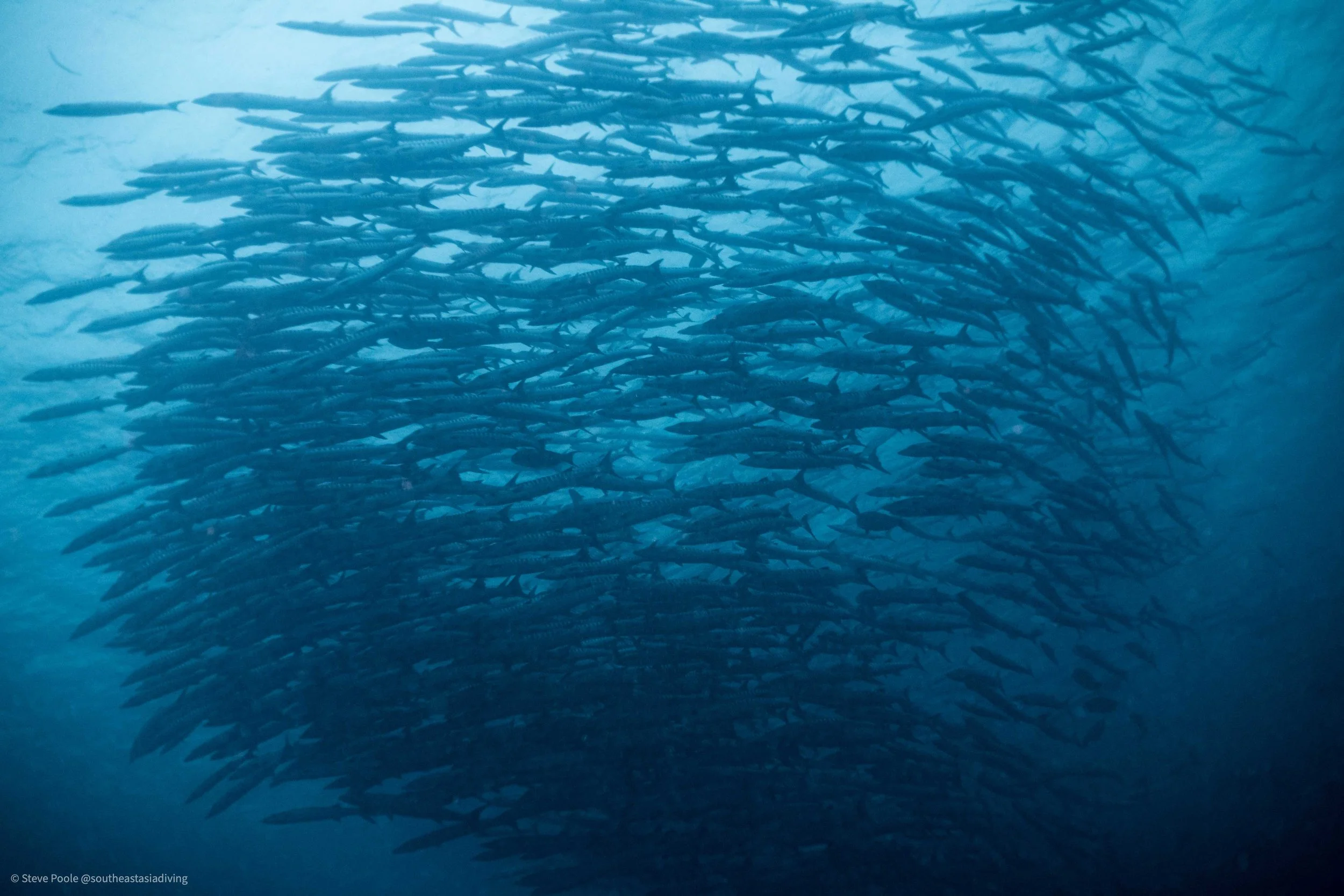
Current brings pelagic species such as chevron Barracuda here at Sipadan in Malaysia
At Barracuda Point, divers often find themselves suspended in blue water as thousands of barracuda rotate together in dense, spiraling formations overhead. Below, white-tip reef sharks cruise along the drop-off, while green turtles drift effortlessly through the current, barely moving as the ocean carries them past.
Compared to the explosive energy of Komodo or the flowing abundance of Raja Ampat, Sipadan feels more exposed and vertical. The reef falls away quickly into the blue, and much of the action happens just off the wall, where current and open water meet. Instead of moving continuously across a reef, dives here often involve holding position and letting the encounter unfold around you.
Current at Sipadan can vary significantly depending on conditions, but even moderate flow transforms the entire atmosphere of the dive. Without it, the reef is still impressive; with it, the site becomes something far more dynamic, drawing in schooling fish and larger predators in numbers that define the experience.
🦈 Sipadan Drift Diving: Conditions at a Glance
- Current level: Mild to moderate (can be strong at certain sites)
- Best for: Schooling fish, barracuda, turtles, reef sharks, wall diving
- Typical dive style: Wall diving, blue-water hovering, holding position near drop-offs
- Key sites: Barracuda Point, South Point, Mid Reef
- Photography: Wide-angle, schooling fish, clean blue-water compositions
- Safety focus: Maintain position near the wall, monitor depth, stay aware of open water
There’s a unique feeling that comes with hanging along the edge of the wall, watching huge schools of fish move as a single entity through open water. It feels less like observing marine life — and more like stepping into the middle of it.
For underwater photographers, Sipadan offers a different kind of opportunity. Rather than complex reef compositions, the focus often shifts to blue-water scenes, schooling behavior, and clean, minimalist images of marine life moving through current. Timing and positioning become everything, as the best moments tend to unfold quickly and without warning.
🦈 Galápagos: Chaos at Darwin’s Arch
If Raja Ampat feels vibrant and Komodo feels explosive, the Galápagos Islands often feel something else entirely — wild, exposed, and unpredictable.
At Darwin's Arch, current is not simply part of the dive; it defines the entire experience.
Descents begin into open blue water, where volcanic rock formations rise abruptly from the depths and powerful ocean movement is felt almost immediately. Schools of hammerheads emerge slowly from the distance, holding position in the current before disappearing just as quietly back into the blue. Around the reef, surge and shifting flow wrap unpredictably around the structure, requiring divers to stay alert and positioned carefully behind rocks and ledges.
🦈 Darwin’s Arch Drift Diving: Conditions at a Glance
- Current level: Strong to very strong (often unpredictable)
- Best for: Hammerheads, pelagics, big animal encounters
- Typical dive style: Negative entry, descend to shelter, hold position behind rock
- Environment: Exposed open ocean, surge, shifting currents
- Photography: Wide-angle, blue-water subjects, fast-moving pelagics
- Safety focus: Stay close to structure, monitor depth, follow guide closely, carry SMB
Everything about the dive feels untamed.
Silky sharks move through the current with effortless precision, tuna flash past in open water, and sea lions dart overhead with bursts of speed and curiosity. Massive schools of fish pulse along the reef edge, constantly reshaped by the movement of the water.
Unlike many drift diving destinations in Southeast Asia, Darwin’s Arch feels raw and fully exposed to the open Pacific. There is little sense of shelter here — only the constant presence of current, swell, and deep water all around you. Conditions can shift quickly, and the current itself becomes part of the adrenaline that defines the dive.
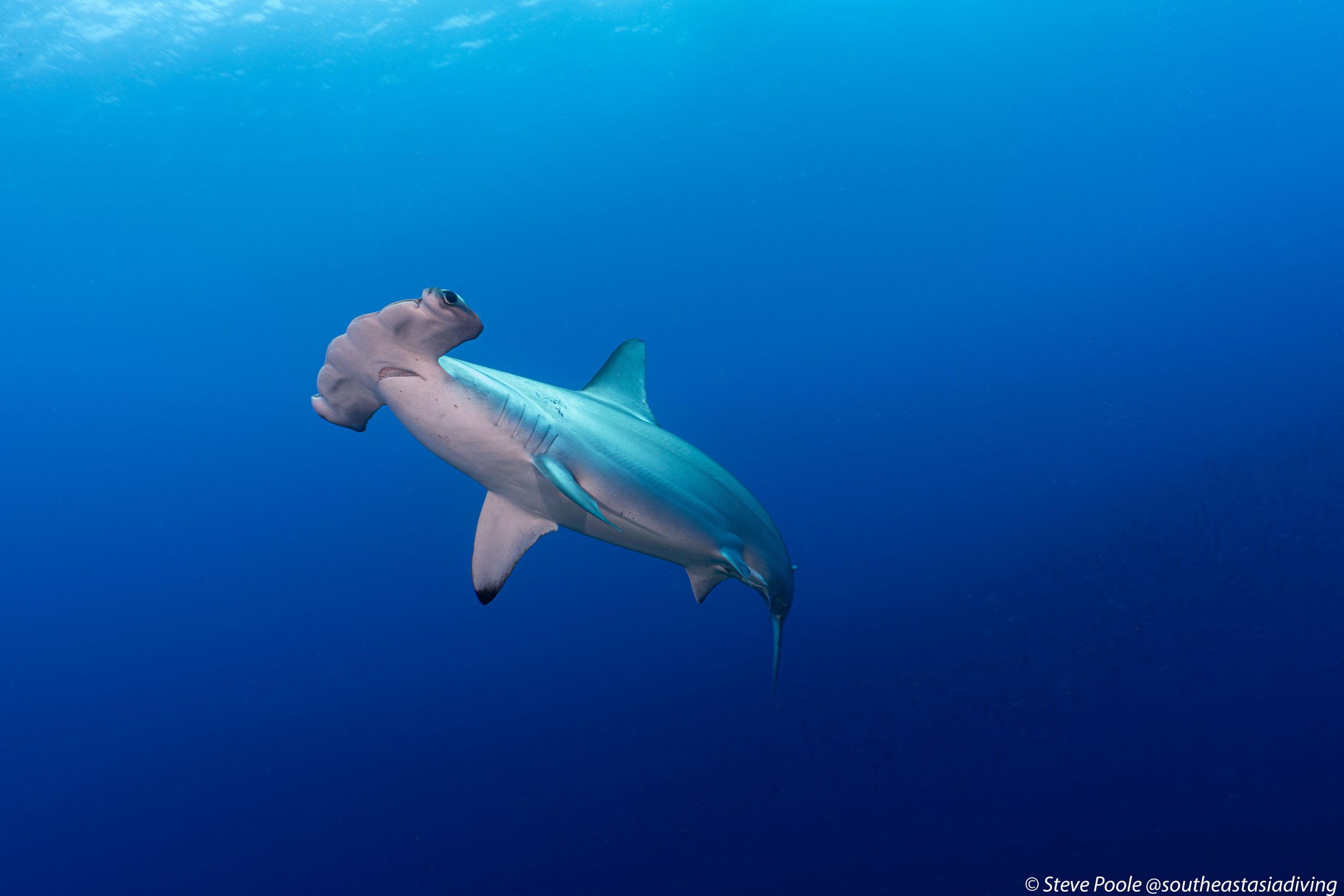
Scalloped Hammerhead sharks are one of the attractions besides the current at Darwins Arch in the Galapagos
Yet it is this same nutrient-rich flow that creates the extraordinary pelagic encounters the Galápagos are known for. The convergence of currents brings life from the deep, concentrating it around isolated structures like Darwin’s Arch and turning each dive into something that feels both unpredictable and completely alive.
For underwater photographers, the challenge — and the reward — lies in embracing that unpredictability. Encounters unfold in open water, often at a distance, requiring patience, awareness, and a readiness to react quickly. The result is a very different style of image: less about reef composition, and more about capturing fleeting moments in a vast, moving ocean.
For many divers, this is as close as it gets to truly wild ocean diving — a place where conditions, current, and marine life come together in a way that feels powerful, raw, and unforgettable.
🧠 How Experienced Divers Stay Safe in Current
Despite its reputation, current diving is not about fighting the ocean — it’s about understanding how to work with it.
Experienced divers approach moving water with preparation, awareness, and efficiency. That starts before the dive even begins, with careful attention to briefings, entry procedures, and expected current direction. In advanced destinations such as Komodo National Park or the Galápagos Islands, timing a dive around tidal changes can make a significant difference to both safety and enjoyment.
Underwater, small details matter. Streamlining equipment reduces drag and effort, while good trim and buoyancy control allow divers to stay low and stable near the reef, where current is often less intense. Divers who remain controlled and efficient typically use far less energy than those trying to swim directly against the flow.
🛟 Essential Drift Diving Safety Gear
In strong current, having the right safety equipment isn’t optional. These are two of the most important items every diver should carry when drift diving or diving in moving water.
|
Reef Hook Helps you safely hold position in strong current without constant finning. Essential for sites like Komodo and Darwin’s Arch. |
View on Amazon |
|
DSMB (Surface Marker Buoy) Critical for visibility during drift ascents and open-water pickups. A must-have in any current diving environment. |
View on Amazon |
As an Amazon Associate, we earn from qualifying purchases. This comes at no extra cost to you and helps support the site.
One of the most common mistakes is attempting to overpower the current. In most situations, this leads quickly to fatigue without improving your position. Instead, experienced divers use the reef strategically for shelter, move with the flow when appropriate, and conserve energy wherever possible.
In certain locations, reef hooks may also be used to maintain position in strong current, allowing divers to observe marine life without constant finning. When used correctly, hooks are placed only on dead rock or rubble — never on living coral — and always in line with local guidance.
Safety equipment becomes increasingly important in current-heavy environments. Surface marker buoys (SMBs), reels or spools, and audible signaling devices help ensure visibility during drift ascents and open-water pickups, while strong group awareness keeps divers connected throughout the dive.
Ultimately, strong current demands respect — but not fear. With the right approach, it becomes not only manageable, but one of the most rewarding and exhilarating forms of diving in the world.
📸 Underwater Photography in Strong Current
Some of the most dramatic underwater images are captured in moving water, where current transforms not just the reef, but the behavior of everything within it.
Fish naturally face into the flow, predators patrol reef edges more actively, and soft corals open fully in nutrient-rich conditions. The result is a scene that feels more dynamic, more structured, and far more alive than in still water — exactly the kind of environment that lends itself to powerful wide-angle photography.
Because of this, most current diving setups are built around wide-angle flexibility. Whether shooting reef scenes in Komodo National Park or schooling fish in Raja Ampat, a versatile system — such as a compact zoom paired with a wet wide-angle lens — allows photographers to adapt quickly as conditions and subjects change.
Macro photography, while still possible in current, tends to play a smaller role. Fast-moving water makes it harder to stabilize for super-macro work, and many of the most compelling subjects in these environments are larger, more mobile, and better suited to wider compositions.
That said, shooting in current introduces a different set of challenges.
Large camera rigs create significant drag, making it harder to maintain position and increasing task loading in already demanding conditions. Over time, most underwater photographers learn that streamlined, well-balanced setups are far easier to manage in strong flow — allowing them to stay controlled and responsive rather than constantly correcting their position.
Strobe positioning also becomes more critical. In moving water, poor placement can easily illuminate suspended particles and increase backscatter. Many photographers position strobes wider and slightly behind the dome, reducing the chance of lighting the water directly in front of the lens while still maintaining even coverage across the scene.
Just as important as equipment and technique, however, is judgment.
Experienced photographers understand that not every moment is meant to be captured. In challenging conditions, maintaining position, monitoring depth, and staying aware of your surroundings always take priority over the shot. Sometimes the best decision is to clip off your camera, stabilize yourself, and simply experience the dive as it unfolds.
Because while current can create incredible photographic opportunities, it also demands focus — and the best images often come from divers who know how to balance both.
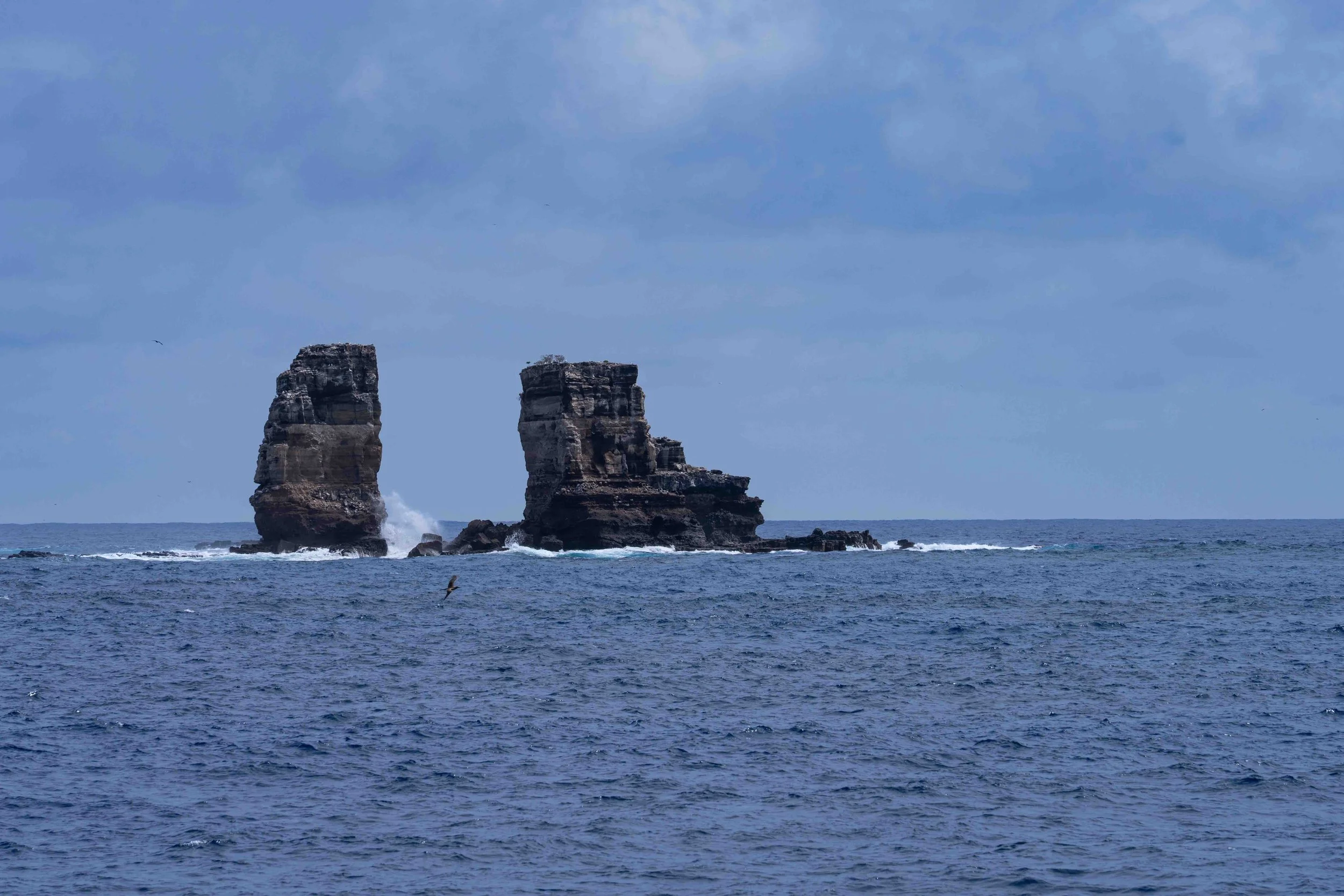
Darwin’s Arch is a classic drift/current dive
🌊 Final Thoughts: Why Divers Keep Coming Back
Strong current can feel intimidating at first. The noise of rushing water, fast descents, exposed blue water, and the constant sensation of movement all push divers beyond their comfort zone.
But for many, that same intensity becomes part of the attraction.
Because current changes the entire atmosphere underwater. Reefs feel more alive, marine life becomes more active, and encounters unfold in ways that feel less predictable and more authentic. Instead of hovering passively above a reef, divers become part of the movement itself — adjusting, drifting, and responding to the rhythm of the ocean.
In destinations like Komodo National Park, Raja Ampat, Sipadan Island, and the Galápagos Islands, this connection becomes even more apparent. These are places where current shapes everything, and where the most memorable dives are often those where the water is moving the most.
And once divers experience these conditions at their best, calmer dives can sometimes feel strangely quiet by comparison.
In the end, current isn’t something experienced divers simply tolerate — it’s often what draws them back. Not just for the marine life it attracts, but for the way it transforms the dive itself into something more immersive, more dynamic, and ultimately more rewarding.
Because some of the best drift dives in the world don’t happen in spite of the current — they happen because of it.
❓ Frequently Asked Questions About Drift Diving & Current Diving
Is drift diving dangerous?
Drift diving is not inherently dangerous, but it does require the right conditions, planning, and experience. When conducted with proper briefings, experienced guides, and appropriate safety equipment, it is considered a safe and widely practiced form of scuba diving.
Most risks come from poor preparation or trying to fight the current. Experienced divers stay safe by working with the flow, maintaining good buoyancy control, and following established dive procedures.
What is the difference between drift diving and current diving?
Drift diving is a type of current diving where divers intentionally move with the flow of the water rather than swimming against it.
Current diving is a broader term that includes all diving in moving water — whether you are drifting, holding position, or navigating changing conditions. Many of the world’s best dives combine both, with moments of controlled drifting and periods of holding position near reef structures.
What certification do you need for drift diving?
Most divers can try drift diving after completing an Open Water certification, but experience and comfort in the water are more important than certification level alone.
For stronger current environments like Komodo National Park or the Galápagos Islands, an Advanced Open Water certification and prior experience in current are strongly recommended.
Some dive operators may also require a minimum number of logged dives before allowing access to more challenging sites.
Where are the best drift diving destinations in the world?
Some of the best drift diving destinations include:
Komodo National Park – strong tidal currents and high-energy reefs
Raja Ampat – incredible biodiversity with steady current
Sipadan Island – schooling fish and wall diving
Galápagos Islands – powerful currents and pelagic encounters
Cozumel – accessible and beginner-friendly drift dives
Each offers a different style of current diving, from gentle drifts to high-energy, advanced conditions.
How do divers avoid getting swept away in strong current?
Divers avoid being swept away by planning dives carefully, staying close to the group, and using proper techniques such as staying low near the reef where current is weaker.
Surface marker buoys (SMBs) are also used during ascents to ensure that boats can track divers during drift dives. In some locations, reef hooks may be used to maintain position safely in strong current.
What is a reef hook and when should you use one?
A reef hook is a tool used by divers to hold position in strong current without constant finning. It is typically clipped to a line and secured onto dead rock or rubble.
Reef hooks are commonly used in high-current destinations like Komodo National Park and Darwin's Arch, but should only be used where appropriate and in accordance with local guidelines to avoid damaging coral.
Is drift diving suitable for beginners?
Drift diving can be suitable for beginners in mild conditions, such as those found in places like Cozumel, where currents are predictable and manageable.
However, stronger current environments require more experience, confidence in buoyancy control, and comfort in open water. It’s always best to start in easier conditions before progressing to more advanced dive sites.
What camera setup is best for drift diving?
Wide-angle setups are generally best for drift diving and current-heavy environments, as they allow photographers to capture reef scenes, schooling fish, and larger marine life.
Compact, streamlined systems — such as mirrorless cameras with wet wide-angle lenses — are often easier to manage in strong current than large, bulky rigs. Macro photography is still possible, but is typically more challenging due to movement and positioning.